
What do you do when your org chart never settles?
In many organizations, teams no longer align neatly to long-term structures. Groups form around initiatives, expand quickly, and dissolve just as fast when priorities change. Decisions about how the organization should work are made in weeks or months. Decisions about office space often last years.
That gap creates friction. Space assignments lag behind organizational change. Moves take longer than the decisions that require them. Over time, the office becomes a physical record of past assumptions rather than a reflection of how work actually happens.
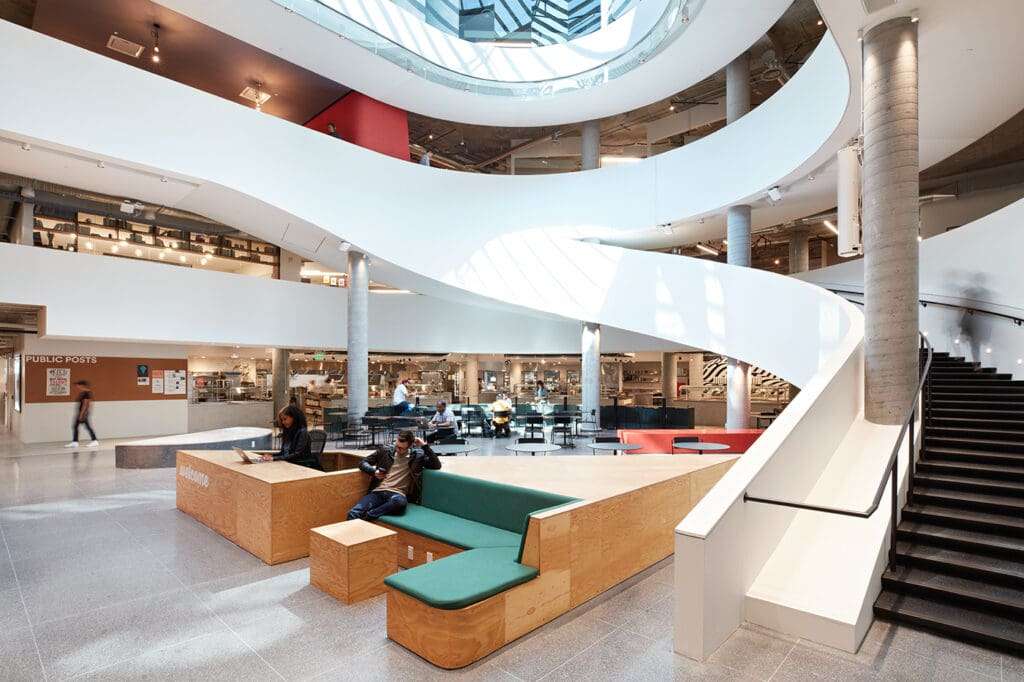
The Airbnb headquarters at 999 Brannan Street offer a useful reference point for this problem. The design of its offices does not attempt to mirror a fixed organizational structure. Instead, it emphasizes flexibility and reuse, allowing the workplace to remain useful even as the organization continues to change.
What Airbnb Designed
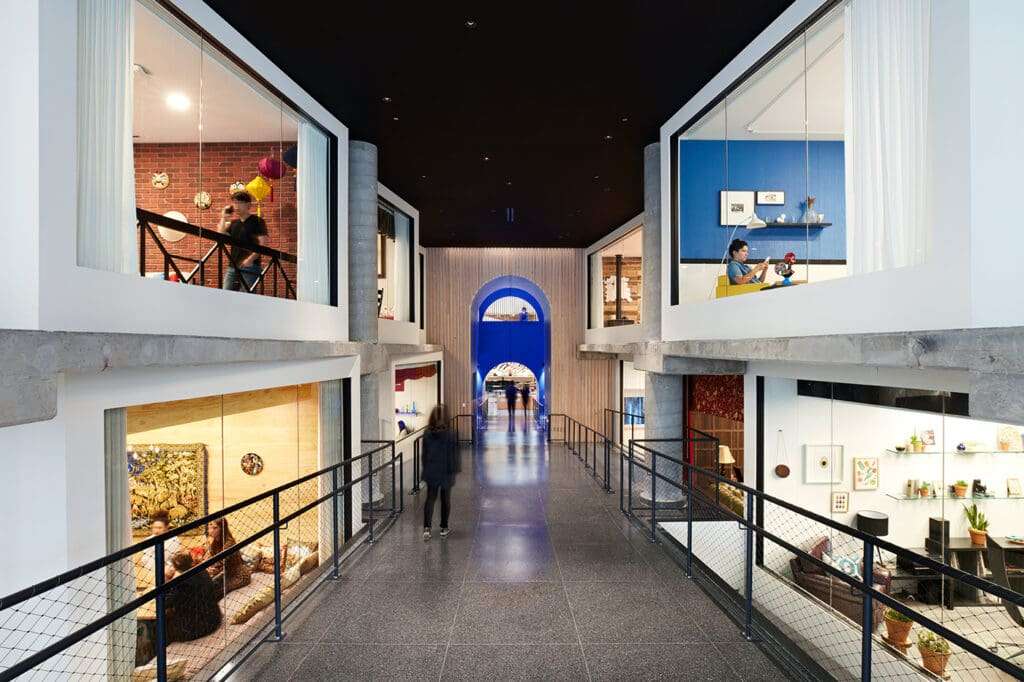
The Airbnb San Francisco offices were designed by the company’s in-house Environments Team in collaboration with WRNS Studio. The building spans large floorplates, but the interior avoids rigid hierarchy or highly specialized layouts.
Rather than tailoring space tightly to specific teams, the office is composed of repeatable zones that support a range of work modes. Open work areas, enclosed rooms, communal tables, and shared amenities are distributed throughout the floor, connected by clear circulation paths that allow people to move easily between settings.
WRNS Studio describes the interior as a “kit of parts” – an approach that allows spaces to be used in different ways over time rather than optimized for a single configuration.
Architectural coverage notes that the floorplates are deliberately broken down into adaptable areas that can be reassigned without major rework, reducing dependence on bespoke layouts tied to specific moments in the company’s evolution.
The result is a workplace that feels cohesive without being prescriptive. Space is structured, but it does not dictate how long any one group should occupy it.
Why This Design Holds Up Under Change
This approach matters because it lowers the operational cost of reorganization.
When space is standardized rather than customized, teams can be reassigned without triggering redesign cycles or extended planning. When areas support multiple work modes, they remain useful even as team size, focus, or composition shifts. When shared amenities are distributed across the floor, the office continues to function as different groups pass through it.
None of this prevents change. What it does is stop change from cascading into disruption.
For organizations where strategy evolves faster than buildings, that difference is significant. Space that can adapt quietly in the background allows leadership decisions to move without being constrained by physical layout.
When Space Can’t Keep Up With Decisions
Most organizational change happens incrementally. New roles are added. Teams adjust scope. Attendance patterns shift. Space, however, tends to change only when pressure becomes unavoidable.
That delay is where risk accumulates.
Teams remain in layouts that no longer reflect how they work. Capacity looks sufficient on paper but fails under new patterns of use. Real estate decisions are made to relieve immediate pressure, then locked in for years. By the time space is addressed directly, the organization has already adapted around it.
What the Airbnb offices demonstrate is not speed, but tolerance. The space remains usable even as assumptions change, reducing the number of moments where leaders are forced into rushed, high-stakes decisions about moves or commitments.
SpaceOps as the Operating System for Change
Airbnb achieved adaptability by making flexibility a property of the building itself. Space remains useful because it was never over-specified, and because no single organizational structure was allowed to harden into the layout.
Software allows that same logic to operate at a different level.
Kadence SpaceOps applies the principle behind Airbnb’s design to the way space decisions are made. Instead of fixing layouts and hoping they hold, leaders can model how different organizational futures would play out before committing to them.
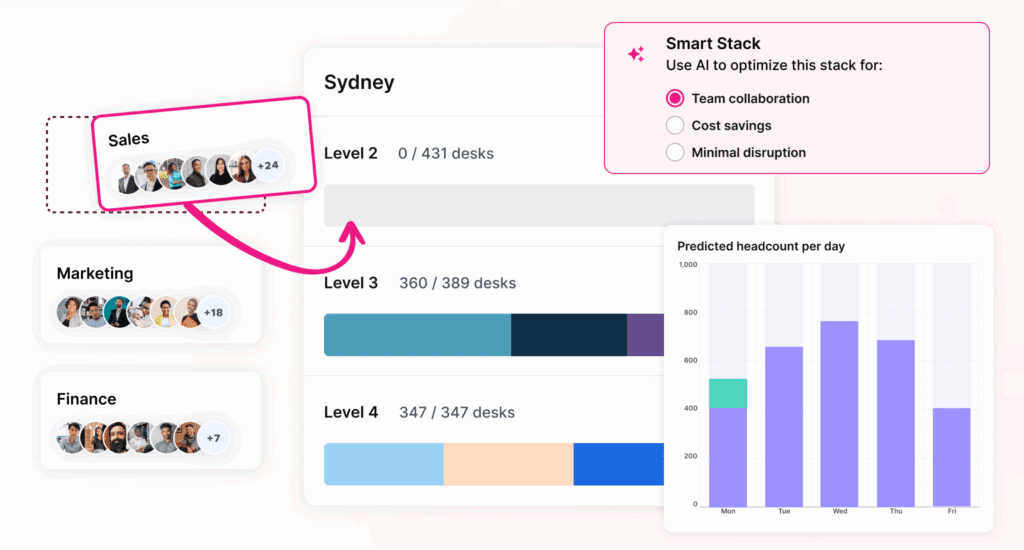
Through dynamic stack planning, teams can see how people and functions are distributed across floors and buildings and test alternative configurations without reworking physical space. This mirrors Airbnb’s use of repeatable zones, but extends it across entire portfolios rather than individual floorplates.
Scenario planning takes this further by allowing organizations to explore growth, contraction, policy shifts, or reorganizations as parallel futures. Instead of selecting a single plan and locking it in, leaders can compare options, understand tradeoffs, and delay commitment until uncertainty resolves.
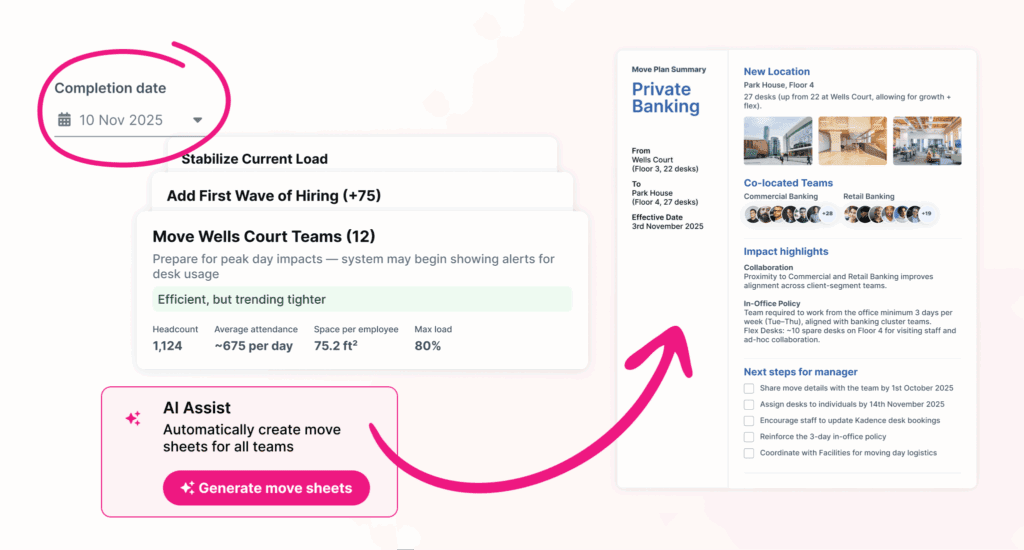
When change does need to happen, coordinated move management ensures that execution does not undo the benefits of planning. Dependencies are tracked, sequencing is clear, and teams move without the operational fragmentation that often accompanies reorganization.
Where the Airbnb offices reduced the cost of change through architecture, SpaceOps reduces it through foresight.
Where Software Goes Further Than Design
Architecture can only absorb a finite amount of change. Once portfolios span multiple floors, buildings, or leases, flexibility depends less on how space is designed and more on how decisions are governed.
This is where software extends beyond what architecture alone can do.
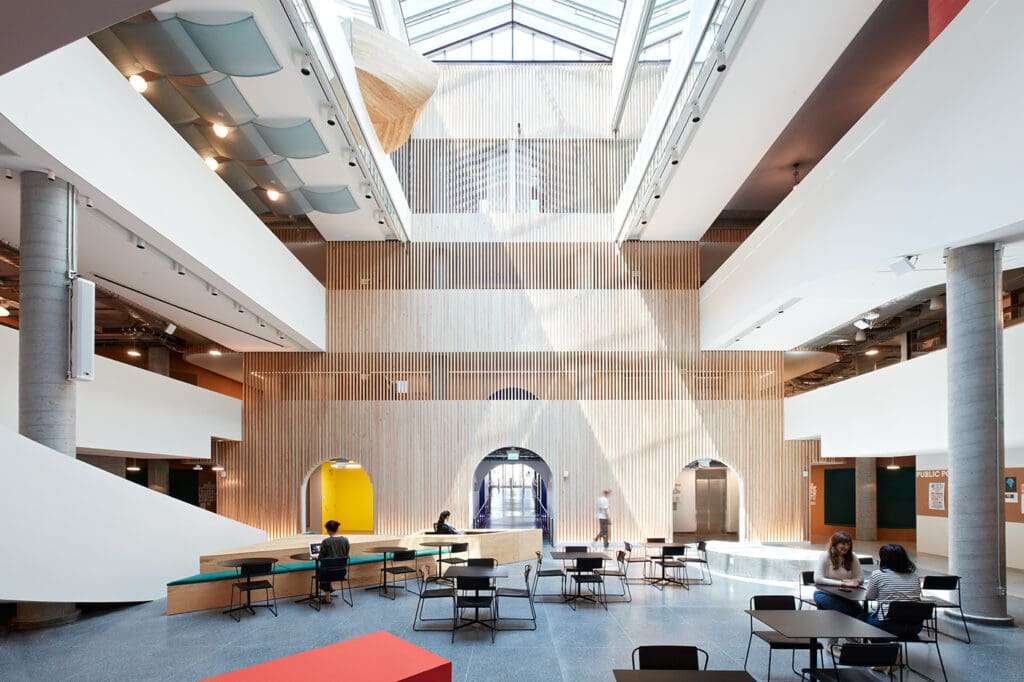
The Airbnb offices avoid encoding a single organizational structure into the building. SpaceOps allows organizations to avoid encoding those assumptions into leases, layouts, or move plans. Decisions that would otherwise become irreversible can remain provisional. Options can be tested rather than assumed. Tradeoffs can be made explicit before they carry financial or operational consequences.
In that sense, SpaceOps does not replace design. It generalizes it.
It takes the principles that make Airbnb’s office resilient and applies them continuously, at scale, and across environments that were never designed for constant change in the first place.
What Airbnb Makes Clear
The Airbnb offices work because the headquarters resists permanence. The workplace does not need to be renegotiated every time the organization changes, because it was never tied too closely to a single version of the company.
That separation between organizational decisions and spatial commitments is rare. In many organizations, offices become increasingly coupled to past structures, making future change harder rather than easier.
Airbnb avoided that outcome architecturally. Kadence SpaceOps addresses the same risk operationally, allowing organizations to plan for change, test assumptions, and execute decisions without letting space become a brake on progress.
Book a demo with our workplace operations experts to see how Kadence SpaceOps helps organizations adapt office space as fast as the business evolves.