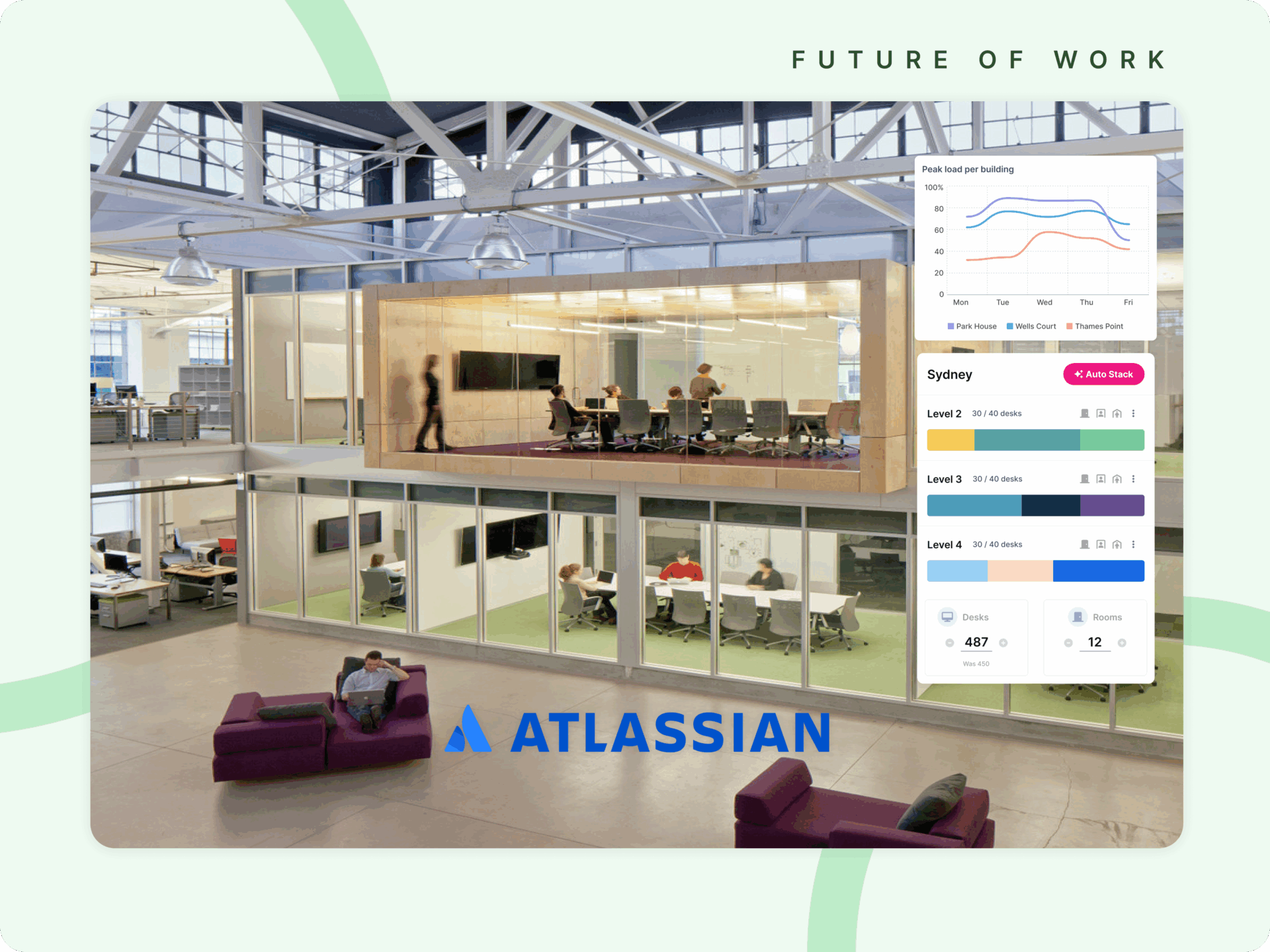
Most office space is planned around consistency. Leases, desk counts, and floor plans typically assume that attendance is broadly stable across the week, with minor fluctuations that can be absorbed through buffer space. Even many hybrid strategies quietly rely on this assumption, planning for an average day and treating anything outside it as an exception. Atlassian operates its office on a very different premise.
Under its Team Anywhere model, the Atlassian office is no longer the default place where work happens. Teams are distributed most of the time and come together in person intentionally, often for planning cycles, project kickoffs, retrospectives, or moments that benefit from being in the same room. As a result, office attendance is uneven by design. Many days are quiet. A small number of days carry intense demand.
This makes peak demand, not average utilisation, the central planning challenge.
Why Peak Demand Changes the Office Planning Equation
In an episodic model, average attendance stops being a useful signal.
A team that gathers in person only a few times a quarter may appear to require minimal space when viewed through monthly or quarterly averages. But when those gatherings happen, they often involve most of the team and frequently overlap with other teams doing the same thing. The result is a sharp spike in demand that averages completely obscure.
This is the trade-off Atlassian’s model forces into the open. Office space must be capable of supporting high-intensity use without being permanently sized for it.
Traditional planning approaches struggle here. Planning for the median day leads to overcrowding on peak days. Planning for peak demand leads to excess capacity and long-term cost inefficiency. Atlassian’s approach makes that tension unavoidable rather than hiding it behind smoothing assumptions.
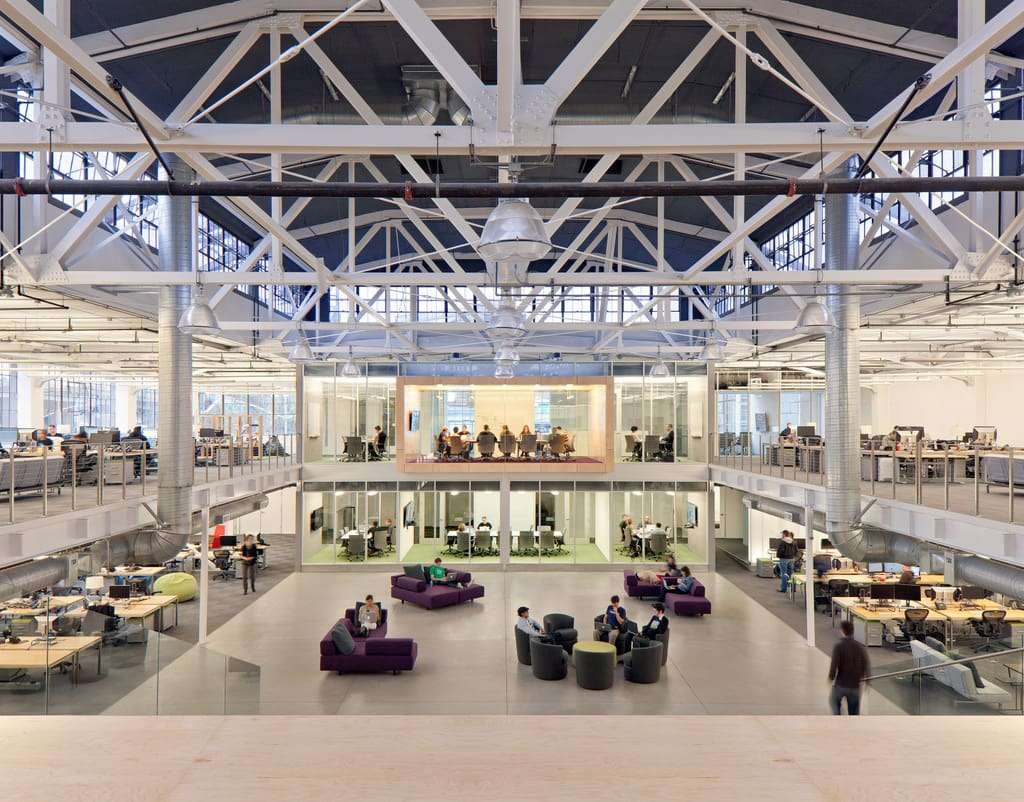
Offices as Infrastructure for Peaks, Not Baselines
Atlassian has been clear that the office is a destination.
People come together with intent, not obligation. The office supports moments of alignment, collaboration, and relationship-building, while most individual work happens elsewhere. Operationally, this reframes the workplace from a daily container into infrastructure designed to support peaks.
That distinction matters. Infrastructure designed for peaks behaves differently from infrastructure designed for steady flow. Demand is uneven. Utilisation is lumpy. The success of the space depends less on daily occupancy and more on whether it performs when demand is highest.
In this model, office space must flex in time as much as it flexes in layout.
The Operational Challenges Peak Demand Creates
Designing offices for peak demand introduces constraints that many organisations underestimate.
First, overlapping demand becomes a primary risk. When teams choose when to gather, multiple groups often converge on the office simultaneously. Without planning, this leads to congestion, degraded experience, and frustration that undermines the purpose of coming together.
Second, services are stressed unevenly. Meeting rooms, collaboration spaces, catering, and on-site support may sit idle for weeks and then be overwhelmed in a single day. Static provisioning either overserves the quiet days or underserves the critical ones.
Third, real estate decisions become harder to defend. Long-term leases and fit-outs are difficult to justify when space is intentionally underutilised much of the time. Leaders are forced to balance financial discipline against peak-day resilience.
The Atlassian model does not remove the office from the equation. It makes office space planning more complex and less forgiving.
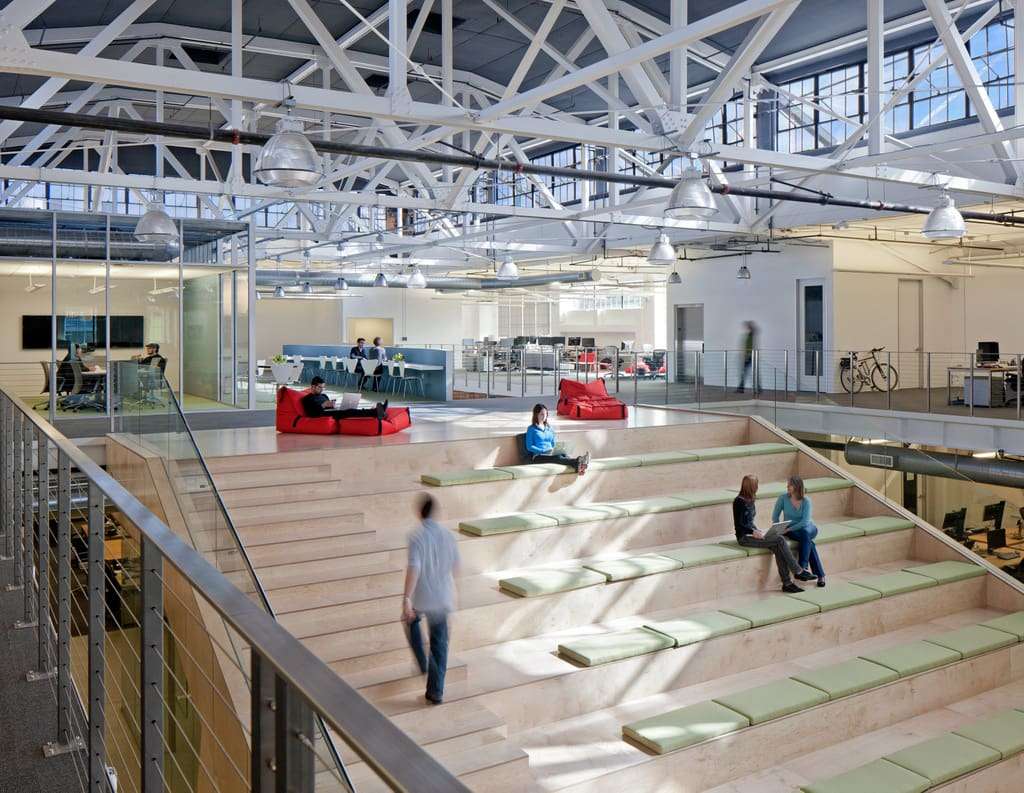
Why Traditional Planning Models Break Down
Most workplace planning tools are built for stability.
They allocate teams to floors, estimate desk counts, and assume attendance distributes itself relatively evenly over time. Peaks are treated as anomalies rather than core inputs into planning.
In an episodic model, peaks are not anomalies. They are the moments that matter most.
Without tools designed to model demand over time, organisations rely on informal coordination or blunt policy to manage peak days. Informal coordination breaks as organisations scale. Policy introduces rigidity that undermines flexibility.
This is where distributed strategy often outpaces operational capability.
How SpaceOps Enables Planning for Peak Demand
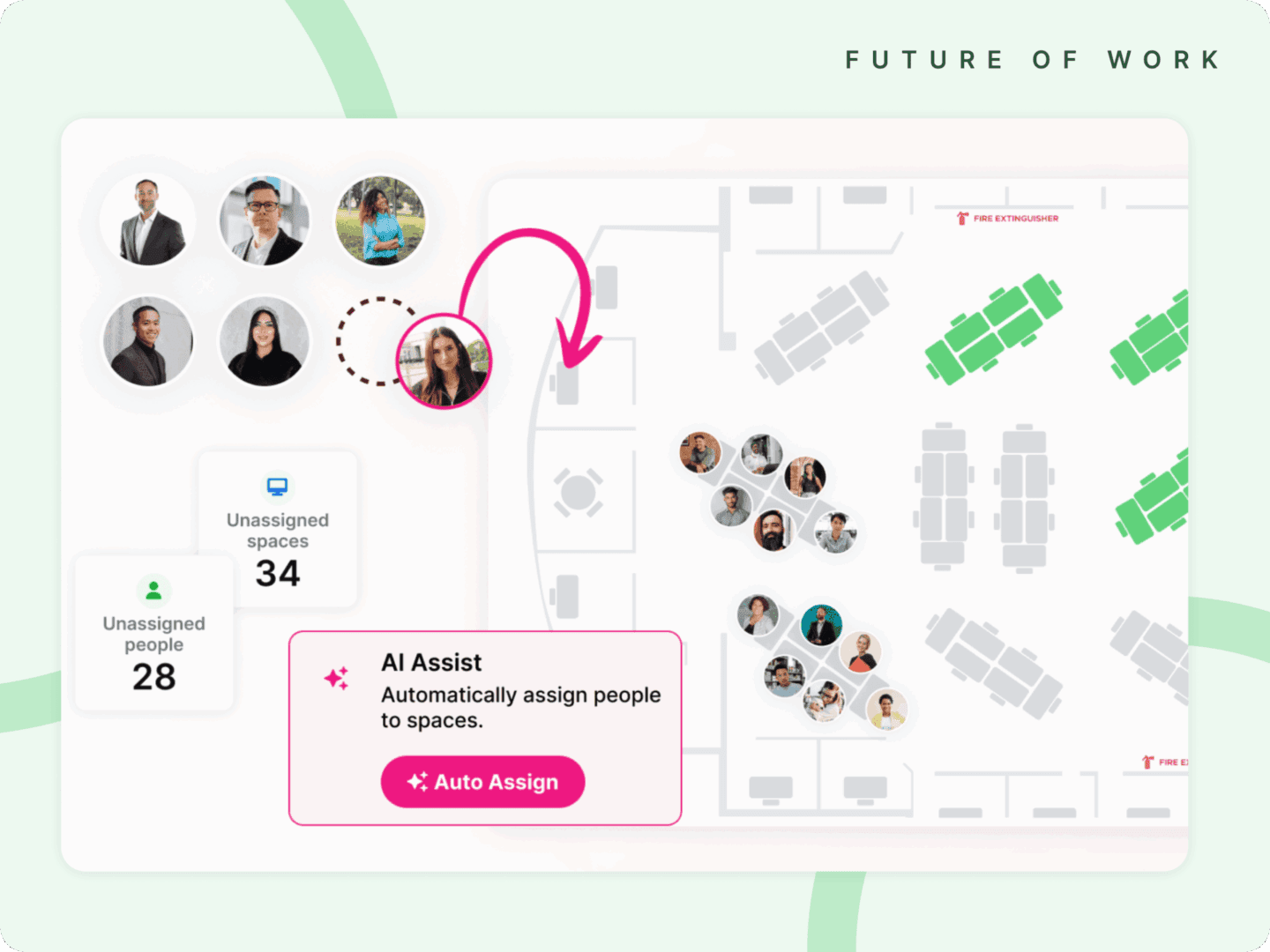
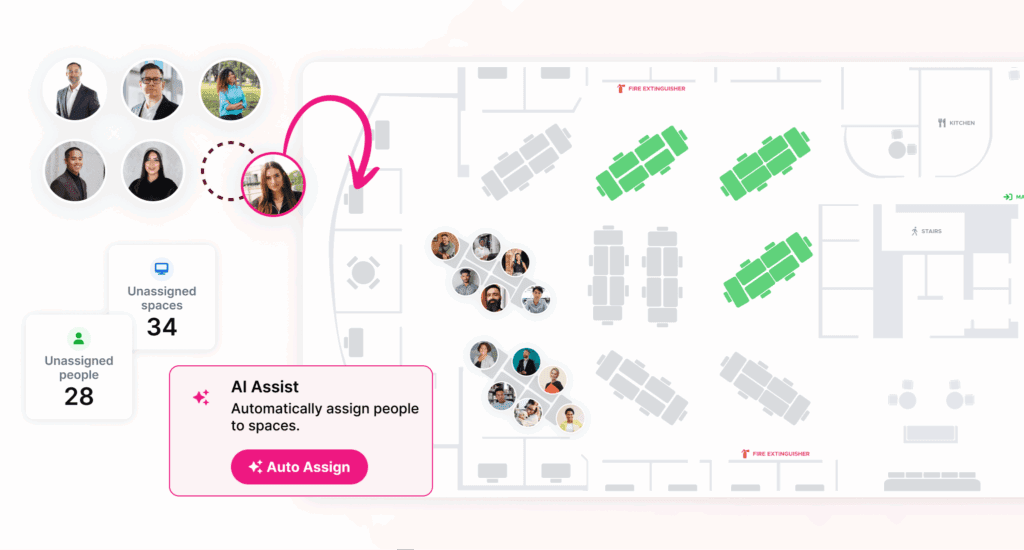
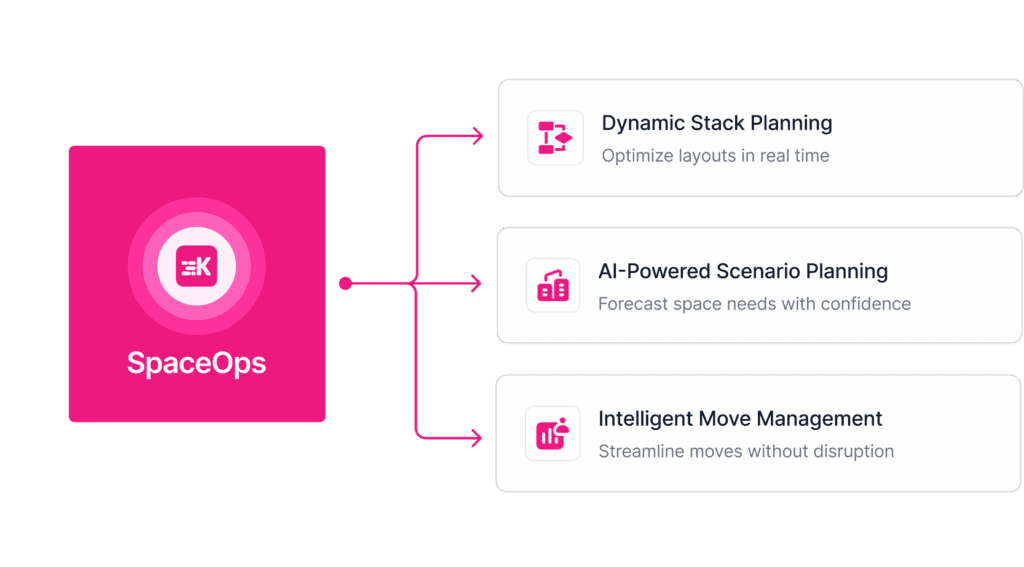
Kadence SpaceOps is designed for environments where demand is uneven and uncertainty is structural.
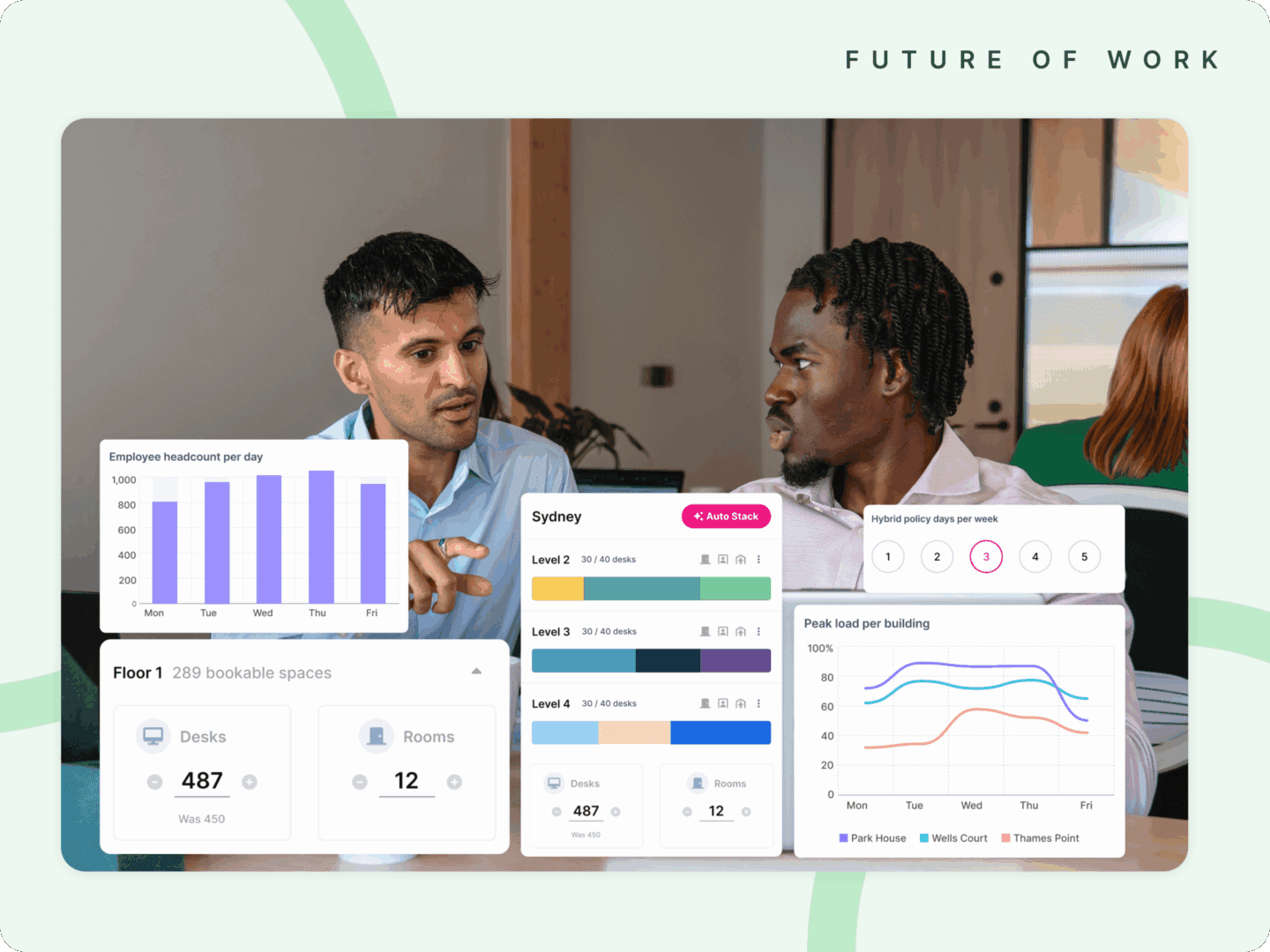
Instead of planning office space around a single assumed pattern, SpaceOps allows leaders to model multiple scenarios across time. Teams can test what happens when several groups schedule in-person work during the same period and see where capacity holds or fails before those moments arrive.
This makes it possible to plan for peak demand without permanently building for it.
For example, organisations can model Intentional Together Gatherings across teams and quarters to identify high-risk overlap periods. Space can be shared dynamically rather than duplicated. Small adjustments to timing, room mix, or team overlap often resolve pressure without structural change.
Office space becomes something that flexes with demand rather than something that is overbuilt to absorb it.
Avoiding the Peak-Day Overreaction
A common failure mode in episodic models is overreaction.
After experiencing overcrowding on peak days, organisations often respond by adding desks, expanding leases, or tightening attendance rules. These responses address immediate pressure but lock in long-term inefficiency and erode the flexibility that made episodic work valuable in the first place.
SpaceOps supports a more precise response. By making peak demand visible in advance, leaders can intervene earlier and with greater accuracy. Adjustments can be targeted to the specific periods and teams that create pressure, rather than applied broadly across the portfolio.
This is the operational discipline required to make models like Atlassian’s sustainable at scale.
Why This Matters for Office Planning in 2026
By 2026, more organisations will operate with uneven attendance patterns, even if they do not describe themselves as distributed.
Hybrid strategies, global teams, and asynchronous work reduce the need for daily co-presence while increasing the importance of specific, high-impact moments. Office space will continue to exist, but its value will concentrate around fewer days that matter more.
The challenge will not be encouraging people to come in. It will be ensuring the office performs when they do.
Atlassian illustrates what happens when office work is designed around flexibility. SpaceOps ensures that office space planning can keep up with that reality.
What Atlassian Ultimately Shows
Atlassian’s model is often discussed in cultural terms. Its more consequential impact is operational.
When work happens in bursts, office space must be planned differently. Averages stop helping. Peak demand becomes the primary constraint. Coordination replaces compulsion.
With SpaceOps, organisations can plan for peak demand without overspending on permanent capacity or sacrificing experience on the days that matter most.
The office does not disappear in distributed work. It becomes episodic, more valuable, and harder to plan.
Book a demo with our workplace operations experts to see how Kadence SpaceOps helps organisations plan office space for peak demand without waste or disruption.