Six years on from the disruption that reshaped how work happens, the most striking thing in the data is how little drama there really is.
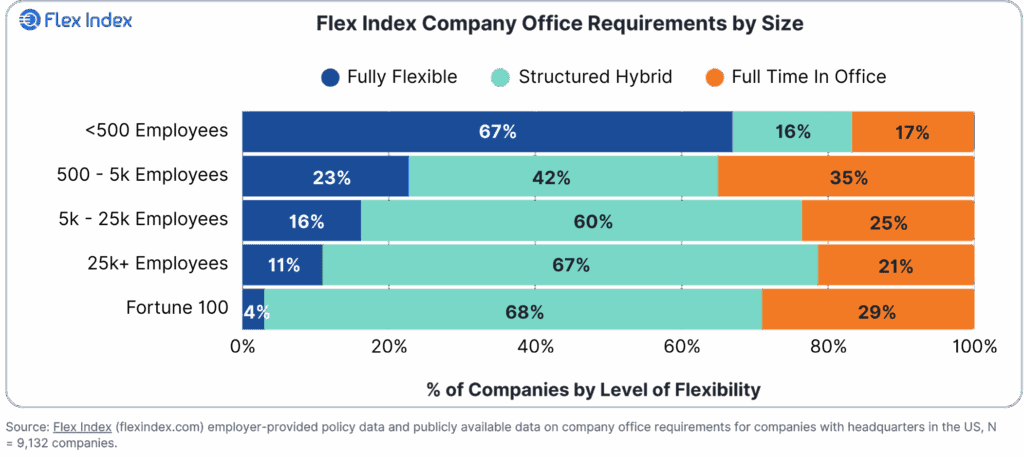
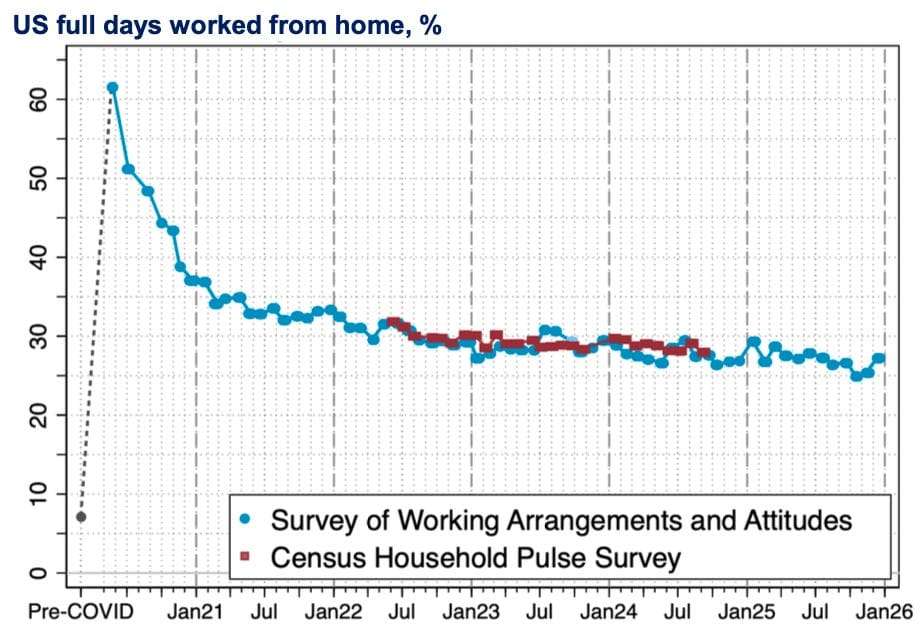
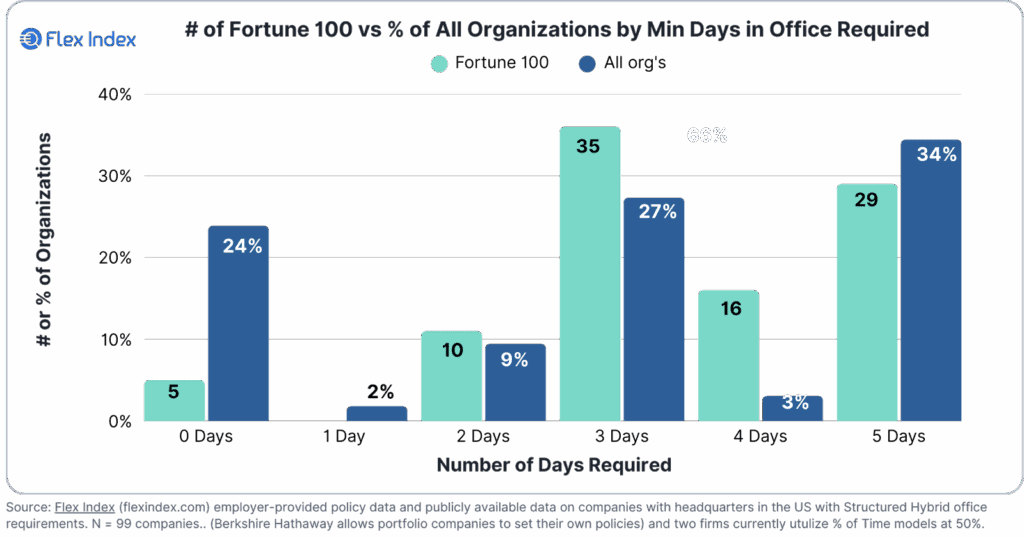
Work from home in the US has stabilized at around 25 percent of working days, nearly four times pre-pandemic levels. Office utilization increased modestly in 2025, by roughly two to three percentage points, despite a year of headlines predicting a mass return. Even among the Fortune 100, the majority of companies still operate with some form of flexibility, with only a minority requiring five days a week in the office.
Brian Elliott’s recent analysis makes this clear, drawing heavily on years of research and ongoing collaboration with Stanford professor Nick Bloom. The loudest return-to-office mandates attract attention, but they are not representative. Across markets and industries, the pattern is one of stabilization rather than reversal. The system has found a new equilibrium, one that Bloom’s data has been documenting consistently over time.
That equilibrium, however, is not the same thing as resolution.
Many organizations have moved away from a rigid, office-only model of work. Fewer have fully reckoned with what the next model should actually look like.
When a Word Loses Precision
As behavior has stabilized, the language used to describe it has grown less helpful. “Hybrid” has become a catchall term, asked to explain everything from attendance expectations to culture, collaboration, and performance.
This is not a semantic complaint. Language shapes decisions. When conversations center on whether teams are “really hybrid” or whether policies are being followed closely enough, attention drifts away from more practical questions about how work actually moves through an organization.
The result is a debate that feels endless even as day-to-day behavior changes very little.
What the Data Actually Shows
The underlying data tells a consistent story. Office utilization has risen slightly, not dramatically. Work from home has plateaued rather than declined. Markets like San Francisco and New York have seen increases in office traffic, but remain well below pre-2020 baselines.
Even among large enterprises, where return-to-office pressure has been most visible, flexibility remains common. More than 70 percent of Fortune 100 companies allow some form of flexible work, while roughly 29 percent require full-time office attendance. The companies most frequently cited as evidence of a broader shift are, in fact, the exception.
This matters because it reframes the problem leaders are trying to solve. The question is no longer whether flexibility exists. It does. The question is whether organizations are equipped to operate effectively with it.
Economics, Not Ideology
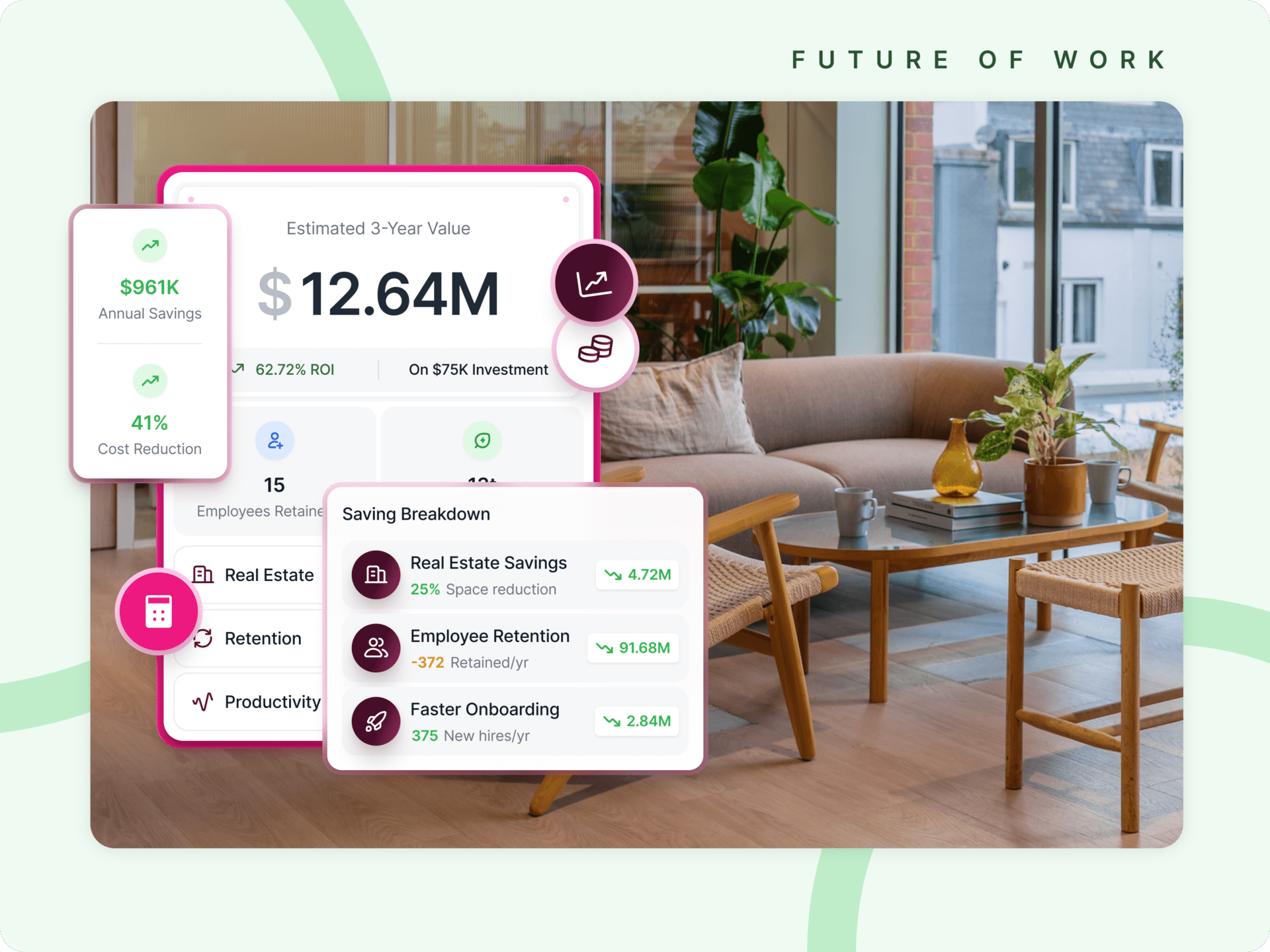
The economic evidence reinforces this shift. In Nick Bloom’s randomized trial at Trip.com, employees working a hybrid schedule showed no measurable difference in performance after two years compared with fully in-person peers. What did change was retention. Quit rates fell by roughly a third, saving an estimated $20,000 to $30,000 per employee.
Those gains did not come from novelty or morale alone. They came from continuity. Teams stayed intact. Knowledge stayed put. Work experienced fewer interruptions.
When coordination is weak, flexibility feels chaotic. When coordination is strong, flexibility fades into the background. It becomes an unremarkable feature of how work gets done, rather than a point of contention.
Presence, Used With Intent
Newer research adds another layer of nuance. Bloom’s findings suggest that bringing fully remote workers together just one day a month can significantly reduce quit rates and boost productivity, by as much as 8 percent. The effect is not driven by attendance itself, but by the quality of interaction those moments enable.
This aligns with other research suggesting that roughly a quarter of time spent together, whether structured weekly or monthly, supports collaboration without recreating the constraints of full-time office work. The variable that matters most is not frequency, but purpose.
Organizations that design gatherings around decision-making, learning, and connection tend to see very different outcomes than those that mandate presence without clarity.
From Deciding to Operating
Across all of this data runs a quieter shift. The organizations making progress are no longer focused on announcing policies or settling debates. They are focused on maintaining coherence.
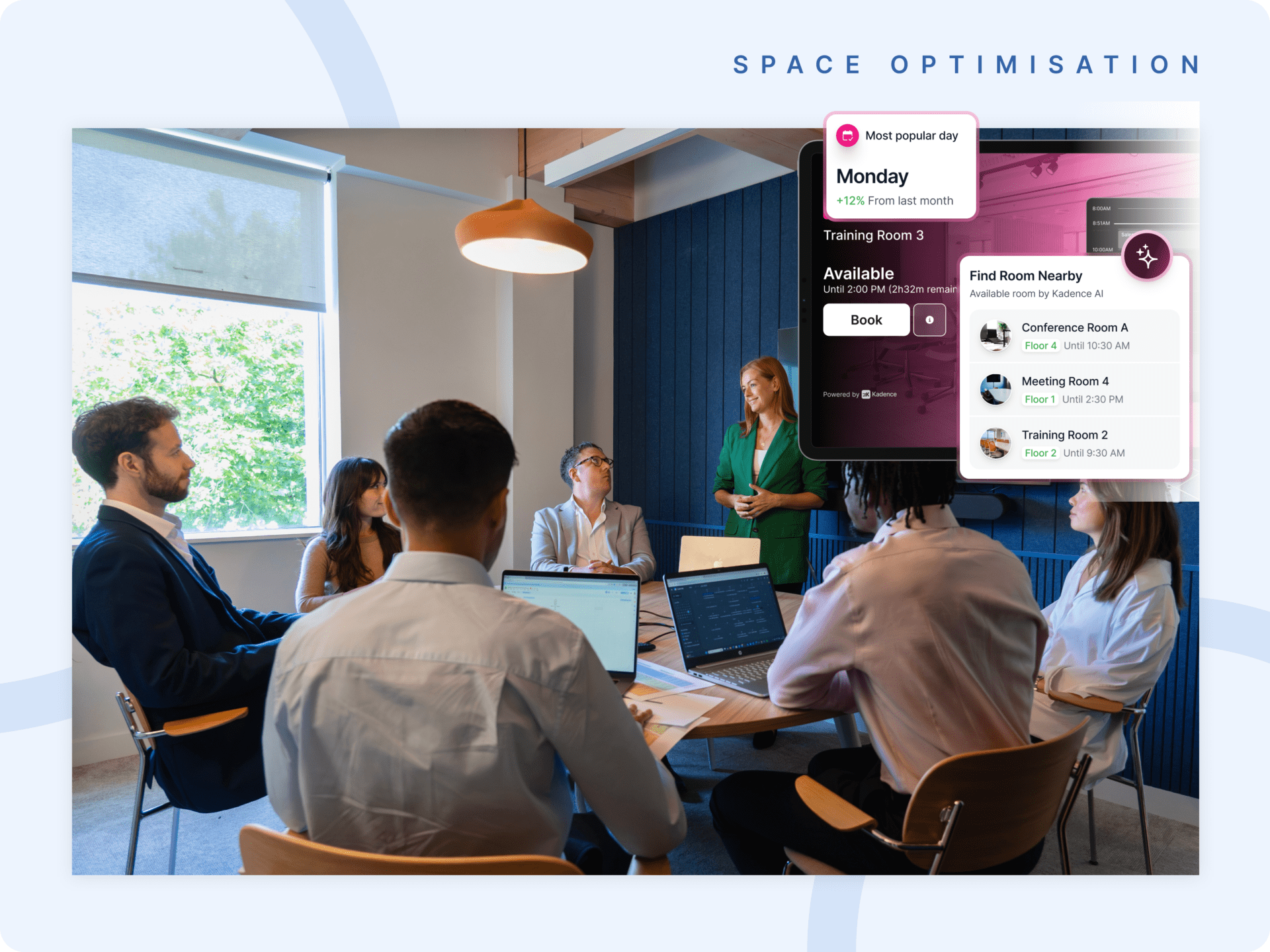
They adjust how space is used as teams evolve. They revisit collaboration norms as work becomes more distributed. They treat attendance data as a signal to be interpreted, not a rule to be enforced.
The biggest mistake leaders make is thinking they’re looking for the right policy. They’re actually looking for a system that doesn’t break the moment conditions change.
This work is less visible than a mandate and harder to summarize in a memo. It also happens to be where the advantage now lies.
Where the Bridge Leads
Hybrid was never meant to be a place to stay. It was a way through.
At a moment of disruption, it gave organizations enough structure to move away from a rigid, office-only model without breaking how work got done. It loosened assumptions about presence and productivity and created room to adapt.
In that sense, it worked.
But bridges are transitional by design. Once crossed, standing still creates congestion rather than progress.
The data suggests most organizations have already crossed. Work from home has stabilized. Office attendance has recovered modestly. The extremes attract attention, but they are no longer where most work actually happens.
What remains unresolved is not where work should happen, but how it should now run.
The challenge ahead is not to defend or abandon hybrid, but to build what comes next: ways of coordinating, gathering, and using space that assume flexibility as a given. The organizations pulling ahead are no longer arguing about location. They are focused on whether work moves cleanly, whether teams stay connected, and whether their workplace can adapt as conditions change.
Hybrid did its job.
The destination was never the bridge.