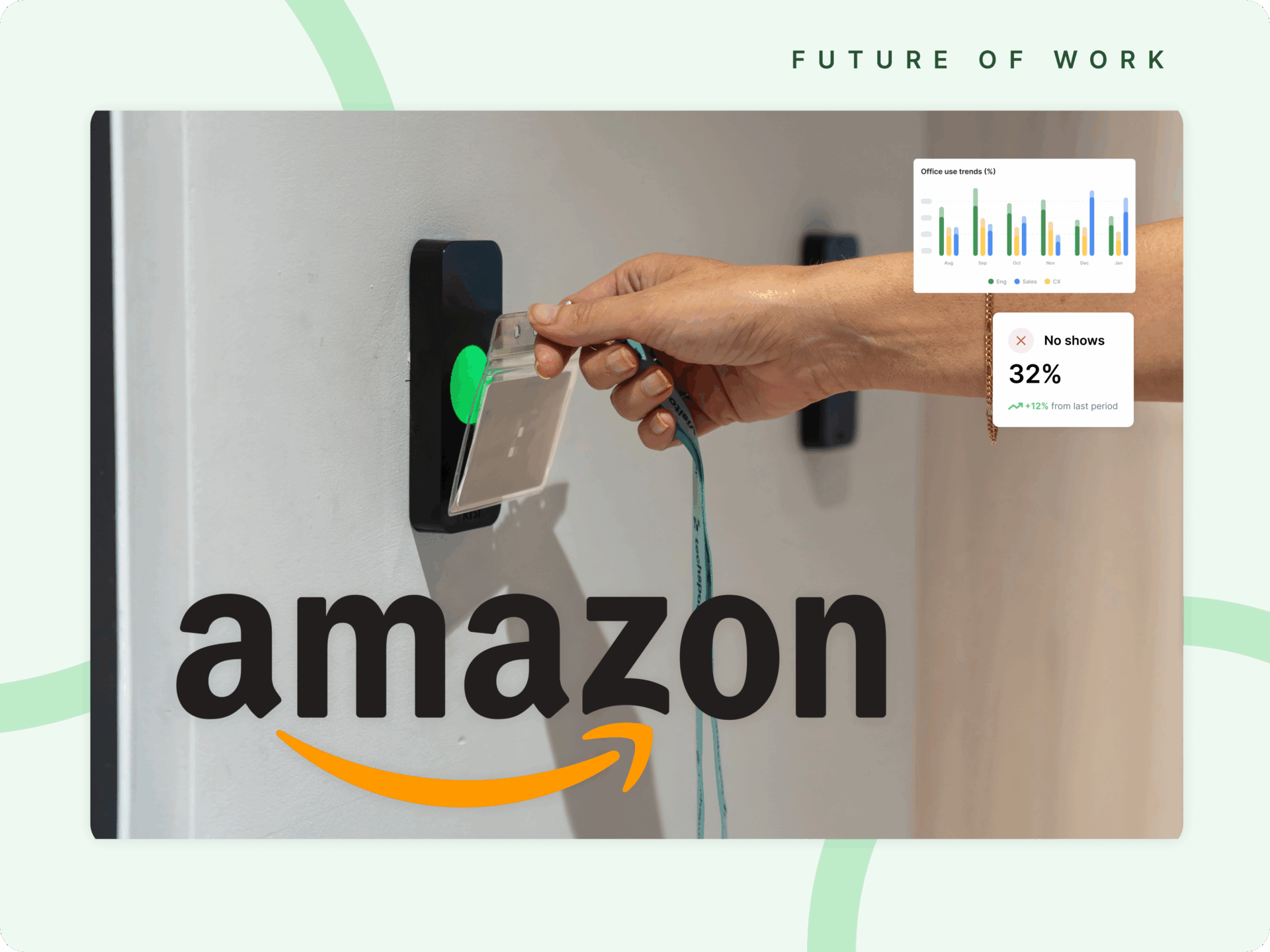
Amazon is no longer just tracking whether employees come into the office. It is tracking how long they stay.
In December, the company rolled out a manager dashboard that measures employees’ in-office hours across a rolling eight-week period. The system categorises workers based on duration rather than attendance alone, flagging those who spend fewer than four hours per day in the office, those who do not badge in at all, and those working from locations they are not assigned to.
This marks a meaningful shift. Office presence is no longer binary. Time itself has become the metric. And more so, this is not simply a return-to-office policy refinement. It is a change in how work, space, and compliance are being operationalised.

What is Amazon Tracking
Amazon’s dashboard refreshes daily and gives managers direct access to office-time data that previously sat with HR. It aggregates badge data over time, producing median hours, rolling averages, and location-level compliance indicators.
The system builds on Amazon’s earlier crackdown on so-called “coffee badging” by narrowing the definition of acceptable attendance. Showing up briefly is no longer sufficient. Duration is now the signal.
Amazon has framed tracking as a way to encourage collaboration. Operationally, however, the impact is broader. Office time has become legible, comparable, and enforceable at scale.
Amazon joins companies such as Samsung, Dell, Bank of America, JPMorgan, and PwC in using badge tracking to support return-to-office mandates. What differentiates Amazon is not enforcement itself, but precision. Hours are treated as a measurable unit of participation.

Why Time Is an Attractive Metric
Time is seductive because it is simple. It is easy to measure. Easy to compare. Easy to explain to leadership. When organisations struggle to define productivity or collaboration, time provides a concrete proxy that feels objective and defensible.
From a management perspective at Amazon, tracking hours reduces ambiguity. It tightens expectations and limits interpretation. Compliance becomes visible.
But that simplicity comes with trade-offs. When time becomes the primary signal, behaviour adjusts to satisfy the metric rather than the underlying goal.
People optimise for presence. Visibility replaces effectiveness. Space fills predictably, but not necessarily purposefully.
This is not unique to Amazon. It is the natural outcome of choosing duration as the organising principle.
What Time-Based Measurement Misses
The limitation of time as a metric is not that it is inaccurate. It is that it is incomplete.
Recent Flex Index reporting using 2024–2025 data from Kastle Systems and Roam highlights the gap. Remote employees showed significantly higher levels of work activity on holidays and weekends than in-office workers. On Christmas Day, remote work activity reached 13.3 percent, while in-person activity fell to 1.9 percent.
Stanford economist Nick Bloom has pointed out that measuring work through 9-to-5 office presence overlooks the contribution employees make outside those windows.
Time spent in the office does not reveal whether people coordinated effectively, whether space supported the work at hand, or whether collaboration actually occurred. It only shows that people were present for a defined period.
When Offices Become Compliance Infrastructure
Once time becomes the metric, the office itself changes role.
It stops being primarily a tool for coordination and becomes a system for enforcement. Space is evaluated based on how reliably it can host people for long enough to satisfy policy requirements.
This creates second-order effects. Peak periods intensify as employees cluster to demonstrate compliance. Meeting rooms fill defensively. Quiet spaces become less accessible. Utilisation rises, but friction often rises with it.
More subtly, time-based measurement shifts the relationship between organisations and employees. Trust is replaced by verification. Outcomes become secondary to observable effort.
This is not a moral judgement. It is a structural consequence of how measurement works.
Measuring Space as a System, Not a Rule
Amazon’s approach reflects one way to achieve operational control. It defines desired behaviour, measures time against that definition, and enforces compliance.
There is another approach.
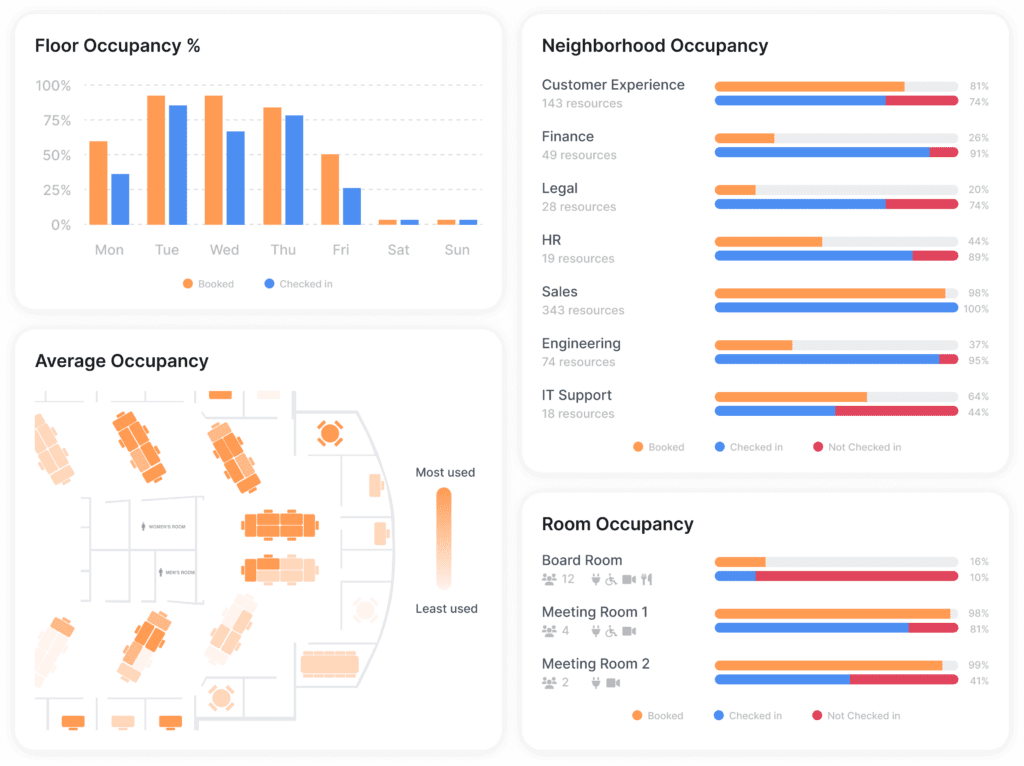
Rather than measuring whether individuals meet time thresholds, organisations can measure how space actually behaves. Which areas are consistently occupied. Where collaboration concentrates. When demand exceeds capacity. Where space remains underused despite policy.
This is the distinction Kadence Sense is built around.
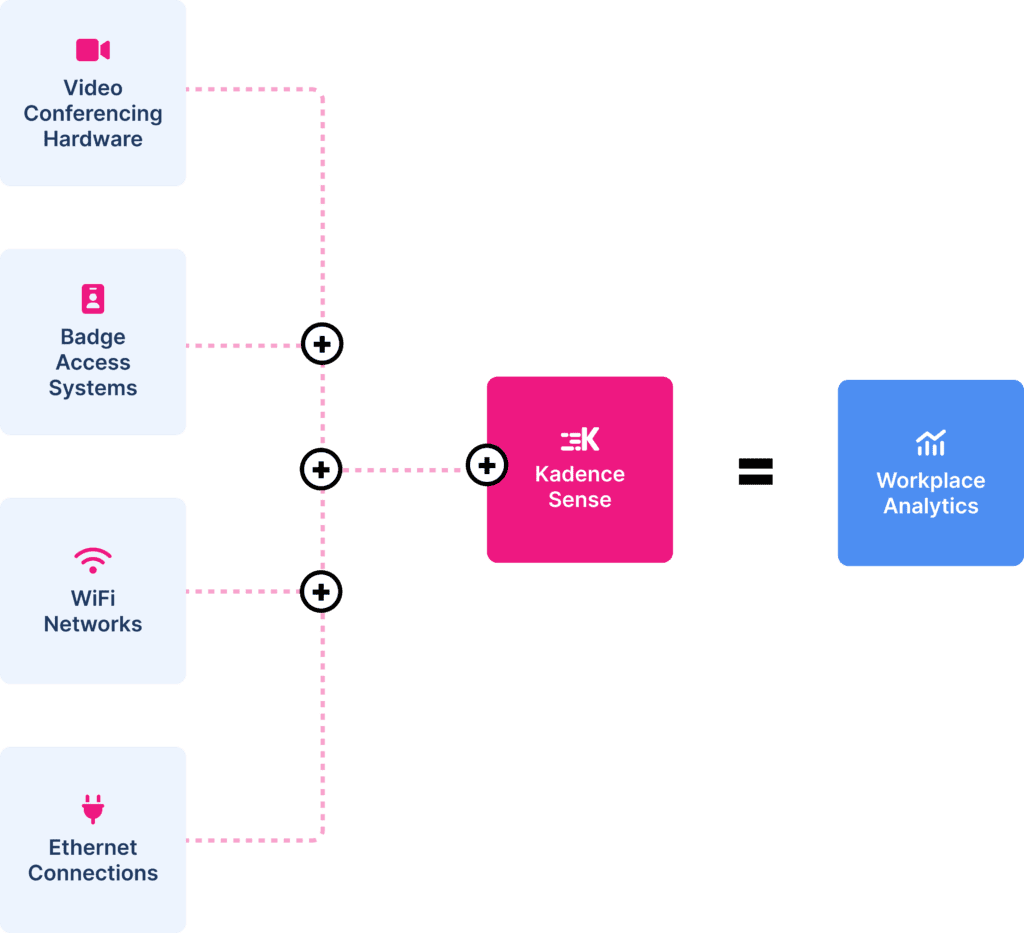
Kadence Sense provides real-time, accurate occupancy insight using existing digital infrastructure such as Wi-Fi, network connections, and workplace systems. Instead of counting badge swipes or tracking individual duration, it builds a unified view of how space is occupied and how patterns change over time.
The difference is not privacy alone. It is perspective.
Sense does not answer whether someone stayed long enough. It reveals whether the workplace supported the work people came in to do.
From Measurement to Decision-Making
Occupancy intelligence becomes powerful when it feeds decisions, not enforcement.
With accurate occupancy patterns, leaders can see where policies create congestion, where space performs well, and where assumptions about collaboration do not hold up in practice. Services like cleaning, catering, and support can be aligned to real demand rather than fixed schedules.
This is where Kadence SpaceOps extends the picture.

SpaceOps allows organisations to model different attendance expectations, schedules, or policy scenarios and understand their impact on utilisation and operational risk before enforcing them. Instead of assuming that longer office hours improve collaboration, leaders can test what actually happens under different conditions.
Together, Sense and SpaceOps enable adaptive control. Behaviour is shaped through insight and iteration rather than rigid rules.
What Amazon Makes Clear
Amazon experimenting with office time tracking illustrates a broader shift. When organisations cannot redesign their offices quickly enough to influence behaviour, they redesign measurement instead.
Time becomes the interface between people and space.
For some organisations, that level of control will feel necessary. For others, it will feel constraining. The critical question for 2026 is not whether offices are used enough, but whether they are used well.
The most resilient workplace strategies will be those that measure outcomes, not just hours, and adapt space without turning offices into compliance tools.
Kadence helps organisations take that path. By combining occupancy intelligence with scenario planning, teams can evolve workplace strategy without redesigning their offices or hard-coding assumptions into policy.
Book a demo with our workplace operations experts to see how Kadence helps organisations design workplaces around how work actually happens, not just how long people stay.