
Meet SpaceOps: The Agentic Workplace

Accelerate Every Workplace Change With The Power of SpaceOps
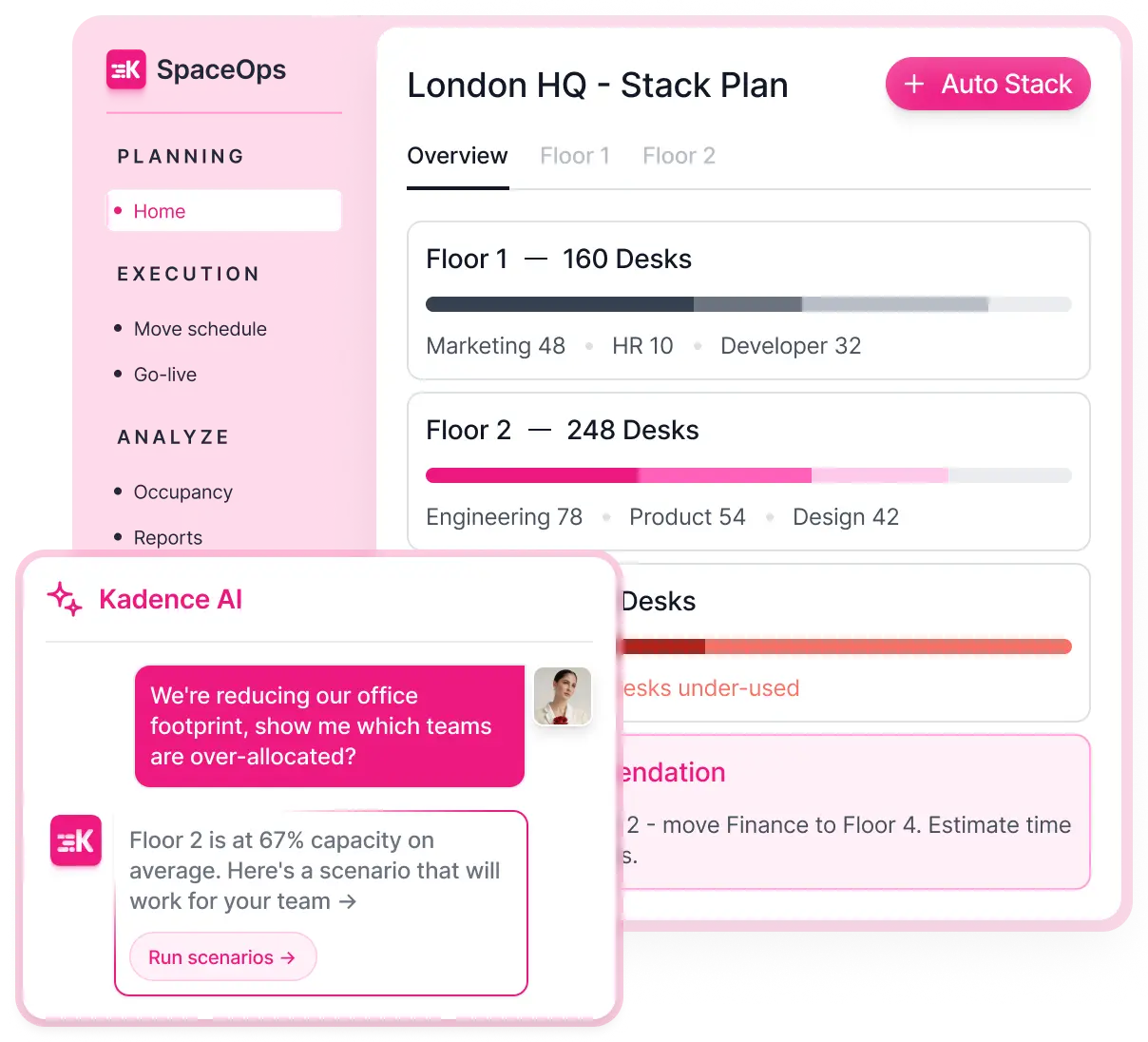
Floors 4 and 5 are averaging 34% occupancy. That’s your lowest across the building. Here’s how Engineering actually uses the space right now.
I can model three consolidation scenarios — should I optimize for space, team adjacency, or minimum disruption?
Three scenarios that minimize moves, optimize for team adjacency and reduce space.
Close one floor now. Reassess in six months.
Close two floors. Engineering and Product stay co-located.
Close three floors. Smallest footprint, highest cost saving.
Scenario B hits your Q2 deadline and keeps all teams in their neighborhoods. Shall I build the stack and schedule around that?
Stack locked: Floors 3 and 4 closing, with Engineering and Product consolidating to Floor 2. Move scheduled for the week of June 23 — your lowest-attendance window before the Q2 deadline. Three room bookings clash with the Legal team move in week 1.
All set. 3 conflicts cleared, 3 new starters seated in Engineering, move sheets generated for all 4 teams. The Q2 consolidation is staged end-to-end.
One final flag: Engineering’s neighbourhood needs dual monitors and ethernet drops at 8 desks.
Your AI-Powered Space Planning Agent
Discover how SpaceOps uses AI to turn your workplace data into an optimized, actionable plan, without lengthy planning cycles or guesswork.

Plans Built on Real Data
SpaceOps uses your actual occupancy and team data to show how your office is being used before you make a change.
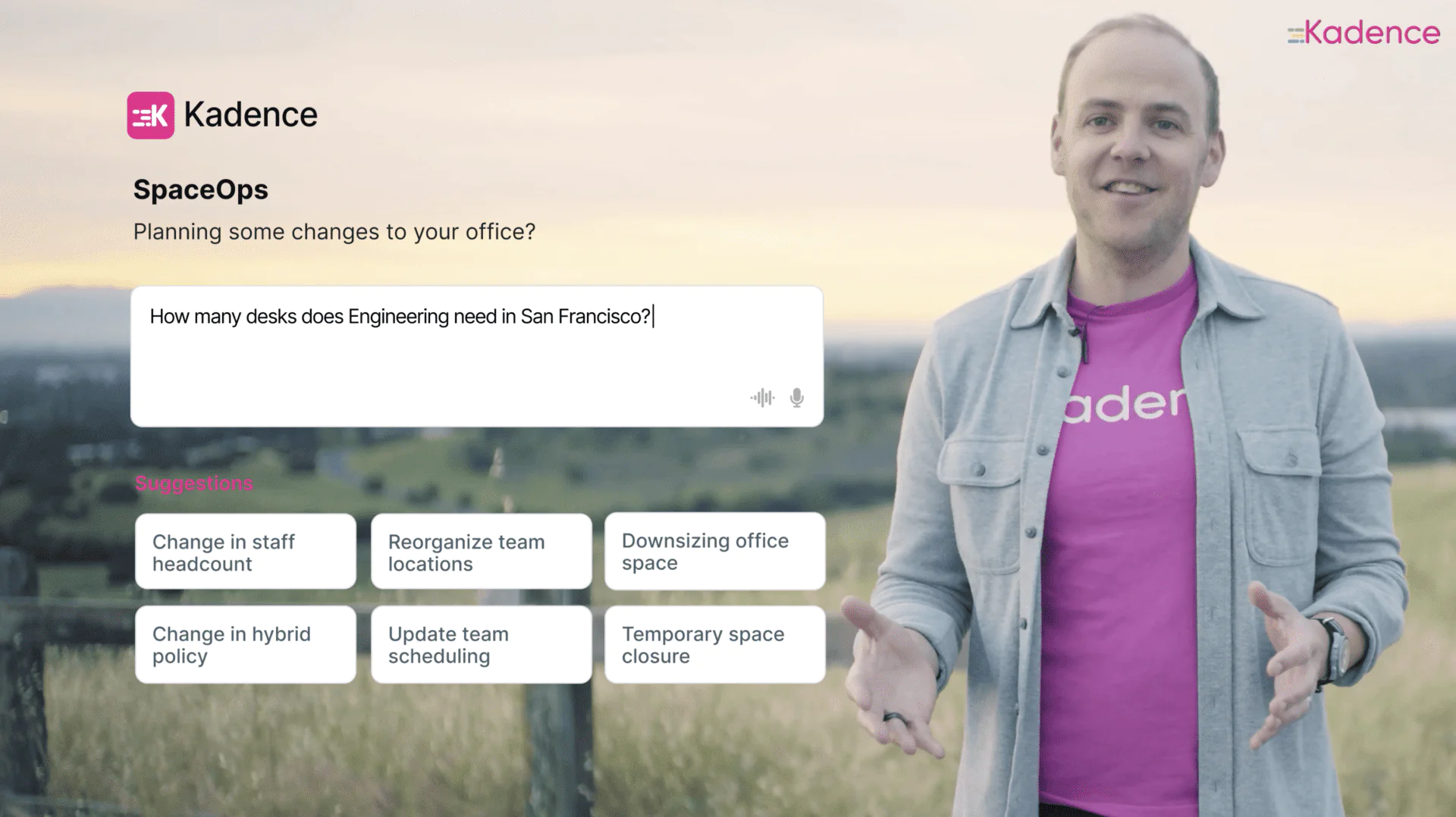
Ask For The Change You Need
Tell SpaceOps what you want to achieve in plain language. It models scenarios, compares trade-offs, and recommends the best path forward.
From plan to execution
Once you approve a plan, SpaceOps turns it into action, applying desk assignments, neighborhoods, and floor configurations within the platform.Work Has Changed, Your Tools Should Too
| Capability | Kadence Spaceops | Legacy Workplace Systems | Consultants |
|---|---|---|---|
|
Agentic AI
|
Explain what you need in plain language
|
Build reports manually
|
Manual briefing process required
|
|
Occupancy modeling, stack planning, scenario modelling and space planning
|
One platform with every stage connected
|
Separate tools, separate budgets
|
Separate engagements, separate fees
|
|
Occupancy data source
|
Your actual space usage, no sensors required
|
Sensors, badges, or spreadsheets
|
Interviews and assumptions
|
|
Re-plan when things change
|
Re-run plans in minutes, unlimited times
|
Manually rebuild every time
|
New engagement, new fee
|
|
Implementation time
|
Days for Kadence customers
|
Weeks to months
|
8 to 12 weeks per project
|
|
No specialists required
|
Designed for workplace leaders
|
Requires trained admin or IWMS specialist
|
Requires a consultant every time
|
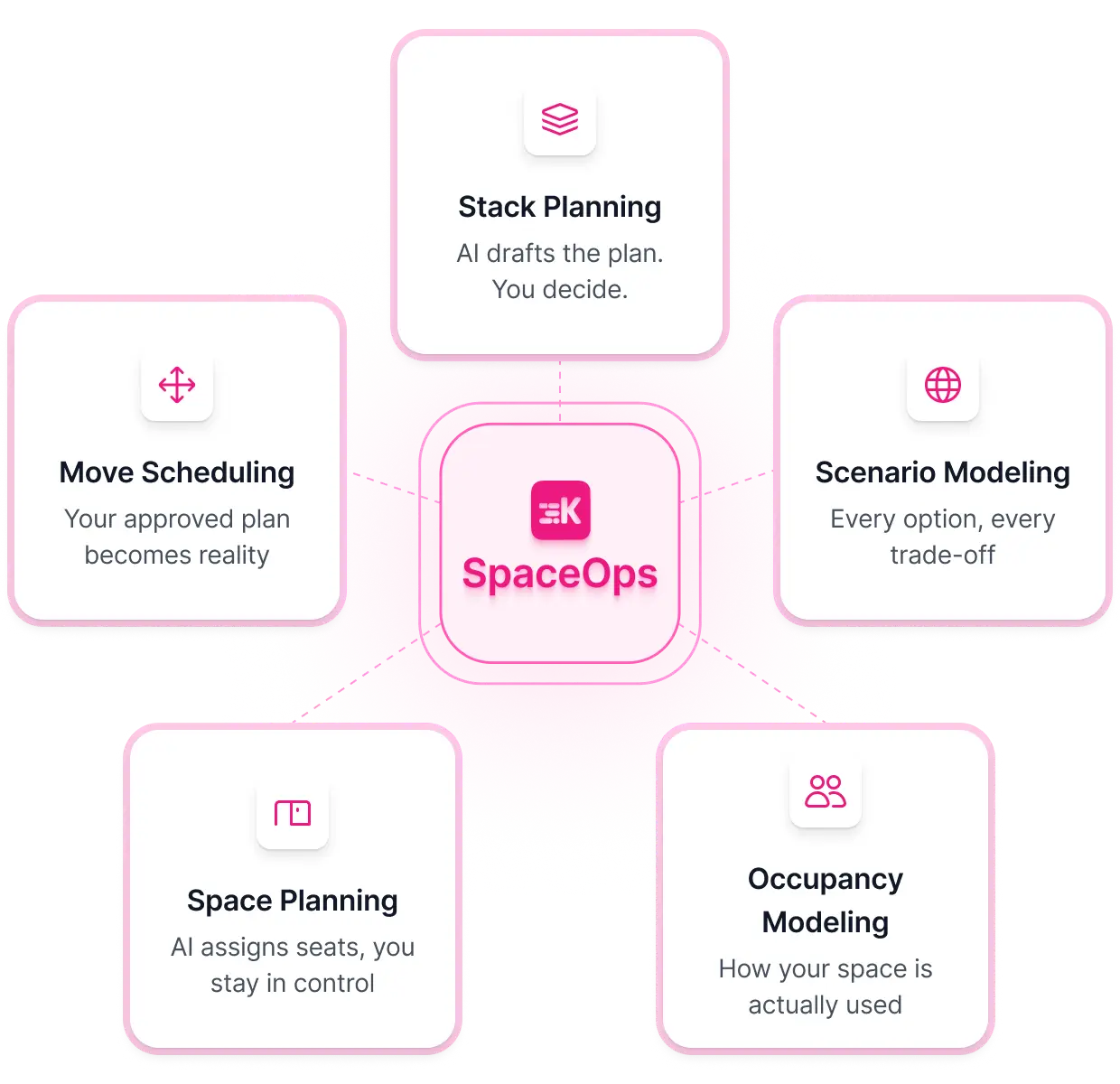
Five Tools. One Platform.
SpaceOps is an AI agent that plans, models, and executes workplace change, turning scenarios into reality.
10 Space Planning Fears: What Leaders Can Do About Them
When teams change, attendance shifts, or office footprints need to shrink, every planning decision carries risk. Use this guide to identify space planning challenges and see how SpaceOps helps you turn them into clear, executable plans.

Got Questions?
SpaceOps is an AI-powered space planning and workplace management platform that helps organizations optimize how their office space is used. It combines real-time occupancy data and AI-powered planning tools to help space and facilities teams make smarter decisions.
SpaceOps gives space teams a single platform to visualize occupancy, model space scenarios, and act on workplace data. From floor plan management to utilization reporting, SpaceOps helps organizations right-size their real estate, reduce wasted space, and plan for workplace change with confidence.
Organizations using SpaceOps reduce real estate costs by identifying underutilized space, improve employee experience by aligning space supply with demand, and save hours of manual planning work through AI-powered automation. The result: faster decisions, lower overhead, and a workplace that works harder for the business.
Unlike legacy IWMS platforms that are complex, expensive, and slow to implement, SpaceOps is built for the speed of modern workplace change. It’s intuitive enough for space teams to use daily, flexible enough to adapt as your workplace evolves, and powered by AI, not just data dashboards.
Kadence SpaceOps is priced based on the size of your organization and the features you need. Whether you’re managing a single office or a global portfolio, there’s a plan built for your scale. Refer to pricing plans here or get in touch with our team for a custom quote tailored to your needs.
You can book a personalized demo with our team to see SpaceOps in action with your own workplace context. We’ll walk you through the platform, answer your questions, and help you understand the ROI before you commit.
SpaceOps manages the entire lifecycle of workplace change — from stack planning and move orchestration to post-move analytics.
AI assists with demand modeling, capacity forecasting, and scenario optimization while maintaining full governance and manual control.