
To assign desks in a hybrid workplace, start with how your teams actually work, then give a set desk to the people who come in on a regular rhythm and keep bookable desks for everyone else. Assigned desks suit teams that want consistent time together; flexible desks suit people who come and go. One office can offer both.
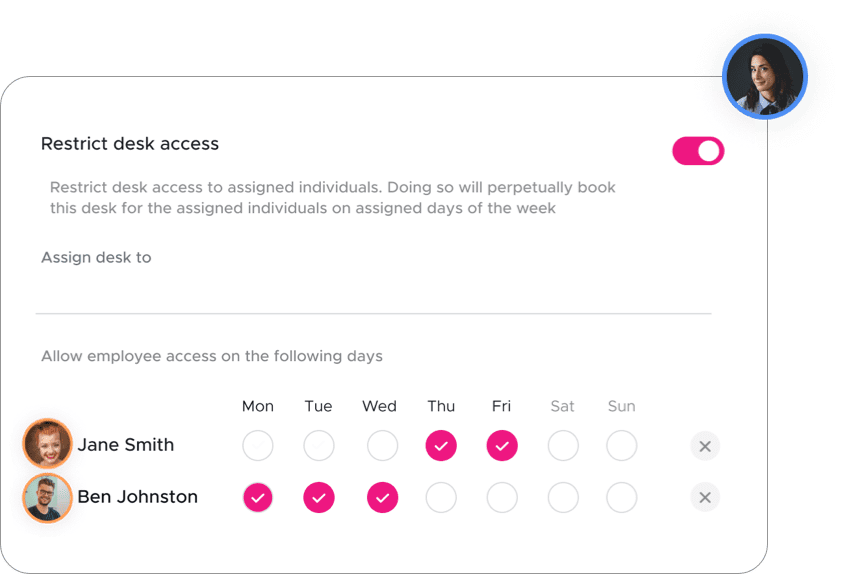
In November 2022, Kadence launched Assigned Desks, a feature that let managers give team members a specific desk on specific days of the week. The launch is a useful example of how assigned and bookable desks can run side by side. The product details below describe the feature at that time.
Should a hybrid workplace use assigned desks or flexible desks?
There is no single right answer. Hybrid work looks different for everyone, and it probably always will. Some people come in whenever they want to see friends and need come-and-go flexibility. Others keep a regular rhythm on set days and value sitting near the same people. A good desk strategy serves both groups instead of forcing one model on everyone.
An assigned desk is a desk reserved for one person, either permanently or on set days. A flexible desk, sometimes called a hot desk, is shared and booked or taken as needed. For a fuller comparison of these approaches, see the guide to flexible office models.
Before choosing, list what each side needs.
What your people need:
- Come-and-go flexibility
- Regular in-person connection with their team
- To see where their friends are working
What the organization needs:
- A smooth space booking process for teams
- To know which spaces are being used and what to expect
- More space management options
How do you find out whether your teams need assigned desks?
Look at how teams already use the office before you assign anything. Talk to managers and team members, then check booking data for patterns: how often teammates are in together, whether people keep booking the same spaces, and which areas are most popular. Those patterns show where a set desk would help and where flexibility matters more.
Four practical steps:
- Talk to team managers and team members to understand how they work.
- Check your team’s booking activity to see how often they meet in person at the office. In 2022, Kadence customers could see this in the Kadence web app.
- Look at your team’s booking history to see whether people use the same spaces regularly.
- Review space usage and find out which areas of the office are more popular than others.
How did Kadence Assigned Desks work when it launched in 2022?
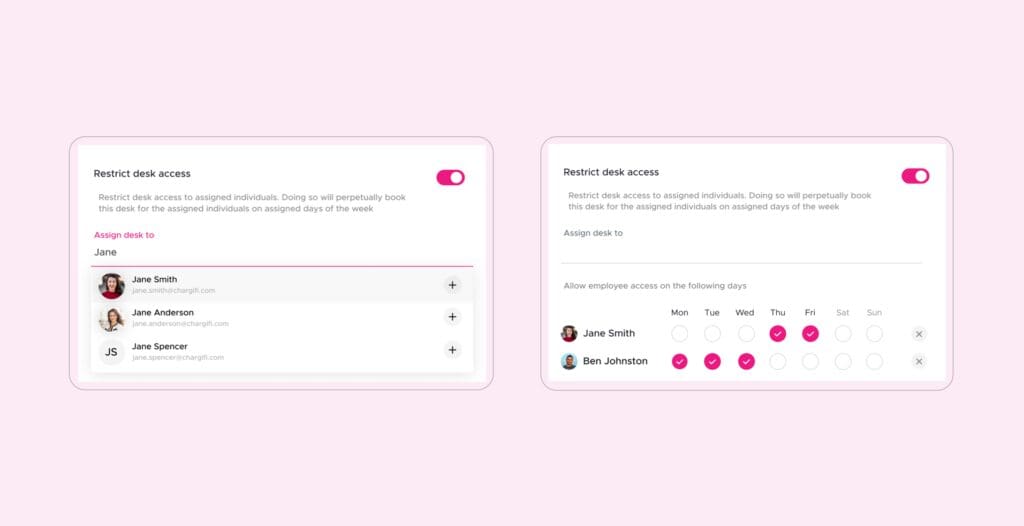
Assigned Desks let a manager give a team member a specific desk on specific days of the week. The person did not need to book in advance; they could simply arrive and check in to their desk. Everyone could see who was sitting where on any given day, and unused assigned desks could be given to someone else.
Picture the experience the feature was designed for. It is Monday morning, and you do not need to book a desk because your manager has already assigned you one you use regularly. You pick up coffee for the teammates you know will be sitting near you, meet them at the door, and all check in to your desks.
What are the benefits of assigned desks for hybrid teams?
Assigned desks give people a guaranteed place to work and a familiar group around them, which makes office days easier to plan and more worthwhile. They also give workplace teams clearer visibility of who is on site. The benefits fall into three areas: visibility, connection between coworkers, and a more organized workspace.
Visibility of who is sitting where
With assigned desks, everyone can see who is working where on any given day. Coworkers can find friends who are sitting nearby, and facility managers get a clearer picture of how spaces are used. Knowing exactly who is on site also matters in an emergency. For employees, it means a guaranteed space to do their best work.
Deeper connections with coworkers
One of the main reasons people come into the office is to connect with colleagues. Assigning desks to team members on specific days creates regular touch points: people sit near the same teammates, with the amenities they need, on a consistent basis. Those repeated contacts help build working relationships and a shared sense of mission.
A more organized workspace
For office and facility managers, assigned desks remove much of the confusion of hot desking. In 2022, Kadence let managers share desks of their choice among any team members on any day of the week. If someone did not show up, the desk could go to another person or be released back into the system for anyone to book.
How do assigned desks improve space utilization data?
Assigned desks make occupancy data more accurate because the system knows who is expected where. People with assigned desks know where they sit, and people who book flexibly know which desks they can and cannot use. That reduces booking conflicts, and cancellations free desks to reassign ahead of time, so usage data reflects how the office is really used.
Accurate data matters beyond the day-to-day. It supports decisions on repurposing space and cutting costs, and it can inform a hybrid policy that works for both the organization and its people. For the wider picture, see the guide to hybrid work strategy, and for managing desks across a portfolio, see Kadence space management.
Frequently asked questions
Can assigned desks and hot desks work in the same office?
Yes. A hybrid office can assign desks to people with a regular rhythm and keep other desks bookable for people who come and go. Kadence’s Assigned Desks, launched in November 2022, was designed for this mix.
What happens to an assigned desk when the person does not come in?
In the 2022 launch, a manager could give the unused desk to someone else or release it back into the system so any team member could book it. People could also cancel ahead, so the desk could be reassigned in advance.
How do I decide who should get an assigned desk?
Talk to managers and team members, then review booking data. People who come in on the same days, sit with the same teammates and book the same spaces are the strongest candidates. People who visit occasionally may be better served by bookable desks.
Do assigned desks help with workplace data?
Yes. Because the system knows who is expected at each desk, occupancy data is more accurate and booking conflicts fall. That data can inform decisions on repurposing space, cutting costs and shaping hybrid policy.