When people hear that we’re building an AI-powered platform for space planning, the assumption is often that the hardest part is the technology itself.
What we’ve found is that the technology is rarely the constraint. The real challenge has been deciding where intelligence genuinely adds value, where it introduces risk, and how to design a system that supports better decisions without creating a false sense of certainty.
As SpaceOps has taken shape, much of that learning has come from watching Rory, our Machine Learning Lead, demo the platform live with customers. Modelling real portfolios, testing scenarios in real time, and stress-testing assumptions has surfaced patterns that are hard to see in theory. What follows reflects those moments and the lessons they’ve revealed.
From Chaos to Intelligence, Not Control
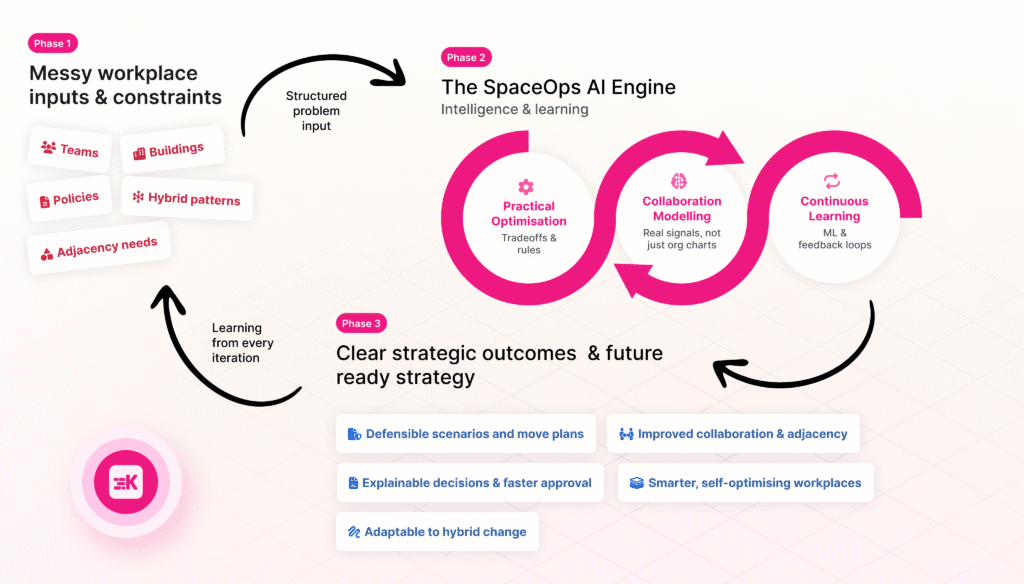
The starting point for most space decisions is messy by default. Teams overlap in ways that don’t show up on org charts, attendance fluctuates regardless of policy, and buildings carry constraints that only surface once change is underway. Even small adjustments tend to create knock-on effects elsewhere, which is why space planning so often feels harder than it should.
Early on, we realised that the goal of SpaceOps couldn’t be to eliminate this chaos. Instead, the system needed to absorb it, structure it, and make it intelligible. Intelligence, in this context, isn’t about enforcing control. It’s about translating a complex set of inputs into scenarios leaders can reason about.
That shift becomes tangible during live demos, when leaders can see how different priorities affect outcomes and where trade-offs begin to emerge.
Choosing What Not to Optimise
On paper, optimisation problems tend to look clean. You define the objective, apply the model, and arrive at an answer.
Workplaces don’t behave that way. Every space decision sits between competing forces, and optimising too aggressively for one almost always degrades another. Cost efficiency, collaboration, disruption, fairness, and speed all matter, but rarely in equal measure at the same time.
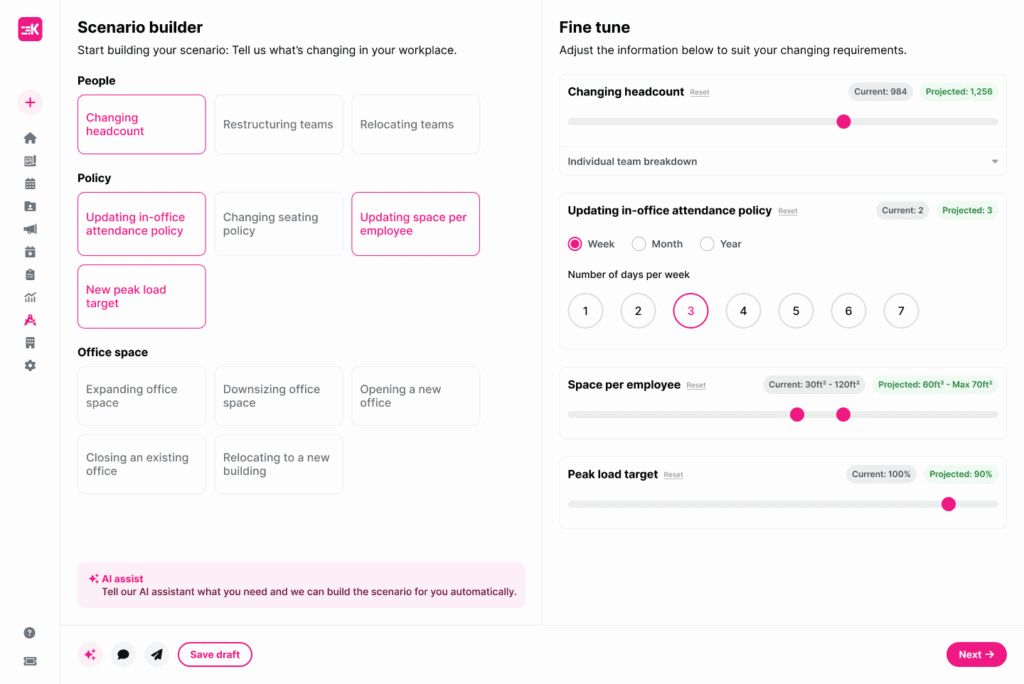
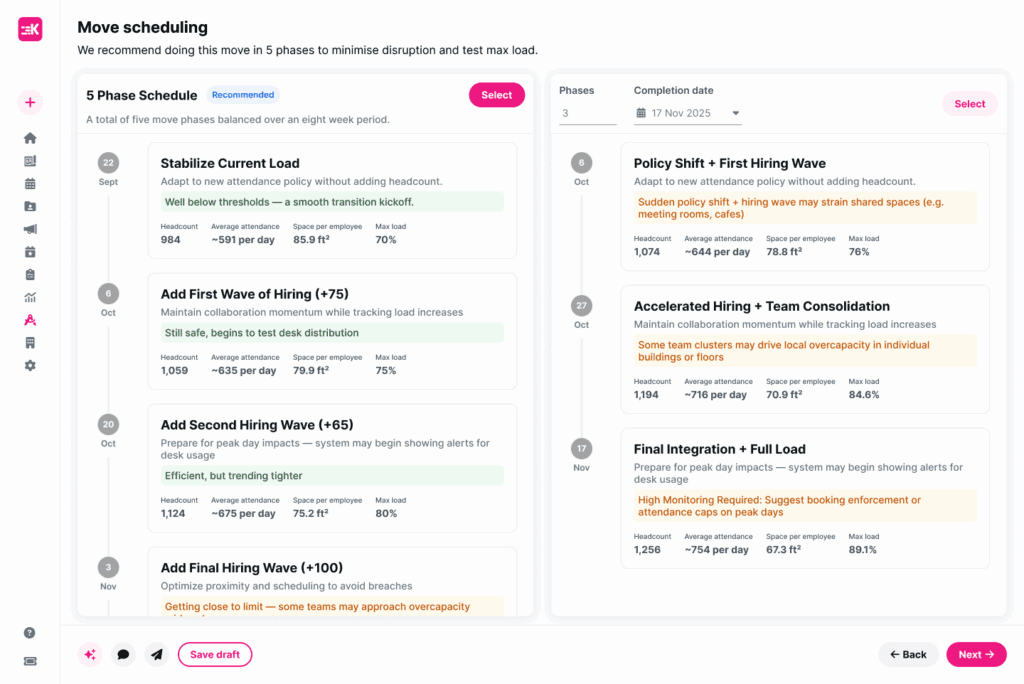
As Rory walks teams through scenarios, this is often where the conversation changes. Rather than asking for “the best plan,” leaders start asking what happens if they act earlier, sequence moves differently, or prepare for growth instead of reacting to it.
What we’ve learned is that intelligence is most useful when it helps leaders understand timing and consequence, not just layout efficiency.
There Are No Right Answers, Only Defensible Ones
As we’ve worked with customer teams, a consistent pattern has emerged. Different parts of the organisation are often optimising for different outcomes at the same time, and those priorities don’t always align neatly.
What SpaceOps does in those moments is make the tension visible. When leaders can see the implications of prioritising collaboration over consolidation, or speed over stability, the conversation shifts. Decisions stop being about approval and start becoming about exploration.
That reaction comes through clearly when teams see the modelling in context. The value isn’t that the system tells leaders what to do. It’s that it gives them a way to reason through trade-offs with confidence.
What We’re Learning About Real Workplace Behaviour
Building in public also means being honest about what the data is teaching us.
Some assumptions we expected to hold have proven weaker than anticipated. Org charts, for example, describe reporting lines, but they rarely capture how work actually flows day to day. Patterns of collaboration tend to emerge from behaviour rather than structure, and proximity often matters more for small, highly interactive groups than it does for larger teams.
These insights tend to resonate most when leaders can see collaboration patterns shift as scenarios change.
Hybrid attendance has also challenged expectations. Behaviour often stabilises over time, but not always in line with written policies. Patterns do emerge, just not always the ones organisations expect to see on paper.
We’ve also learned that not all underutilised space is wasted. In many portfolios, some slack exists as a buffer that absorbs growth, change, and variability. Removing it too aggressively can make the system more fragile, even if utilisation metrics improve in the short term.
What these observations reinforce is the need for systems that reflect behaviour rather than assumptions, and for intelligence that remains adaptable as those behaviours continue to evolve.
Why Humans Stay in the Loop
One of the most deliberate choices we’ve made with SpaceOps is keeping people firmly involved in the decision-making process.
Moves affect trust. Seating changes reshape working relationships. Space decisions send cultural signals that can’t be fully captured by a model. While fully automated decisions might be faster, they also introduce risk that’s difficult to unwind.
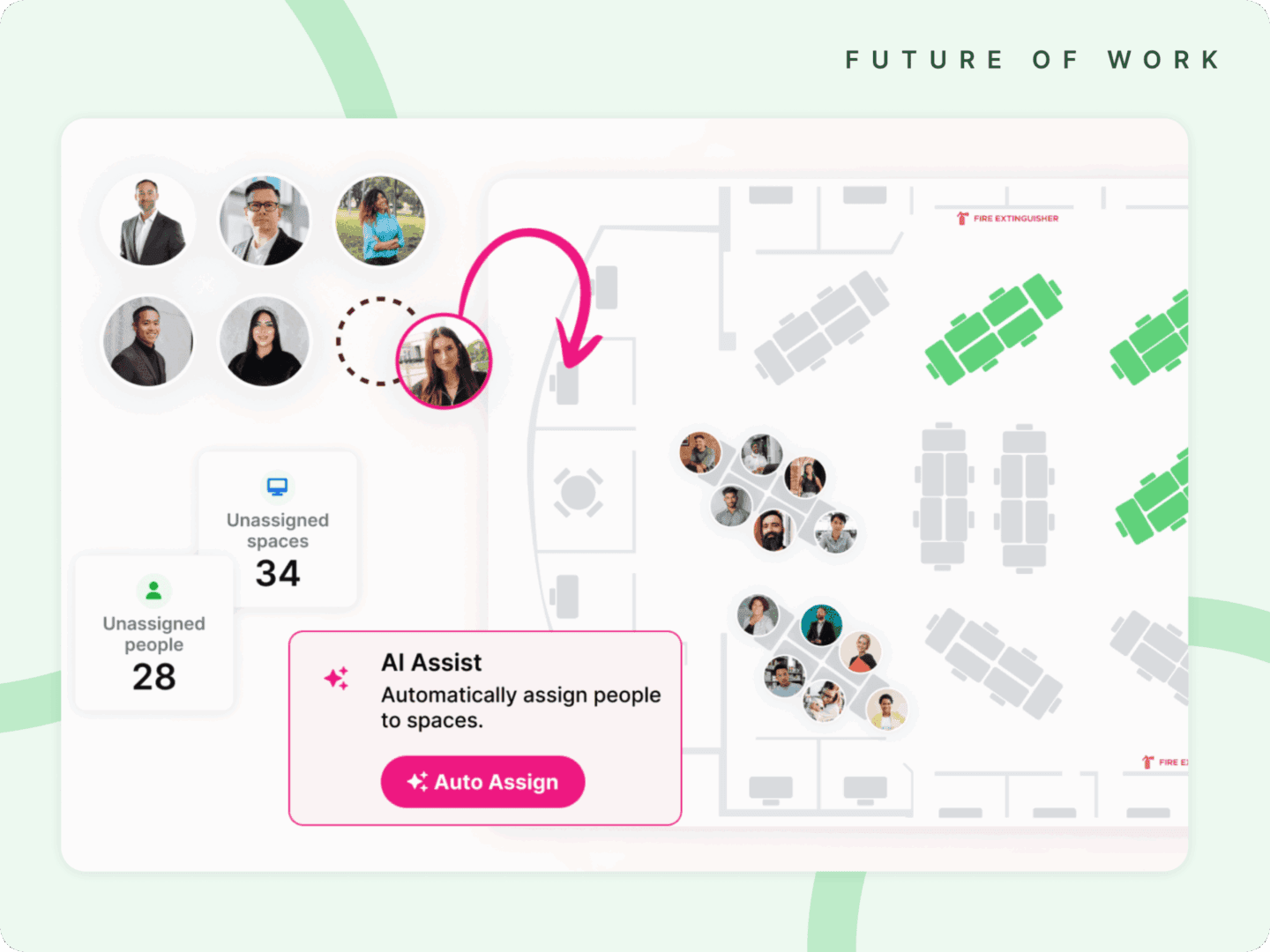
Instead, SpaceOps supports scenarios, stack planning, and move management as connected steps in a single process. Leaders can see how a strategic decision flows into a physical layout and how that layout translates into real moves on the ground.
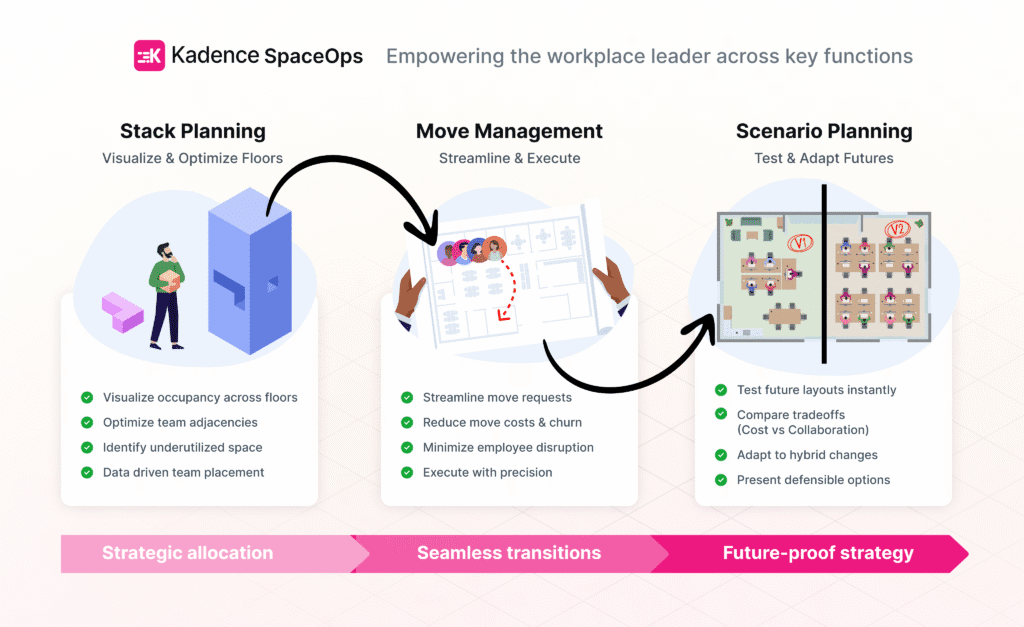
This balance becomes clear during demos, when teams realise they can test ideas without committing to them.
The system structures the problem and surfaces the implications, but the decision itself remains with the people accountable for the outcome.
The Trade-Offs We’re Still Working Through
Some of the most important work happening right now isn’t about adding new capabilities. It’s about navigating ongoing design tensions.
We spend a lot of time debating how quickly moves should be executed without creating unnecessary disruption, where flexibility starts to tip into instability, and how much autonomy teams should have before portfolio-wide consistency begins to break down. These aren’t questions with final answers. They’re tensions that need to be managed continuously as organisations change.
SpaceOps is being built to surface these trade-offs rather than hide them, and to evolve as organisations’ answers evolve over time.
What This Means for Leaders Using SpaceOps
For leaders using SpaceOps today, this approach creates a different experience from traditional workplace tools.
Decisions feel less brittle because multiple paths are visible. Trade-offs are explicit rather than implicit. Plans are easier to explain, defend, and adjust as conditions change.
Rather than being asked to trust a system’s output, leaders can see the reasoning behind it, apply their own judgment where it matters, and move forward with greater confidence.
Why We’re Building This in Public
Workplace strategy is changing faster than the systems designed to support it. Hybrid work, shifting expectations, and economic pressure have made space decisions more visible and more consequential than ever.
By building SpaceOps in public, we’re making our thinking visible, learning alongside customers, and shaping the system around real-world use rather than hypothetical perfection.
This isn’t about showing everything. It’s about being clear about what we’re learning, what we’re still working through, and why those choices matter.
If you’re grappling with questions around consolidation, growth, hybrid strategies, or complex moves and want to understand how this kind of intelligence applies to your portfolio, we’d love to show you.
You can book a demo with our workplace operations experts to see how teams are using real occupancy data and scenario planning to make better space decisions, faster.