Over the past year, enterprise leaders have heard a consistent promise about AI: productivity will surge. And in many ways, it has.
AI copilots draft reports in seconds. Financial models that once took weeks can now be produced in hours. Developers are shipping code faster. Analysts can summarize complex datasets almost instantly. Across industries, AI is compressing work cycles.
PwC engineers recently demonstrated an AI agent capable of handling enterprise-scale spreadsheets, dramatically accelerating financial modeling processes that traditionally required extensive manual effort. Enterprise software vendors are embedding AI directly into productivity ecosystems such as Google Workspace and Slack, integrating automation into everyday workflows.
Organizations are also beginning to treat AI capability as a core leadership skill. Accenture recently linked promotion criteria to employees’ use of AI tools, signaling how quickly the technology is becoming embedded in performance expectations.
Productivity is rising. Teams are completing tasks faster and generating more output than before. But business performance is not improving at the same pace. Revenue growth, operational efficiency, and decision velocity often lag behind the surge in activity.
Work is accelerating, but coordination is becoming more complex, making it harder for organizations to translate productivity into measurable outcomes. This gap is beginning to define the next phase of the AI transformation.
AI Adoption Is Outpacing Operational Change
Many organizations have embraced AI experimentation. Tools are being deployed across departments, integrated into workflows, and tested in everything from customer support to financial forecasting.
Turning those experiments into measurable business performance is proving far more difficult.
A recent survey of enterprise leaders found that while most organizations are exploring AI tools, far fewer have integrated them into core operating models or established clear ways to measure ROI.
Research from McKinsey reinforces the gap. Despite rising investment in AI, only a small share of companies believe they have reached maturity in how the technology is deployed across the business.
The technology is advancing quickly. Organizational systems are not evolving at the same pace.
AI Is Changing The Shape Of Work
The real impact of AI is not just faster task completion. It is changing how work is structured.
Teams iterate more quickly. Decision cycles shorten. Smaller groups are expected to deliver larger outcomes. Work moves fluidly between individuals, functions, and departments.
As routine tasks become automated, employees spend more time interpreting information, coordinating decisions, and collaborating with others. The nature of work shifts from execution toward judgment.
This creates very different operating conditions inside organizations. Work becomes less predictable, more collaborative, and more dependent on rapid alignment between teams.
Most enterprise systems, however, were designed for a slower rhythm of work.
The Productivity Paradox
This is where the AI productivity paradox begins to appear.
Employees complete tasks faster, but decision bottlenecks remain. Collaboration friction persists. Resources are allocated using planning cycles that cannot adapt quickly enough to changing work patterns.
Across many organizations the underlying infrastructure still reflects an earlier era of work:
- planning cycles built around quarterly timelines
- workforce planning processes that struggle to adapt to dynamic teams
- disconnected systems across HR, finance, and workplace operations
- real estate strategies based on static assumptions about how people work
AI accelerates execution. But the systems surrounding work often remain fixed.
The Workplace Is One Of The Biggest Gaps
The physical workplace illustrates this challenge clearly.
Collaboration patterns are evolving rapidly. AI allows individuals to complete more tasks independently, but complex work increasingly requires teams to gather, evaluate information together, and make decisions quickly.
Project groups assemble and dissolve more frequently. Cross-functional collaboration is becoming more common. Leadership teams need faster alignment across the organization.
Yet many workplaces are still managed through static planning models. Leaders often lack visibility into questions that have become strategically important:
- Which teams collaborate most effectively in person?
- Where does physical proximity accelerate decision making?
- How should space be allocated as teams evolve?
- Which environments actually support high-performance work?
Without reliable data, workplace strategy becomes disconnected from how work is actually happening.
Space Ops Aligns The Workplace With Modern Work
Capturing the full value of AI requires more than deploying new tools. Organizations also need to modernize the operational systems surrounding work, including how the workplace is managed.
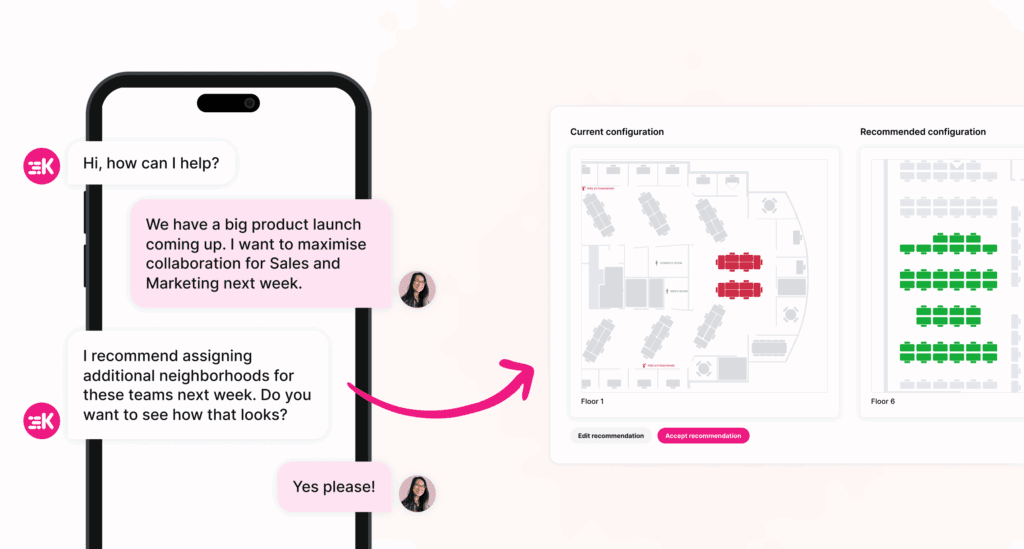
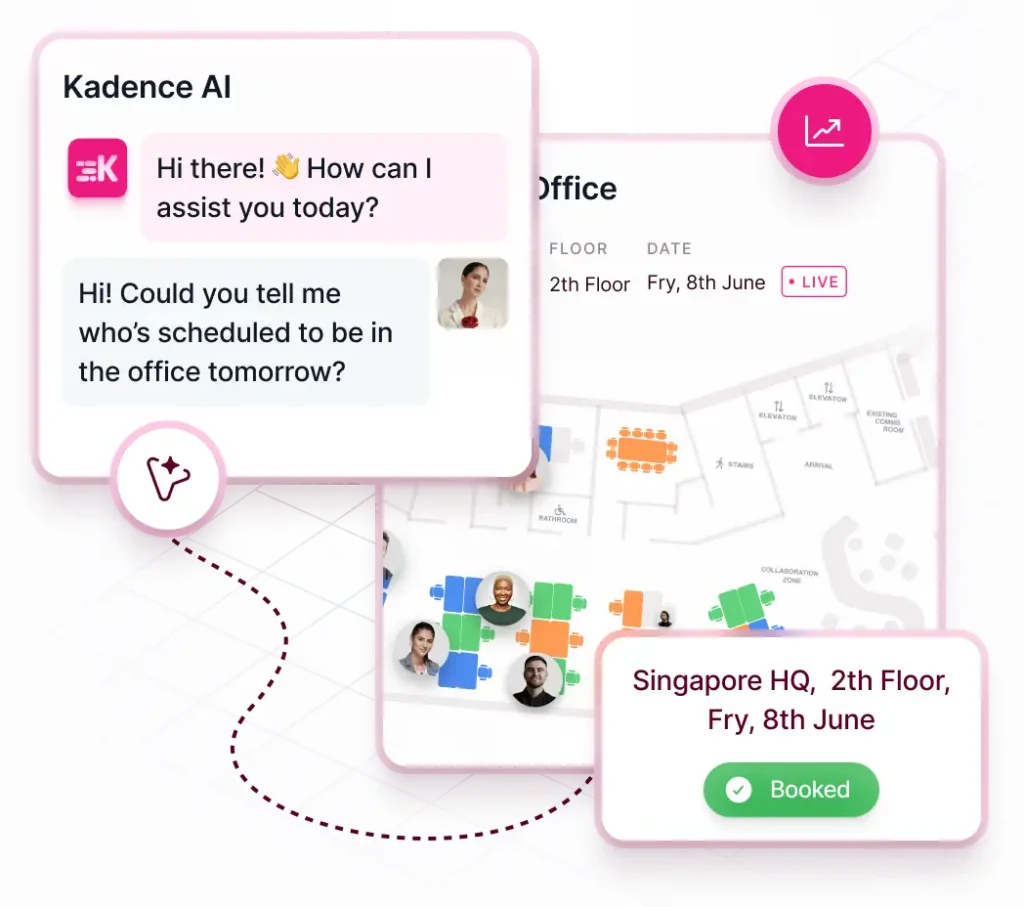
Space Ops provides the intelligence layer that connects workforce activity, collaboration patterns, and physical environments.
Instead of relying on static assumptions, organizations can use Space Ops to understand how space supports real collaboration and business outcomes.
A modern Space Ops approach enables organizations to:
- align team presence intentionally to maximize collaboration
- model workplace scenarios before making real estate decisions
- identify underutilized or inefficient space allocations
- support faster decision making about workplace strategy
- connect workplace data to broader performance metrics
The workplace becomes part of the operating system of the business rather than a passive backdrop.
The Next Phase Of AI Transformation
Artificial intelligence is already changing how work gets done.
But productivity gains alone do not guarantee better business outcomes. Organizations that succeed in the AI era will go beyond adopting new technologies. They will redesign the systems that support collaboration, decision making, and execution.
That includes the workplace.
Companies that treat space as static inventory will struggle to keep pace with faster, more dynamic work patterns. Those that treat the workplace as operational infrastructure will be better positioned to translate AI-driven productivity into real business performance.
If your organization is exploring how AI will reshape the future of work, it is equally important to consider whether your workplace operations are ready to evolve alongside it.
Book a demo with our workplace operations experts to see how Kadence helps enterprises design smarter, more adaptive workplaces for the AI era.