If you wanted evidence that AI in the enterprise workplace has moved beyond experimentation, you didn’t have to look far this past week.
Accenture announced that it is linking employee promotions to AI tool usage, signaling a structural shift in performance expectations. AI literacy is no longer a technical skill reserved for innovation teams. It is becoming a leadership competency.
At the same time, PwC engineers launched an AI agent capable of processing enterprise-grade spreadsheets, dramatically reducing the time required for complex financial modeling. What previously took weeks of manual work can now be completed in hours.
Meanwhile, the EU Parliament restricted certain built-in AI features on official devices due to data security concerns, underscoring that governance and operational risk are now central to AI deployment discussions.
Across corporate real estate, leaders are actively exploring what an “AI-friendly workplace” actually means in practice.
These examples reflect operational decisions being made now, in real time, at enterprise scale. AI is influencing promotion frameworks, accelerating financial workflows, triggering regulatory scrutiny, and reshaping how leaders think about infrastructure. Investment is rising. Expectations are shifting. Work itself is being redesigned.
But there is a structural blind spot emerging inside many organizations.
Digital workflows are accelerating. The physical workplace is not.
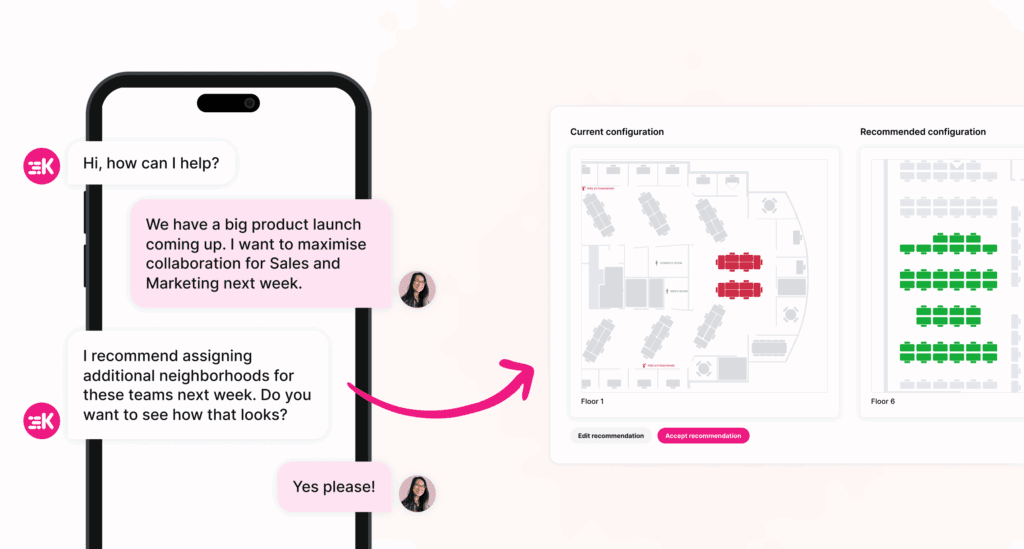
AI Is Changing The Rhythm Of Work
Research from McKinsey shows that nearly all organizations are increasing AI investment, yet only a small fraction believe they are mature in their implementation. The gap is not about tools. It is about integration.
Gartner has urged leaders to create deliberate human-AI collaboration models rather than layering AI onto outdated operating structures.
Taken together, the message is clear: AI is not just increasing productivity. It is compressing decision cycles, redefining team responsibilities, and altering collaboration dynamics.
When AI tools accelerate content creation, forecasting, coding, or analysis, teams iterate faster. Strategic pivots happen more frequently. Cross-functional collaboration becomes more fluid. Organizational structures evolve more quickly.
The speed of work increases.
However, the physical workplace often remains governed by:
- Quarterly or annual planning cycles
- Static headcount-to-desk assumptions
- Manual move coordination processes
- Reactive occupancy reviews
- Disconnected systems across HR, IT, and real estate
This misalignment is becoming harder to ignore.
If digital systems are adapting in real time while space strategy adjusts once or twice a year, friction is inevitable. Cost inefficiencies persist. Collaboration mismatches go unresolved. Leadership decisions are made without full operational visibility.
The AI transformation conversation is incomplete if it excludes the physical layer of work.
The Workplace Is Becoming Strategic Infrastructure
For years, debate centered on where people should work. That framing no longer captures the real issue.
The more urgent question is how the workplace functions as infrastructure inside an AI-accelerated enterprise.
Real estate remains one of the largest expense categories after payroll. At the same time, AI is increasing variability in work patterns. Teams assemble and disband faster. Project cycles shorten. Collaboration spikes are less predictable.
PwC’s recent analysis of AI in real estate highlights how property strategy is beginning to incorporate predictive analytics and automation into asset management decisions.
But experimentation with AI tools in isolation does not solve the core operational challenge.
Enterprises need a system that connects workplace signals to business performance. They need a way to translate messy, real-world constraints into defensible, strategic decisions.
This is where Space Ops becomes critical.
Space Ops Is The Operational Layer AI Has Exposed As Missing
Every modern enterprise has invested in digital operating systems:
- HR systems to manage people
- Finance systems to manage capital
- CRM systems to manage revenue
- IT systems to manage cloud infrastructure
Yet few organizations have an integrated operational layer for physical space. Space Ops fills that gap.
Rather than treating the workplace as static square footage, Space Ops treats it as a dynamic, data-driven asset that responds to real-time signals.
Consider the inputs most workplace leaders manage daily:
- Team structures
- Building portfolios
- Hybrid patterns
- Policy constraints
- Adjacency requirements
- Cost targets
These inputs are often fragmented across spreadsheets, floor plans, and disconnected tools. Decisions are made through manual tradeoff analysis.
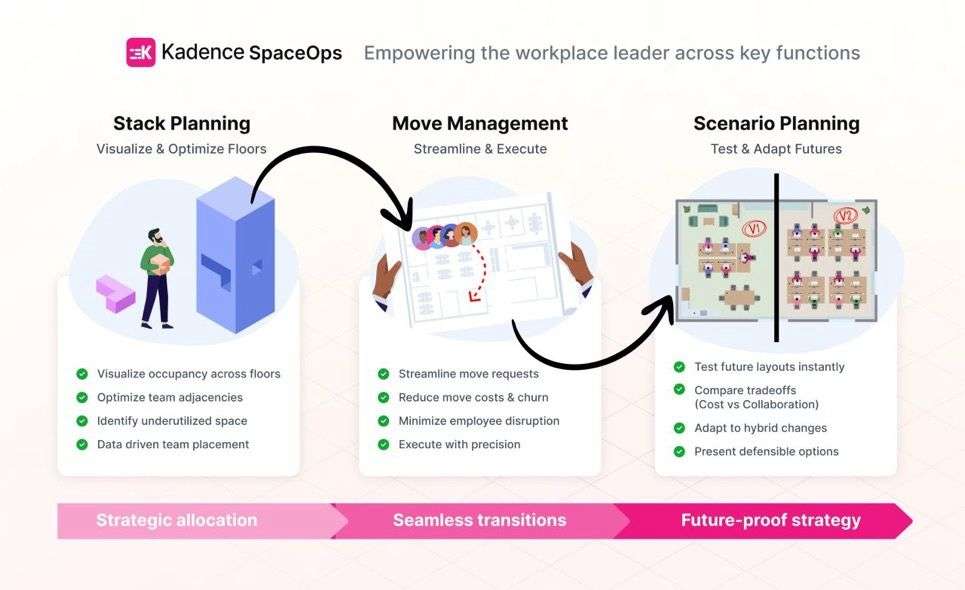
An AI-powered Space Ops engine structures this complexity. As illustrated in the image above, messy workplace constraints feed into an intelligence layer that applies practical optimization, collaboration modeling, and continuous learning.
Instead of generating simple occupancy charts, the system evaluates real collaboration signals. It models tradeoffs between cost and connection. It learns from every move, every reconfiguration, every pattern shift.
The outcome is not just insight. It is strategic capability.
An AI-driven Space Ops platform enables organizations to:
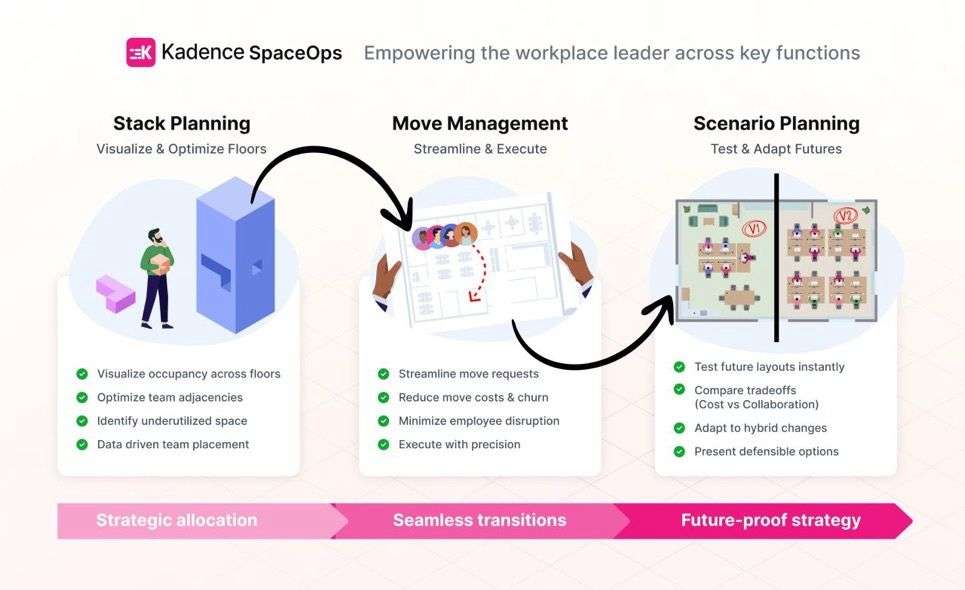
- Visualize and optimize stack planning across floors and portfolios
- Identify underutilized space with defensible data
- Model future layouts instantly and compare cost-versus-collaboration tradeoffs
- Streamline move management while minimizing disruption
- Generate scenario plans that accelerate executive approvals
- Continuously learn and adapt to hybrid and organizational change
This is how the workplace becomes adaptive infrastructure rather than reactive inventory.
AI Is Not Replacing People. It Is Raising The Bar For Operations.
There is understandable concern about AI replacing roles. Yet most enterprise research, including analysis from the World Economic Forum, emphasizes that long-term value depends on integration, governance, and human oversight.
AI amplifies output. It increases expectations. It accelerates iteration. But it also increases operational complexity.
Leaders now face higher standards:
- Faster execution cycles
- Tighter cost scrutiny
- Greater transparency expectations
- More dynamic workforce patterns
Without intelligent Space Ops, the physical workplace becomes the bottleneck.
The organizations that thrive in the AI era will not simply deploy copilots. They will align digital acceleration with physical adaptability. They will treat real estate decisions as strategic, data-driven, and continuously optimized.
The question is no longer whether AI will reshape work. That is already happening. The question is whether your workplace infrastructure is ready to keep pace.
If you are evaluating how AI fits into your broader enterprise strategy, it is time to examine how your Space Ops capability supports it. Book a demo with our workplace operations experts to see how Kadence helps organizations design adaptive, self-optimizing workplaces built for the AI era.