I spent an hour last week with twenty workplace and real estate leaders from Europe and North America, along with Brian Elliott, CEO of Work Forward and executive-in-residence at Charter. He’s also an advisor and investor in Kadence.
A few things are worth carrying back to your teams.
Cutting Isn't Redesigning
Most of what’s being called AI transformation right now is the same structure with fewer people in it, and AI handed to whoever’s left to hit the same numbers.
By the time that reaches anyone in this group, it’s a directive about square feet.
Brian’s counter-example was Zapier. Their customer service lead spent a year working directly with her team to find where AI genuinely helped and where it didn’t. That meant rebuilding the work, including the staffing model and the job descriptions. Average handle time halved, and compensation moved from the 50th to the 90th percentile, because they decided the people who created the gain should get some of it.
Klarna went the other way, announced AI doing the work of 700 agents, then told Bloomberg a year later that they’d focused too much on cost, quality had dropped, and they were hiring humans again.
Real change comes from the teams closest to the work. Not from an edict.
The Poll Named the Real Tension
The biggest pain point the group flagged was that space decisions still follow headcount rather than how people actually work.
That gap is getting harder to close, not easier. JLL’s 2026 Future of Work Survey has 78% of senior leaders expecting AI to significantly change their portfolio strategy, 31% actually preparing to redesign space for it, and 15% at the optimizing stage. For the first time in fifteen years of that research, what’s holding people back isn’t budget. It’s skills.
Meanwhile executives want workforce and workplace plans on a three month cycle, and your estate moves on a ten year one. You can’t make three month iterations against a ten year lease.
Which is why the theory keeps losing to the building.
At the scale he’s working at, with multi-year contracts and thousands of properties, that’s not cynicism. There’s an enormous amount of money and a very long contract sitting between the theory and Tuesday morning.
A space planner at a data and analytics company named the flip side. Build the flexible space, watch it sit empty, cut it out, then field the complaints the next time somebody can’t get a room. Usually because they went looking at 9:59 for a ten o’clock meeting.
Her team plays desk tetris on behalf of everyone else’s planning, and the circle starts again, because nobody has a reliable read on how the space was really used before the next decision lands.
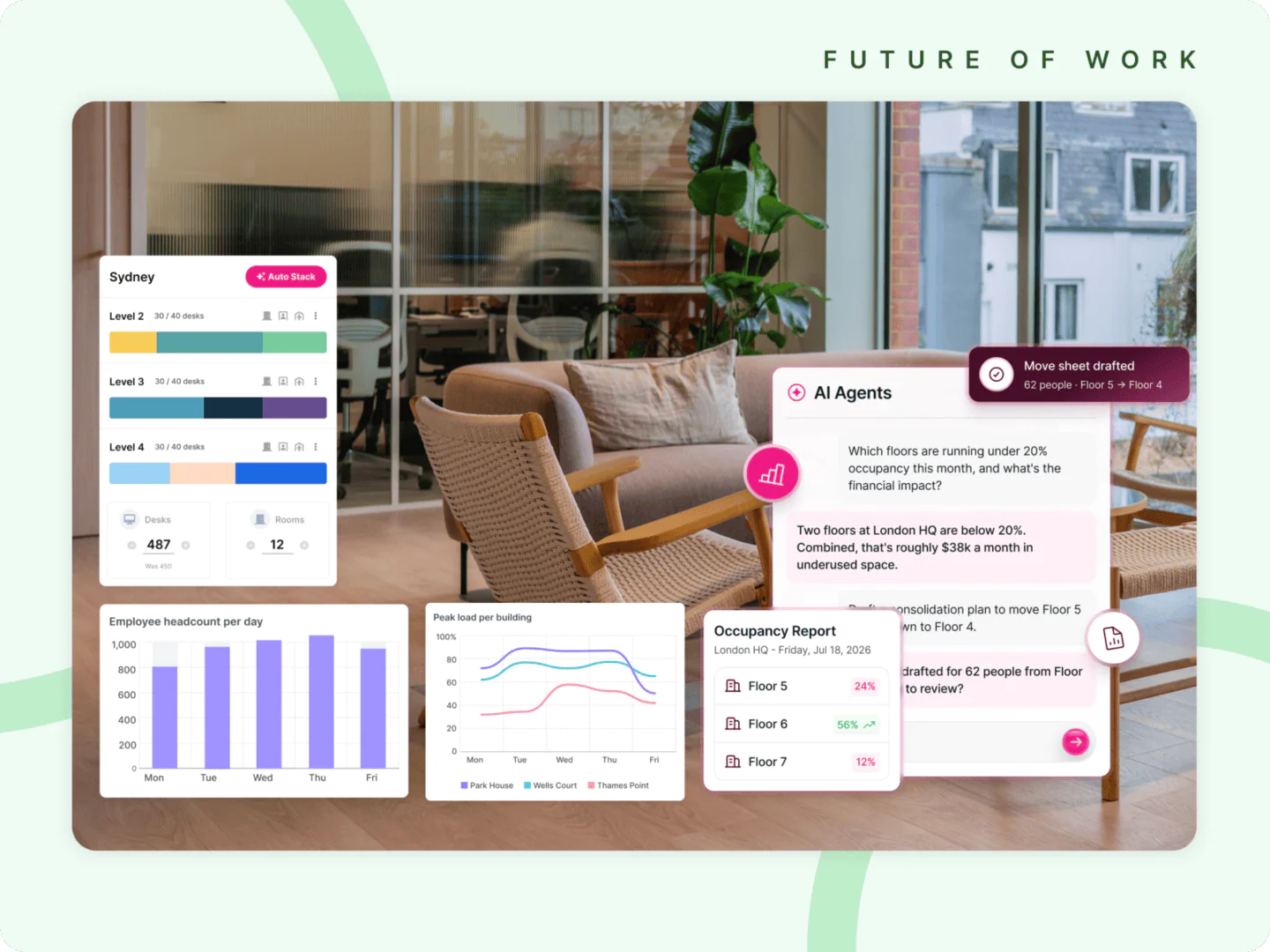
Closing that gap is most of why we built SpaceOps.
There's No Single Fix
What came through clearly is that this group is dealing with opposite versions of the same problem.
Some have built real mechanisms for user input. Committees, surveys, ongoing engagement with occupiers. Design input sits with the people in the building and the money calls sit with the people who own the money, and that separation works.
Others have the inverse.
Her senior leadership is genuinely hands off and happy to defer to a decision backed by data. The friction runs upward instead, out of a collaborative culture where people expect a say in anything that affects them.
The framing that held both together came from a head of workplace experience engineering at a global bank. Everyone in this role is standing on a seesaw, balancing pressure from several directions at once, and everybody’s is weighted differently. At real scale there’s only so far collaboration goes before somebody has to hold the line.
I made the same point to my eight year old two nights ago during an allowance negotiation, which suggests managing expectations doesn’t change as much between a kid and an enterprise portfolio as any of us would like.
For This Quarter
Brian’s advice was refreshingly unglamorous.
Use the AI tools yourself before you ask your team to, and be honest with them about where you’re still figuring it out.
Then bring employees into the design process itself, rather than asking for feedback after it’s built. Drawing on Janet Pogue McLaurin’s research at Gensler, his point is that people who help shape a space understand the trade offs behind it, not just how to use it.
And it’s worth remembering that we’re all operating with ancient brains, medieval institutions and godlike technology. E.O. Wilson said that back in 2009 and it’s aged in the wrong direction.
If you want more of Brian’s thinking, his newsletter Work Forward is where the research behind this conversation lives, including what’s coming in October on managers and AI adoption.
And if you’re building a plan that has to survive the executive above you and the people who use the space below you, book a demo with our workplace operations team.