
According to The Broken Ladder, a study of hiring in the US, UK, Canada and Australia covered here in June 2026, the junior hiring decline may be mainly a workplace operations problem rather than an AI problem. When the researchers tested generative AI and working from home together, the AI effect collapsed toward zero and the remote work effect held.
If that reading is right, the fall in early-career hiring is not happening to organizations but inside them, and better management of hybrid work can fix it.
What is the junior hiring decline?
The junior hiring decline is the sharp fall, since late 2022, in the share of new hires going to early-career workers across the US, UK, Canada and Australia. The drop is between 8 and 11 percentage points, depending on the country. It raised a hard question for employers: who will become the experienced talent of the future?
Early-career workers are people at the start of their working lives, typically hired for their potential as much as for their current output.
The explanation that took hold first was clean and urgent. Generative AI had arrived, and firms no longer needed junior workers for the routine cognitive tasks they were once hired to do. LinkedIn’s chief economic opportunity officer described it as the bottom rung of the career ladder breaking. Stanford economists documented a 16 percent relative employment decline for workers aged 22 to 25 in AI-exposed roles. A consensus formed quickly. The Broken Ladder argues that consensus is premature.
What did The Broken Ladder study find?
The Broken Ladder found that remote work, not generative AI, is the main driver of the junior hiring decline. It tested both explanations at the same time. Measured alone, each looked plausible. Estimated together, the AI effect collapsed toward zero, while the effect of working from home held.
The Broken Ladder: AI, Remote Work, and Early-Career Hiring is by Peter Lambert of Warwick and LSE and Yannick Schindler of Oxford’s Ellison Institute of Technology. It draws on 243 million new hire records and 407 million online job postings collected across the US, UK, Canada and Australia from 2017 to 2025.
The reason is a correlation most earlier studies missed. The occupations most exposed to generative AI are almost exactly the occupations that shifted most heavily to remote work after the pandemic:
- High on both lists: software developers, data scientists, financial analysts, management consultants.
- Low on both lists: electricians, construction workers, janitors.
Across 683 occupations, the rank correlation between remote work (WFH) exposure and AI exposure is 0.77. Studies that controlled only for AI exposure were, without meaning to, measuring the effect of remote work.
One detail adds weight. Lambert co-authored the research behind the WFH exposure index this paper depends on, one of the most widely used measures of remote work adoption.
Why does remote work reduce junior hiring?
Remote work reduces junior hiring because it weakens the investment case for early-career employees. Firms hire junior workers expecting them to learn fast and grow into senior talent, at a manageable supervision cost. When teams are dispersed, feedback slows and each junior hire takes more senior time, so firms shift hiring toward experienced candidates.
Remote and hybrid work put pressure on both parts of that model:
- Slower feedback. Research by Emanuel, Harrington and Pallais found that physical proximity to colleagues significantly increases developmental feedback for junior employees, with the largest gains for the youngest workers.
- Less contact with managers. Aksoy and colleagues found that even one day a month in the office, compared with fully remote work, raised productivity and communication between workers and their managers.
- Higher supervision cost. Each junior hire places a greater demand on senior time when oversight has to happen at a distance.
The paper tested this directly. Firms that adopted remote work in 2021 to 2022, matched against comparable organizations, later shifted hiring toward more experienced candidates, even after controlling for AI exposure.
Why is this a workplace operations problem?
It is a workplace operations problem because the cause sits inside the organization. If AI were replacing junior workers, the only tools would be blunt ones outside a company’s control. If remote work is the main driver, the frictions around supervision, mentoring and on-the-job learning can be managed through how teams schedule, meet and use the office.
If AI is the cause, the available responses are wage subsidies, policy intervention and structural redesign of roles. If remote work is the cause, the problem is operational: it belongs to organizations that have not yet adapted their management practices to hybrid work.
Workplace operations is the day-to-day coordination of people, space and time: who comes in, when, where they sit and who they work alongside.
What questions should leaders ask about early-career employees?
Leaders should ask whether early-career employees get meaningful in-person time with the senior colleagues who develop them, and whether attendance patterns create the conditions for learning or simply fill a headcount requirement. Without reliable answers, organizations manage their future senior talent pipeline blind.
Two more questions help:
- Are your most junior hires in the office on the same days as their managers, or arriving on different days from the people responsible for their development?
- Is your hybrid strategy built on data about how your teams actually work, or on assumptions made when the policy was first written?
For practical ways to bring the right people together on the same days, see the guide to bringing teams together.
How can data help protect junior talent in hybrid work?
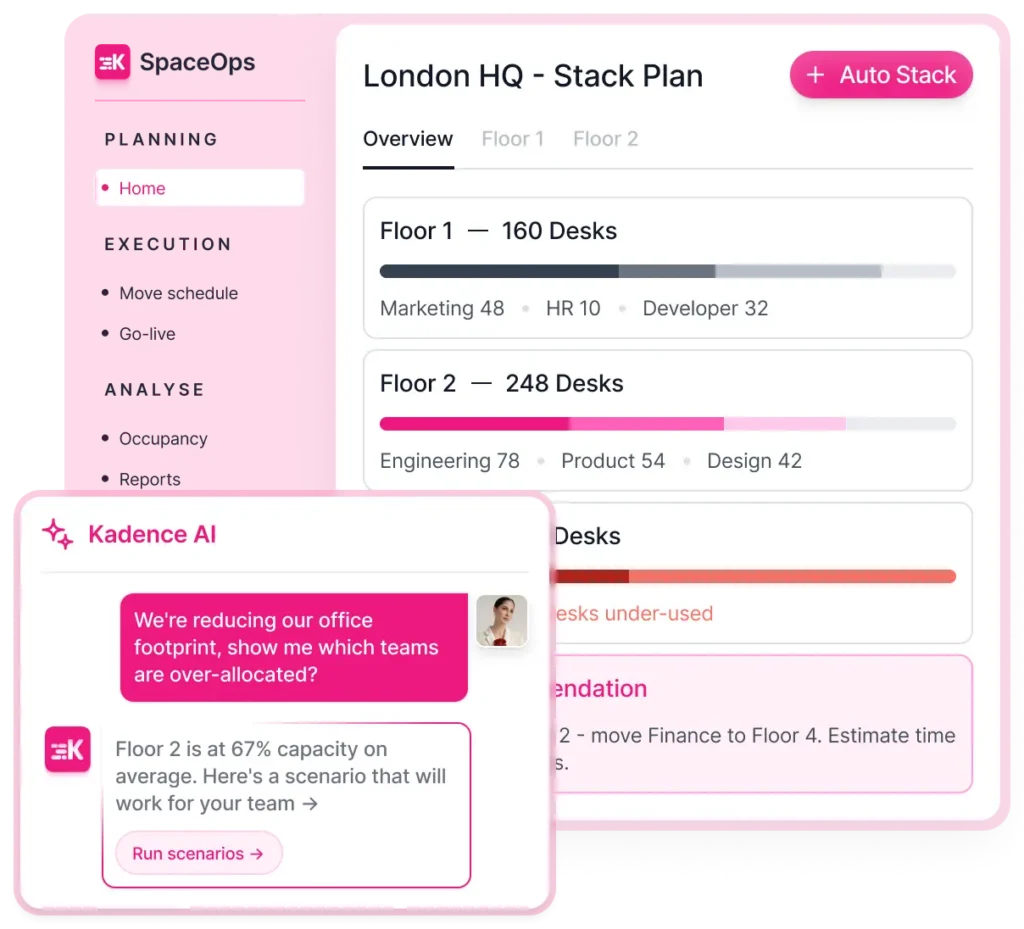
Data helps by showing whether hybrid attendance actually supports early-career development. Workplace leaders can see which teams overlap in the office, whether junior and senior employees are there on the same days, and whether patterns reflect genuine collaboration or coincidental presence. That turns a vague worry into something they can measure and manage.
Kadence gives workplace operations leaders this behavioral data through its workplace analytics, so they can check whether the right people are in the office together.
The goal is not to reverse the flexibility employees value; the research is clear that returning to pre-pandemic arrangements is neither realistic nor desirable. The goal is hybrid work designed well enough to preserve the investment case for junior talent. The paper’s authors describe their finding as cause for hope. In their words:
WFH delivers substantial benefits to workers and firms, and the organizational frictions it creates around supervising and developing early-career workers are surmountable.
Surmountable problems have operational solutions, and operational solutions sit inside the organization.
What is the strategic advantage for employers?
Employers that learn to develop early-career talent inside hybrid structures will do more than repair a damaged pipeline. They will build a structural advantage over competitors still waiting for the technology story to resolve itself, because most of what looks like AI displacement may be a management problem.
The ladder is not broken. The management practices around it need to catch up. For how AI is actually changing work, see the guide to AI and the future of work.
Want to know whether your workplace is set up to develop the junior talent your organization depends on? Book a demo with our workplace operations experts.
Frequently asked questions
Is AI causing the decline in junior hiring?
According to The Broken Ladder, mostly not. When the researchers tested AI exposure and remote work together, the AI effect collapsed toward zero while the remote work effect held. Earlier studies that looked only at AI were largely picking up the effect of remote work, because the same jobs score high on both.
Why does remote work make junior employees harder to develop?
Junior employees learn fastest through frequent feedback from senior colleagues. Research by Emanuel, Harrington and Pallais found that physical proximity significantly increases that feedback, especially for the youngest workers. When teams are dispersed, feedback slows and supervision takes more senior time.
Does fixing junior hiring mean ending hybrid work?
No. The Broken Ladder’s authors say remote work delivers substantial benefits and its frictions are surmountable. The fix is to coordinate hybrid work so junior employees share office time with the people who develop them.