

We have not yet figured out hybrid work.
Most enterprise leaders can tell you their headcount, their cost per square foot, and their target occupancy. Far fewer can tell you, in a single sentence, how their organization actually allocates space. They know the floor is busy on Tuesdays and quiet on Fridays. They know real estate is one of their largest fixed costs. What they often cannot name is the workplace operating model sitting underneath all of it, the set of rules that decides who sits where, on which days, and why.
That gap matters more than it looks. Your workplace operating model is the single biggest determinant of two things finance cares about a great deal: how much space you are paying for, and how much risk you carry every time you need to change that space. It shapes your capital efficiency more than any individual lease decision does. And because it is so rarely named, it is rarely managed.
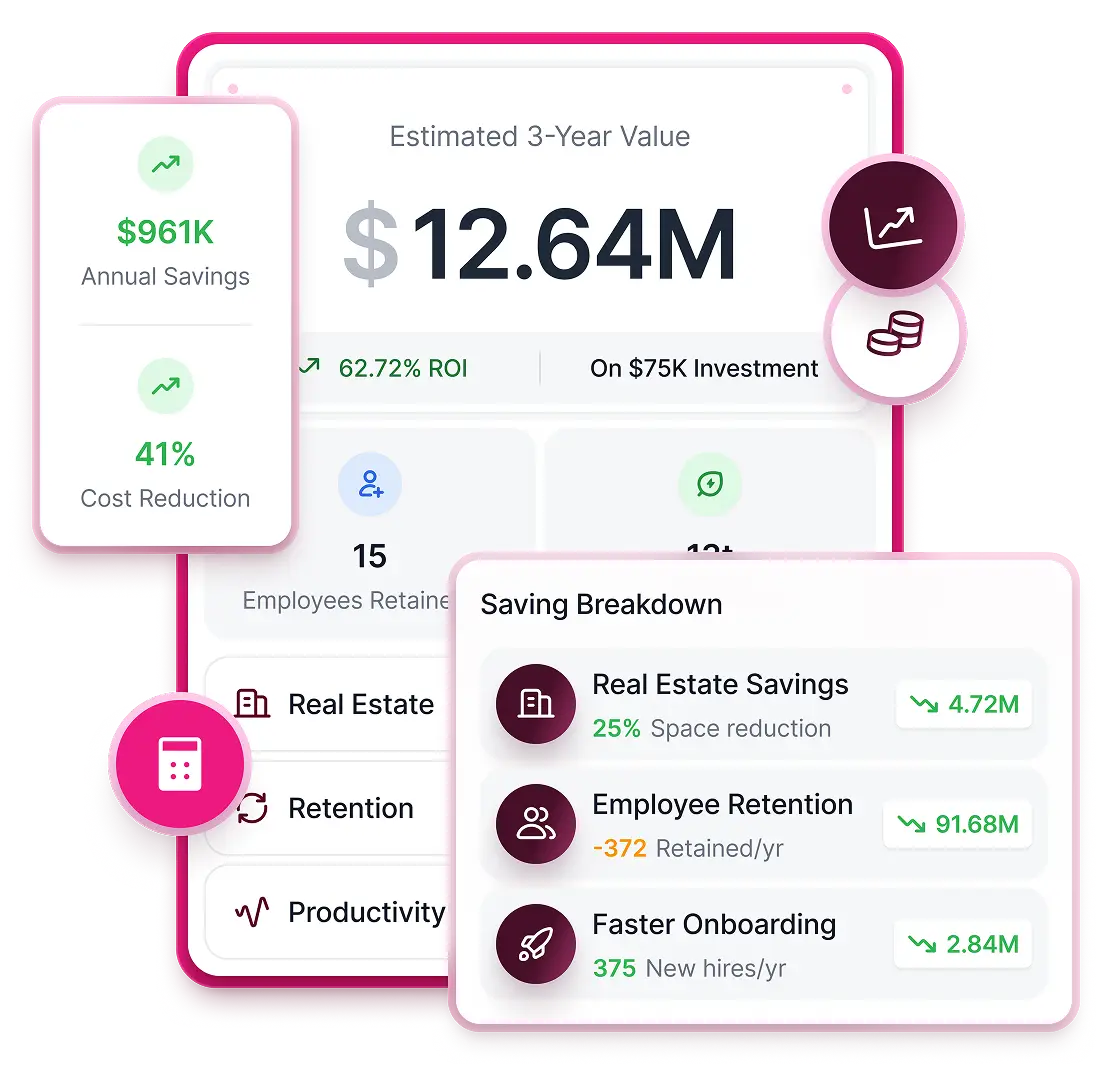
Calculate the ROI of Your Workplace Operations
Our brand-new ROI Calculator is here to help you visualize your success in seconds.
The One-to-One World Is Over
For decades the answer was simple. One person, one desk. Every employee had a seat and every team had a floor, and the planning tools of the era, from AutoCAD to legacy IWMS, were built for exactly that. The floorplan was stable, and a desk belonged to a person for years at a time.
That world has gone. CBRE’s 2026 occupancy research finds that almost no organizations still target a true one-to-one ratio, with a large share now planning for somewhere between one and one and a half people per seat. Desk sharing has moved from the exception to the default.
Here is the part that gets underestimated. The moment you drop below one desk per person, planning stops scaling in a straight line. At one-to-one, allocation is arithmetic. Below it, allocation becomes a forecasting problem, because you are now betting on who shows up, when, and in what numbers. The tools built for the arithmetic world do not handle the forecasting one. They do not break loudly. They break quietly, one over-subscribed Tuesday at a time.
How Enterprises Allocate Space
Once you start looking, most enterprises fall into one of a handful of operating models. Each is worth naming, because each predicts a different kind of pain.
The first is the fully assigned office: one person, one desk, in every day. This is the world of law firms, financial services, and government. The pain is not dramatic, it is constant. It is a steady stream of moves, additions, and changes that dated workflows handle slowly, alongside a floorplan that drifts out of date because IT, HR, security, and facilities all read from it while none of them update the same record. When a restack finally comes it touches everyone, and reaching even a draft plan can take months.
The second keeps assigned desks but layers hybrid on top, often in space-rich enterprises that held on to assigned seating to keep sought-after talent comfortable. It is the least stable of the models. Even the largest technology firms have struggled with it in public: Meta moved away from assigned desks toward desk sharing and has been openly unsure the trade was worth it.
Assigned desks leave empty chairs, shared desks fill with unfamiliar faces, and no option is clean. The challenge in this model is constant rebalancing around shifting project teams, usually with little reliable occupancy data to work from.
The third is zoned hotelling: each team gets a permanent neighborhood, but desks within it are unassigned. This is fast becoming the typical modern enterprise setup. The hard problem is no longer processing moves, it is sizing. How many desks does a team need when attendance shifts week to week? Get it wrong and people cannot sit together, a failure that arrives slowly and then all at once. It plays out under three pressures at once: cost wants the ratio lower, policy wants attendance higher, and behavior refuses to sit still.
The fourth pushes the ratio further. Space-maximizing models time-share whole neighborhoods or individual desks across teams and days, or run desks in shifts across a single day. They are common where real estate is expensive and the numbers have been run hard: city-center financial and professional services, and shift-based operations like contact centers. The pain is the same shape as the assigned models but intensified, because changes now cascade across people, desks, and time.
The fifth is the newest, and the one I would watch most closely. Earn a desk is a mixed model: some employees, by seniority or attendance, hold an assigned desk while everyone else hot-desks within neighborhoods. The attendance variant is the interesting one. It nudges people in without a blunt mandate, but it creates continuous churn as employees cross and drop below the threshold, and it turns a simple question, how many desks will we need, into a live forecasting problem tied to policy.
The Cost You Are Not Pricing
Across every one of these models, one cost runs underneath and almost never appears on anyone’s budget: moves, additions, and changes. Individually each is small. In aggregate, across a large estate, this is a significant and recurring operational load, absorbed quietly by facilities teams maintaining fragile spreadsheets rather than priced as the ongoing cost it really is. The models differ in how much of it they generate, but almost all of them generate more than their tooling was ever designed to absorb.
There is a second cost that hides in plain sight. The floorplan is the source of truth for an entire chain of teams. IT allocates equipment from it, HR onboards from it, security sets access from it, and finance reports from it. When the underlying tools are old and siloed, the floorplan is always slightly wrong, and every team downstream inherits the error.
Why This Is a Portfolio Question
Name your model and the strategic picture sharpens immediately. Each model implies a different relationship between headcount, attendance, and space, which means each implies a different set of levers for reducing cost and a different risk profile when you pull them. You cannot model a restack, test a policy change, or right-size a portfolio you have not first described.
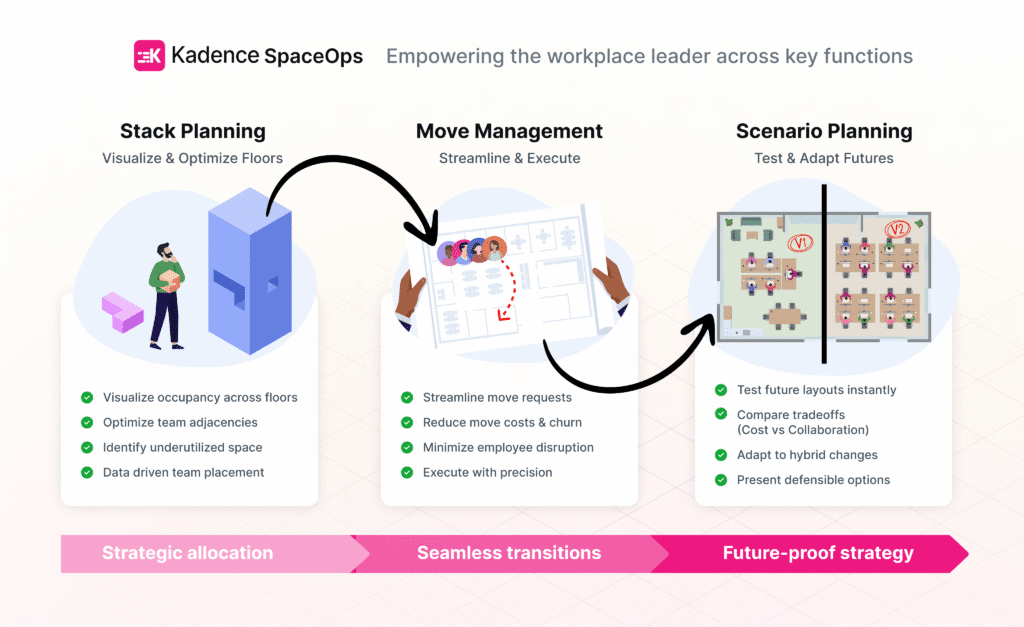
This is where legacy tooling reaches its ceiling and where a Workplace Operating System earns its place. The work is portfolio optimization first: understanding how your model behaves, modeling what happens when you change the ratio or the threshold or the footprint, and grounding those decisions in real occupancy data rather than instinct. SpaceOps exists for exactly this, scenario modeling and stack planning for leaders who need decision-grade intelligence about their portfolio, not another tool for booking a desk. We have built advanced modeling alongside customers facing precisely these questions, and the pattern is consistent. The organizations that can name and model their workplace operating model make faster, cheaper, and lower-risk space decisions than those flying on a floorplan they do not fully trust.
So start by naming your model. It is the cheapest and highest-leverage step most enterprises have not yet taken. From there, the questions that used to take a quarter of project management effort, what the floor looks like at a different ratio, under a different policy, with a different headcount, become questions you can answer with data.
If you want to see what that looks like for your own portfolio, book a demo with our workplace operations experts. Or if you would rather start with the numbers, our ROI calculator will estimate what a better-modeled portfolio is worth against your current footprint.


Speak With Our Workplace Operations Experts
Ditch manual reporting and get deeper workplace insights. Speak with our team today.