
The workplace needs a digital twin because most decisions about offices are still made on incomplete, siloed data and instinct. A workplace digital twin brings that data together and lets leaders model a decision, such as consolidating two offices, before they make it. According to LSE’s Professor Prithwiraj Choudhury, hospitals, factories and energy companies already work this way.
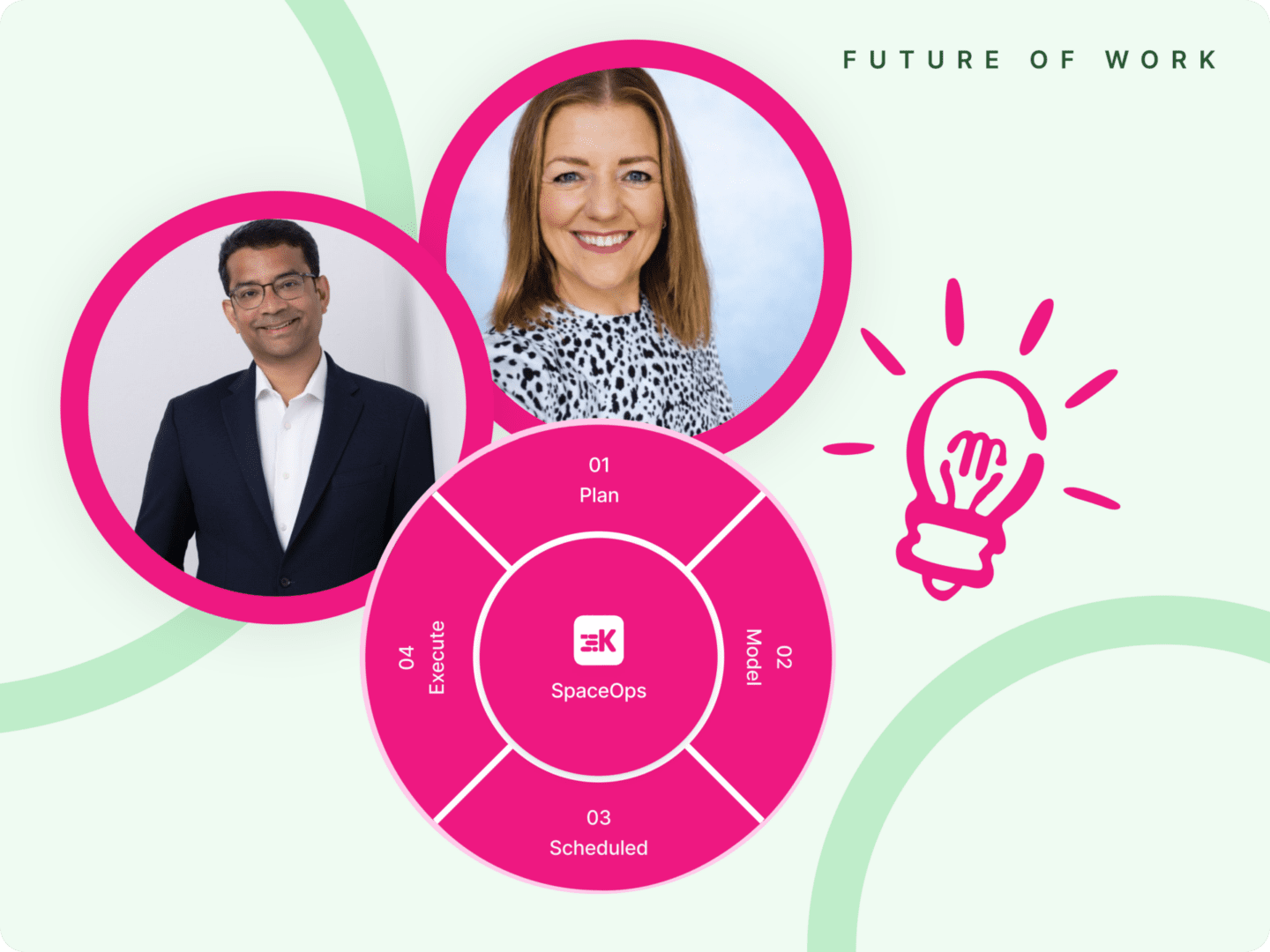
In June 2026, Kadence brought together a group of senior workplace and real estate leaders in London for a conversation over breakfast. We were joined by Professor Prithwiraj Choudhury of the London School of Economics, one of the world’s leading researchers on digital twins and the future of work, and by Bex Moorhouse, a senior workplace strategist at WPP with more than two decades of hands-on experience managing large, complex estates. The conversation surfaced something most workplace leaders already sense: the way we make decisions about the workplace is broken, and fixing it takes the same shift that has already changed other industries.
What is a digital twin?
A digital twin is a virtual replica of a physical operation that runs alongside it. Sensors and real-time data collection feed the replica, AI and machine learning analyze the data, and operating instructions flow back into the physical environment. The physical operation and its virtual twin run in parallel, continuously learning from each other.
Professor Choudhury, known as Raj, opened with this simple observation. Digital twins are not a future technology. They already run in hospitals, factories and energy infrastructure, and he shared an example of each:
- Healthcare: at a hospital in New York, sensors on patients combined with AI prediction meant half the doctors could work remotely while clinical outcomes improved. The system identified which patients needed urgent attention faster and more accurately than human observation alone.
- Manufacturing: at a Unilever detergent plant in Brazil, a digital twin had taken over production management entirely. One outcome was a 6 percent reduction in gas consumption.
- Energy: in Turkey, an energy company built a digital twin headquarters in Istanbul, where engineers manage 26 power plants across the country from a single office. Wind engineers sit next to solar engineers for the first time. The company is moving from a power generation business to a technology business, and its most valuable asset is no longer the plants. It is the data network.
The pattern is the same each time: real-time data, AI-driven analysis, and instructions that flow back into the physical world. Every industry that manages physical operations at scale is moving to this model. The question is not whether it will reach the workplace, but how fast.
What is an organizational digital twin?
An organizational digital twin is a single data infrastructure that combines what an organization knows about its people, teams, spaces and costs, with AI agents on top that can model decisions before they are made. It is the most direct way to apply digital twins to the workplace, and most large organizations already hold the data it needs.
The data exists: how individuals work and perform, how teams interact, how spaces get used, and what the portfolio costs and delivers. The problem is that it sits in separate systems that do not talk to each other, locked in facilities platforms, HR tools, access control systems and finance records never designed to be combined.
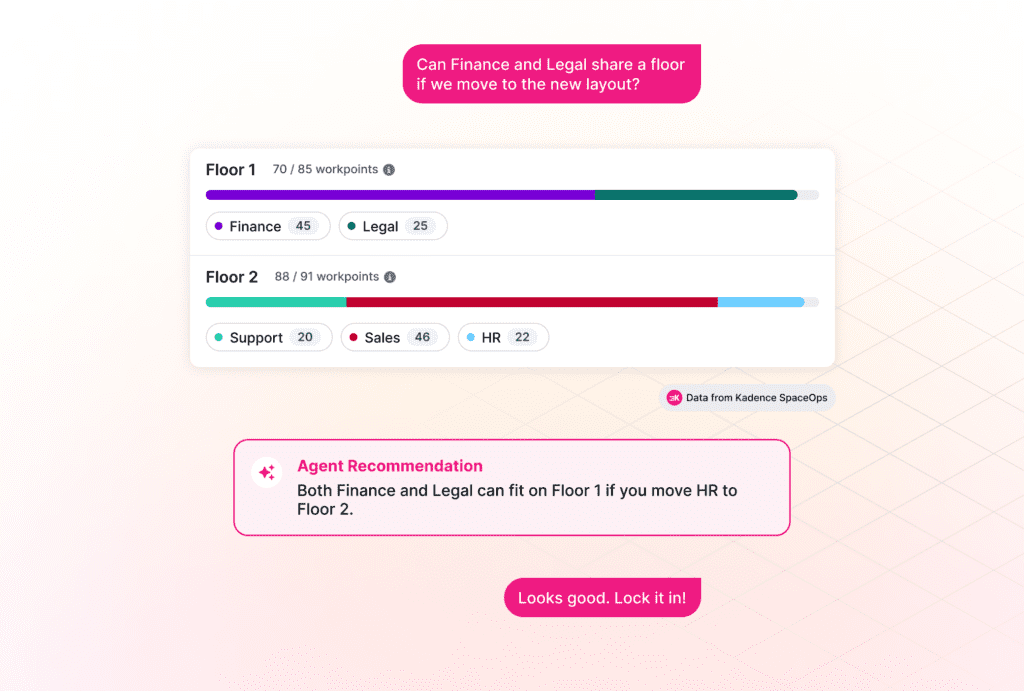
An organizational digital twin integrates all of it and lets AI agents test questions such as:
- Should we consolidate two offices?
- What would happen to team connectivity if we changed our attendance expectations?
- How would a change in how we allocate space affect the cost base?
Raj compared it to crash testing. Automotive companies do not crash real vehicles to test safety. They run the simulation in the digital twin. The same logic applies to organizational decisions: run the scenario first. This is what scenario planning does for workplace and real estate teams.
This is the direction workplace strategy is heading. The organizations that get there first will make better decisions faster, with less cost and less risk. The ones that do not will keep making multimillion-pound portfolio decisions based on incomplete information and instinct.
What is a personal digital twin?
A personal digital twin is an AI agent trained on one person’s communications, such as their emails, messages and meeting transcripts, that can answer routine questions on their behalf. Raj’s research suggests people accept it for impersonal, transactional questions but reject it for interpersonal ones, where they still want the human.
Raj’s experiment with Wade Foster, founder and CEO of Zapier, produced two striking results:
- When employees received communications from either Wade or an AI agent trained on his emails, messages and meeting transcripts, they could not reliably tell which was which. The bot passed the test.
- Employees were fine with the bot handling impersonal questions but strongly rejected it for interpersonal ones. They did not want an AI answering questions about leadership or career.
The implication is that personal digital twins will handle the routine, transactional and repeated work. In doing so, they give leaders time back for what needs human judgment: the one-on-one conversation, the deep thinking, the connection. Raj pointed to Sam Liang at Otter.ai and Melanie Rosenwasser, Chief of People at Dropbox, as early examples of leaders already experimenting with this. For more on how AI is changing work, see the guide to AI and the future of work.
What is the office for?
The office is for connection. Raj and Bex reached the same answer from different directions. Not the performance of presence, and not tasks that could be done at home, but the deep trust-building that needs physical proximity and the broader network-building that exposes people to colleagues outside their own team.
Raj’s research shows that even in a physical office, interactions drop dramatically beyond ten meters. People circulate among the same five to seven colleagues and mistake that for a connected culture. He also described a study of a company retreat where employees spent several days together and came out with more siloed communication networks than when they arrived, because people gravitated toward colleagues like themselves. Designed well, the office interrupts those patterns. Designed poorly, it just formalizes them.
Bex brought the practitioner’s view. Her team at WPP shifted from tracking occupancy to tracking show-up rate, and used it to right-size space and give budget relief to teams that were not coming in.
Show-up rate compares how many people were expected in the office with how many actually came.
She also made a point about retention. In her exit interviews, every person who resigned over one period said some version of the same thing: I stayed longer than I probably should have for my own career because of the people. Connection is not a soft benefit. It is a retention strategy and a talent strategy. The workplace analytics and metrics guide covers how to measure it beyond occupancy counts.
Why do leaders have to go first?
Leaders have to go first because employees copy what leaders do, not what they say. Bex saw office occupancy stay flat despite every other lever until her team checked leaders’ attendance and found they were not coming in either. The same applies to AI adoption: leaders who talk about AI but rarely use it send a clear message.
Bex described a situation where occupancy was not moving despite neighborhoods, booking tools and engagement events. Once leadership presence became a tracked and prioritized metric, everything else started to shift.
On AI, Raj cited research from Stanford showing that senior leaders who talk about AI constantly use it for less than one hour a week. That gap is visible to everyone. If you want people to engage seriously with these tools, you have to engage seriously with them yourself.
On change management, Bex was direct.
Change management is not communications. It is not an announcement email or a slide in an all-hands. It is the sustained, empathetic work of keeping people on the journey, naming the fear rather than talking around it, and being clear about which tasks AI will change and which it will not.
She shared a story from 15 years earlier, when she showed a cleaner a video of a robotic vacuum, thinking it would excite him. Two days later he told her he thought she was going to replace him. The technology was not the issue. The communication around it was. That lesson applies to every AI rollout.
What does a workplace digital twin mean for real estate leaders?
For workplace and real estate leaders, a digital twin means decisions grounded in real data, modeled before they are made and refined as patterns change. The physical estate needs a digital twin, and the data behind it must be integrated, not siloed. That is how leaders move from measuring desks to measuring decisions.
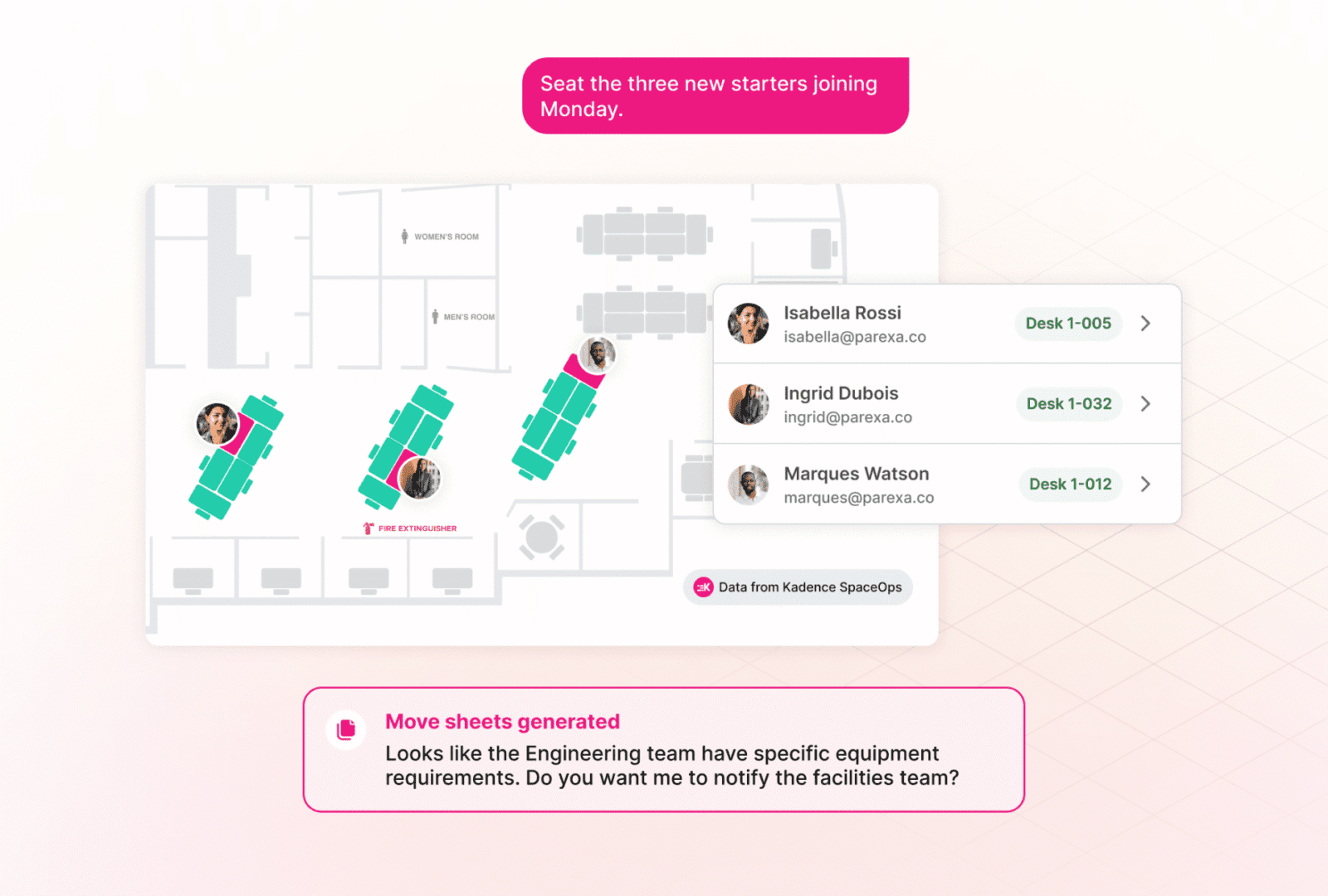
This is the problem Kadence was built to solve. As of June 2026, SpaceOps gives workplace and real estate leaders the portfolio intelligence to move beyond occupancy counts, model scenarios, understand how space supports the connections that matter, and make capital decisions with confidence. Its AI agents answer space planning questions on live floor plans, as the examples above show.
The organizations that treat the workplace as a strategic asset, one that can be understood, modeled and improved with the same rigor as any other part of the business, will get this right. The rest will keep guessing. Book a demo with our workplace operations experts to see how Kadence helps global organizations build that capability.
Frequently asked questions
What is a workplace digital twin?
A workplace digital twin is a virtual model of an organization’s offices, people and space use, fed by real data from systems such as facilities, HR, access control and finance. AI agents on top of it let leaders test decisions, such as consolidating offices or changing attendance expectations, before acting.
How is a digital twin used in other industries?
Professor Prithwiraj Choudhury shared three examples. In research from a New York hospital, sensors and AI prediction let half the doctors work remotely while outcomes improved. At a Unilever plant in Brazil, a digital twin cut gas consumption by 6 percent. And a Turkish energy company manages 26 power plants from one digital twin headquarters in Istanbul.
What should the office be used for?
According to Professor Prithwiraj Choudhury and Bex Moorhouse, the office is for connection: the trust-building that needs physical proximity and the network-building that exposes people to colleagues beyond their own team. Tasks that can be done at home do not justify it.
What is the difference between occupancy and show-up rate?
Occupancy counts how much space is used. Show-up rate compares how many people were expected in the office with how many came. WPP’s workplace team used show-up rate to right-size space and give budget relief to teams that were not coming in.