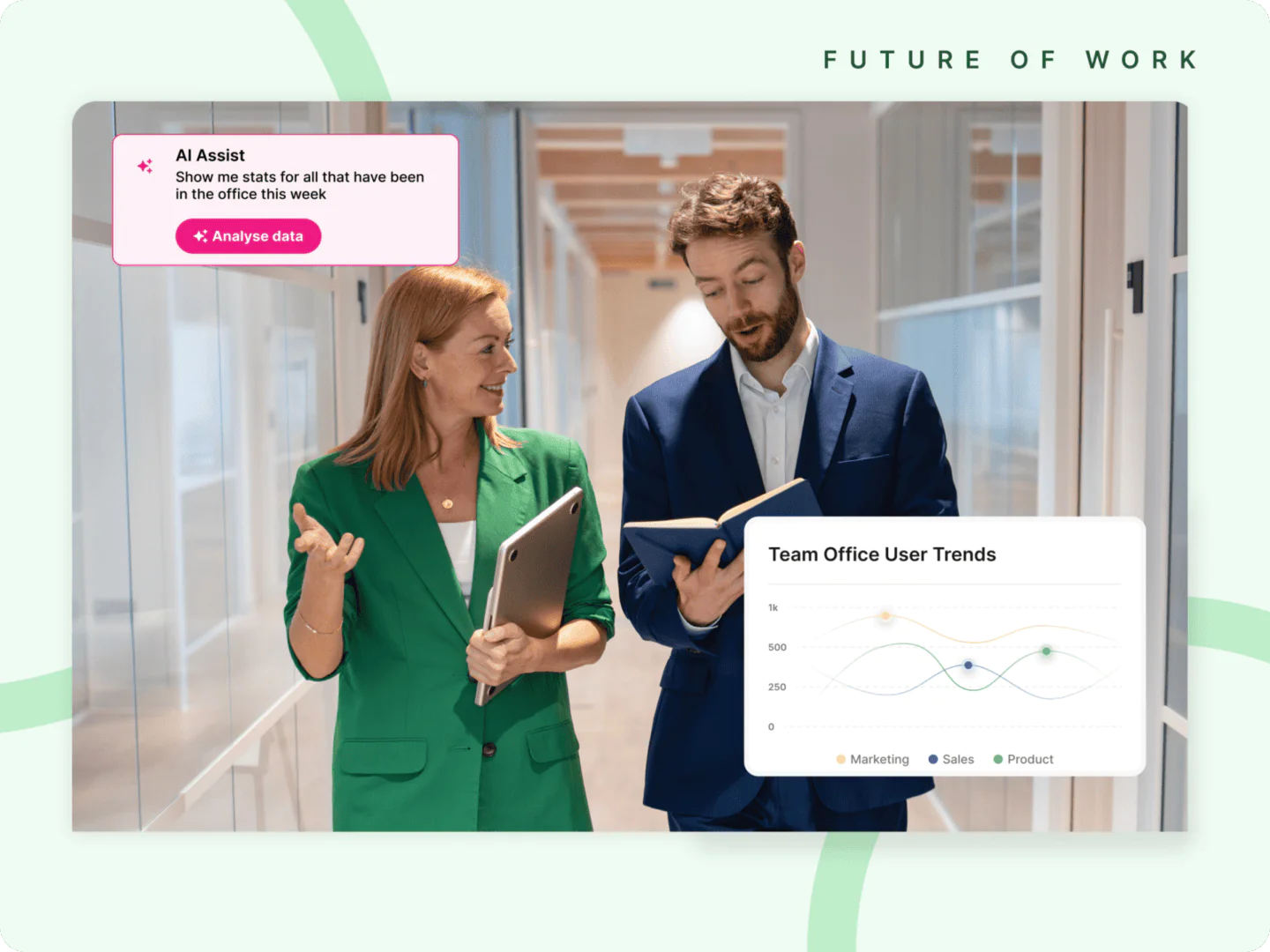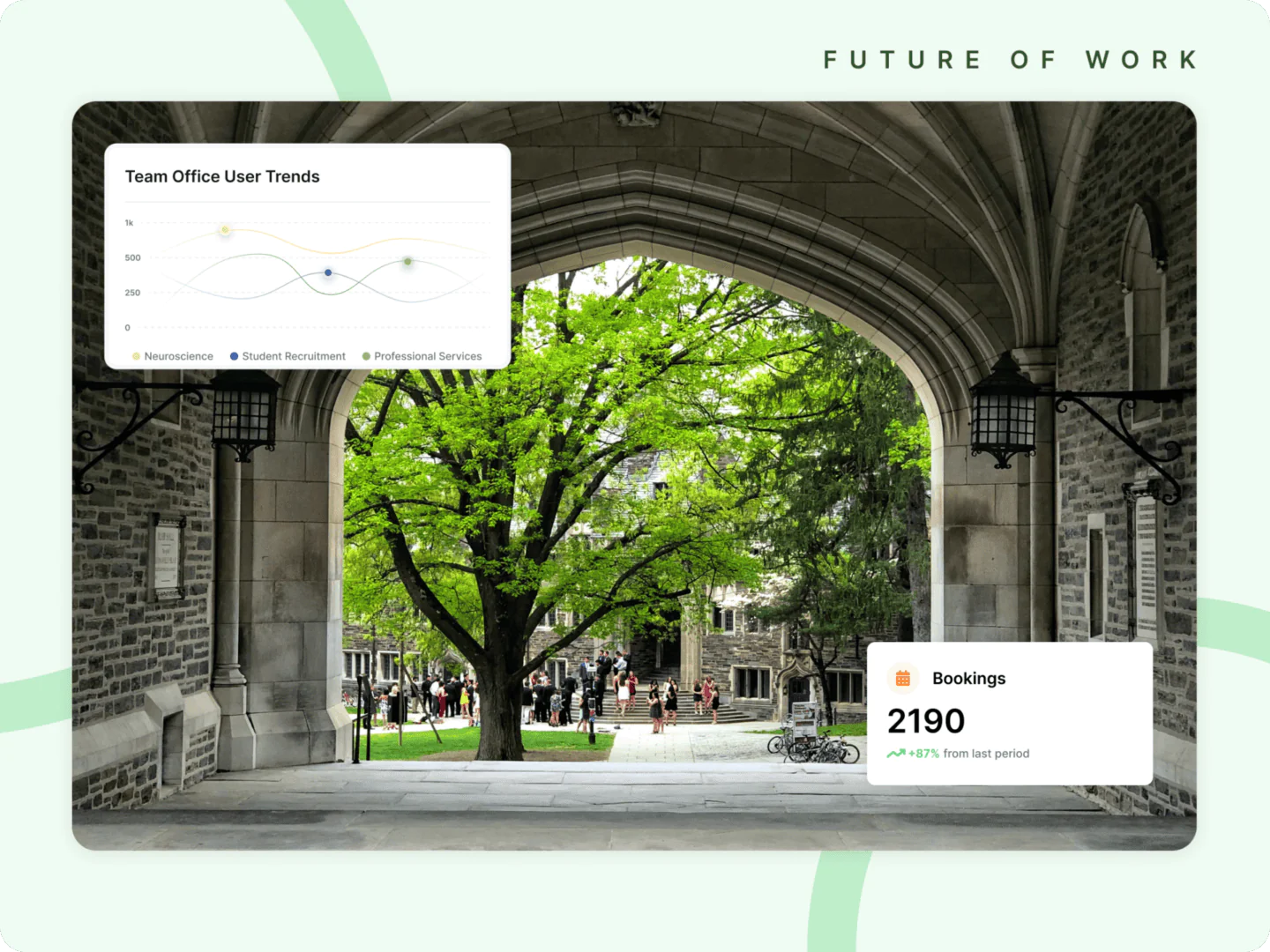
Our team at Kadence was recently in a conversation with a large enterprise, and one thing a workplace leader on their side said has stuck with me. This particular company has publicly, very publicly, re-auged multiple times already this year and the Workplace team are feeling it. When a reorg hits and you have to figure out who should sit next to whom, which desk clusters work, which teams need to be close to each other, there is no product that does that well. So you end up solving it yourself, by hand, late at night, with a floor plan and a color-coded spreadsheet.
That is exactly the problem I want to talk about, because it is not a niche one. A reorg is announced on a Monday. By the following week, someone in the workplace team is expected to have an answer to a question nobody prepared them for: who sits where now. New reporting lines, merged teams, a function that just doubled, another that got absorbed. The org chart changed in a slide deck, and the physical floor has to catch up, fast, while everyone watches to see whether it lands well or badly.
I have watched a lot of talented people run at that problem trying to solve by hand what is actually an optimization problem. It does not have to be that way. So this is a playbook. Five plays, in order, for the workplace leader who just got handed a reorg and a deadline.
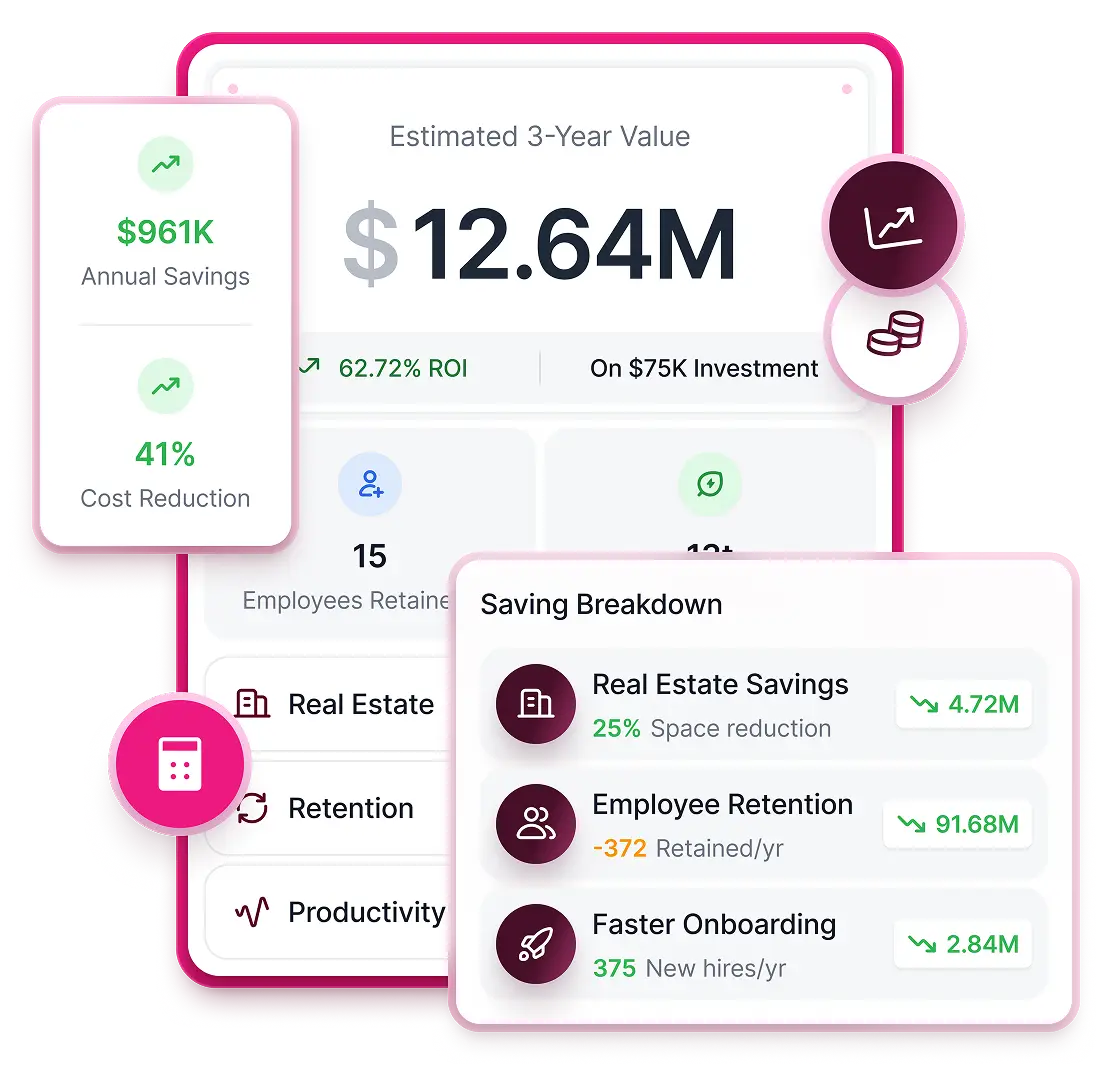
Calculate the ROI of Your Workplace Operations
Our brand-new ROI Calculator is here to help you visualize your success in seconds.

Why the Reorg Moment Is the Hardest One You Own
First, why this moment specifically. Reorgs are not rare events you can treat as one-offs. They are the operating rhythm of the modern enterprise.
In McKinsey’s research, 82 percent of executives said they had been through an organizational redesign at their current company, and of those, 70 percent said the most recent one happened within the past two years. Reorganizing is not the exception anymore. It is roughly a biennial event. And it usually does not go smoothly. By McKinsey’s own measure, only 23 percent of reorgs are judged successful by the companies that run them. More than three quarters fall short of what they set out to do.
The workplace leader inherits the physical half of that risk. Strategy decides the new structure. Somebody still has to make it real in the building, decide which teams cluster, who needs to be near whom, how much room each group needs on its busiest day, and do it before the new structure loses momentum. Get it right and the reorg feels real on day one. Get it wrong and you have teams that were just told to collaborate sitting on different floors, which quietly undercuts the whole point. That is why this moment is the hardest one the workplace team owns. High stakes, no lead time, and almost no tooling built for it.
Play One: Freeze the Real Demand Picture Before Anyone Moves
The instinct under pressure is to start moving people. Resist it. The first play is to establish what is actually true right now, before the reorg scrambles it.
You need the real demand picture, not the headcount on paper. How many people from each team are genuinely in on a typical peak day, which days those peaks fall on, and which groups already sit and work together whether or not the org chart says so. This is your baseline. Without it, every decision that follows is a guess dressed up as a plan. With it, you know your true starting occupancy and you can measure every proposed move against something real instead of against the 2019 seating chart nobody has updated.
The mistake to avoid here is planning off assigned desks or headcount. Both overstate what you need, because neither reflects how many people actually show up. Start from demonstrated demand, not entitlement.
Play Two: Map the New Adjacencies, Not Just the New Boxes
A reorg hands you a new org chart. The org chart tells you the reporting lines. It does not tell you the adjacencies, and adjacencies are what the floor is actually made of.
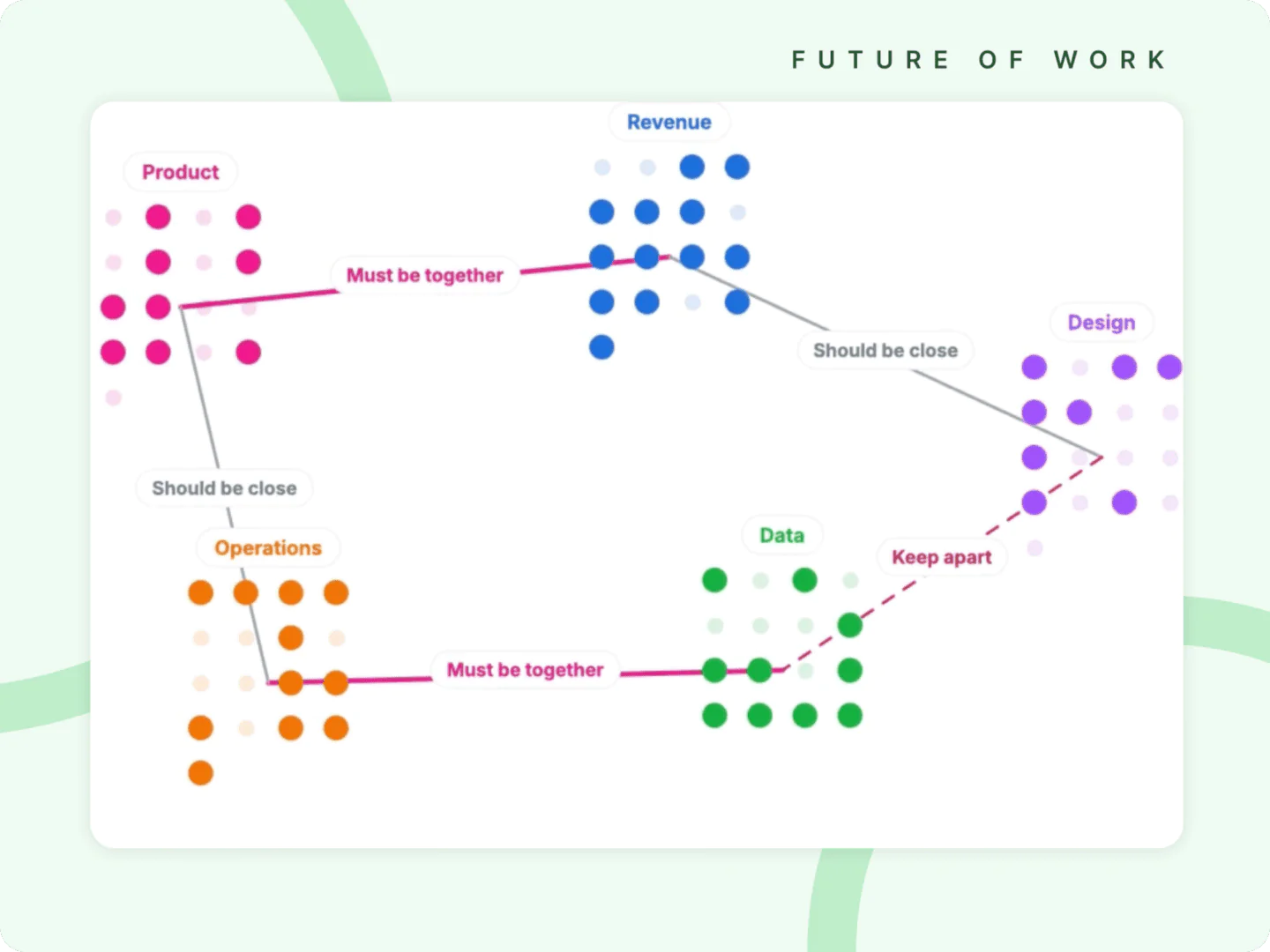
The second play is to translate the new structure into a map of who needs to be near whom. Some of this is obvious from the reorg itself: teams that just merged should probably sit together. Much of it is not. Two functions that now share a goal may never appear on the same branch of the chart but need to be one conversation apart. A team that was split across the business may need to consolidate. Write these down as adjacency requirements, ranked by how much they matter. Must be together. Should be close. Keep apart. That ranked list, not the org chart, is the real brief for the floor.
This is the step most reorgs skip, and it is why so many end up with the right boxes in the wrong places.
Play Three: Generate Options Instead of Defending One
Here is where the late-night spreadsheet fails everyone. Under time pressure, most workplace leaders build exactly one seating plan, the first one that seems to work, and then spend their energy defending it when leaders push back. One plan is a hostage. You cannot compare it to anything, so every objection feels like an attack rather than a trade-off.
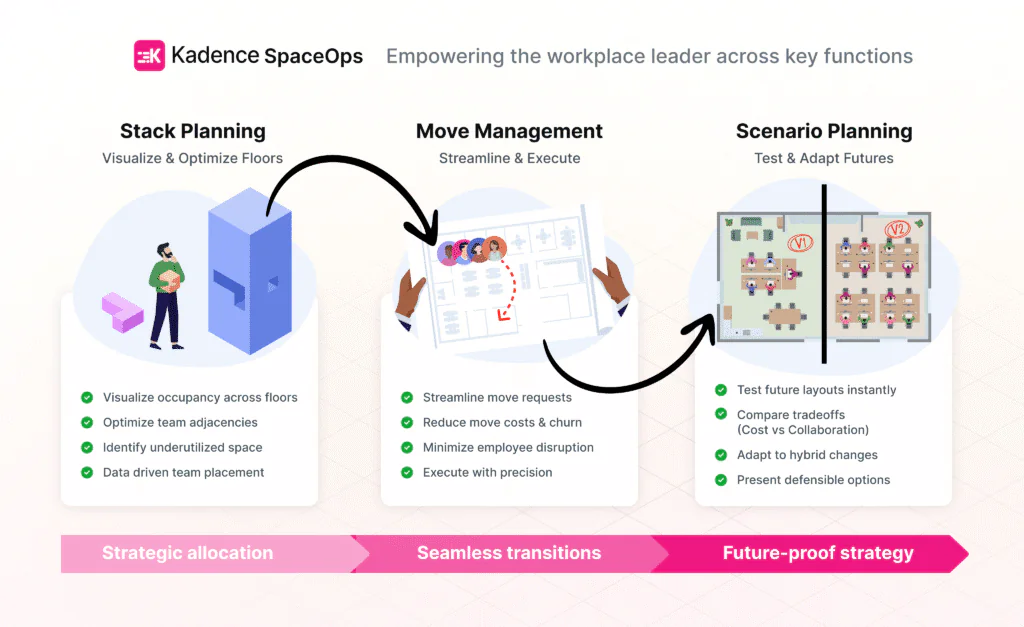
The third play is to generate several viable options, not one. Consolidate the new structure onto fewer floors. Keep the current footprint but redraw the neighborhoods. Prioritize the top adjacencies at the cost of the lower ones, or the reverse. Each of these is a legitimate answer with a different cost, a different disruption level, and a different set of compromises. Having three or four real options changes the entire conversation with leadership. You stop defending a plan and start facilitating a decision, which is a far stronger position to be in and a far faster way to get to yes.
Generating options by hand is exactly the part that does not scale, which is where the tooling comes in later in this playbook.
Play Four: Score the Trade-Offs Openly
Options are only useful if you can compare them honestly, so the fourth play is to score them on the same axes, out loud, in front of the decision-makers.
For each option, put three things on the table. Cost, meaning how much space it takes and what that space costs. Adjacency, meaning how many of your ranked must-be-together and should-be-close requirements it actually satisfies. Disruption, meaning how many people have to physically move to make it happen. Almost no option wins on all three. The consolidation that saves the most money usually forces the most moves. The plan that nails every adjacency usually needs the most space. Making those trade-offs explicit is the entire job, because it turns a subjective argument about seating into an objective decision about priorities. Leadership can then choose which axis matters most this time, and own that choice with you rather than second-guessing it later.
Play Five: Decide, Then Execute in Sequence
The final play is to commit and then move in a deliberate order. Once leadership picks an option, do not execute it all at once in a single chaotic weekend. Sequence it. Move the highest-priority adjacencies first, the teams whose closeness the reorg most depends on, so the structure starts paying off immediately. Then work down the list. Communicate the plan and the reasoning before people arrive to find their desk has moved, because a reorg already makes people anxious and a silent seating change compounds it.
And keep the demand picture from play one running after the move, because the next reorg is, statistically, about two years away. If you still have your baseline and your adjacency logic captured when it lands, you start the next one from play three instead of from a blank floor plan at eleven at night.
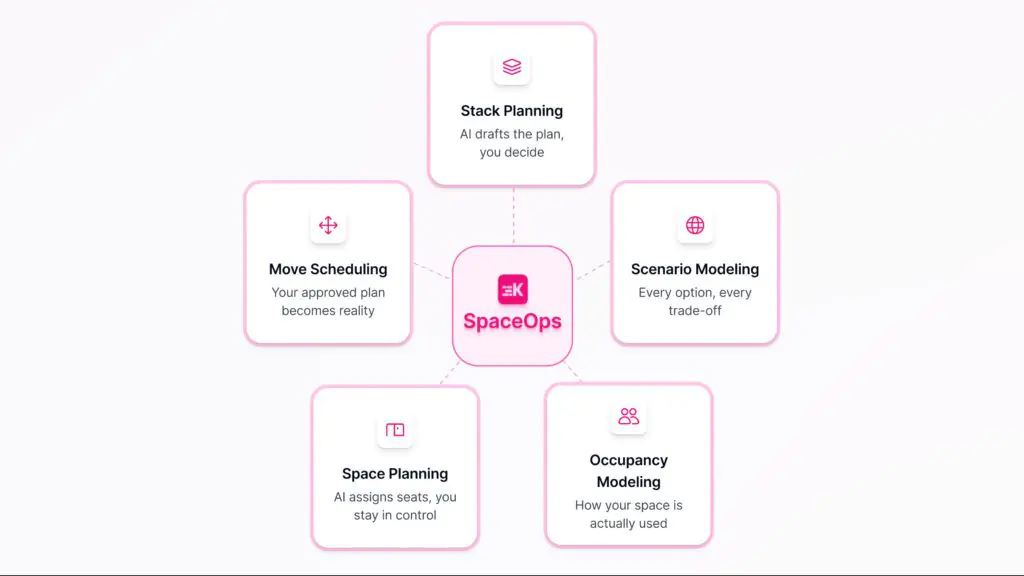
The System That Runs This Playbook
You can run all five of these plays by hand. Most workplace leaders do, and it is exhausting and slow, and it is why the spreadsheet comes out at night. This entire playbook is the problem SpaceOps was built to solve.
You describe what the reorg needs to achieve. SpaceOps pulls in your real demand picture, captured in the flow of how people actually use the workplace and measured through Kadence Sense rather than a stale headcount file. It generates the options, scores the cost, adjacency, and disruption trade-offs for each, and lets you compare them side by side before anything physically moves. It runs on constraint-based optimization, not a generic language model guessing at your floor plan, which is what lets you take the recommendation into a leadership room and defend it. Plays three and four, the two that do not scale by hand, stop being an all-nighter and become a conversation.
The next reorg is already on its way. The only real question is whether the workplace team meets it with a blank spreadsheet or with a system built for exactly this decision. If you want to see what running the reorg this way is worth across your portfolio, put the numbers through the Kadence ROI calculator, and when you want to see the plays run on your own floors, book a demo with our workplace operations team.