Every workplace team is hearing the same instruction right now. Do more with less, move faster, and deliver at a level the function has never been held to before.
Most teams are trying to answer that while quietly losing the one asset that would make it possible, which is their own decision history. A workplace makes thousands of consequential choices every year, covering stack plans, moves, hybrid strategies, and space standards, and then forgets why it made them. The reasoning usually lives in one place, which is somebody’s head. The average workplace leader holds the seat for two to three years. When they leave, the reasoning leaves too, and their successor starts re-litigating settled questions from a blank page.
Here is the argument in one line. The decisions are the asset, the context is the product, and memory is the moat. A lean team that forgets its own decisions is not lean. It is slow with extra steps. And an AI that knows nothing about your history is not an advisor. It is an articulate intern on a permanent first day.
The companies that pull ahead over the next three years will not be the ones with the cleverest model. Everyone will have clever models. They will be the ones whose systems have quietly accumulated decision context while everyone else’s evaporated.
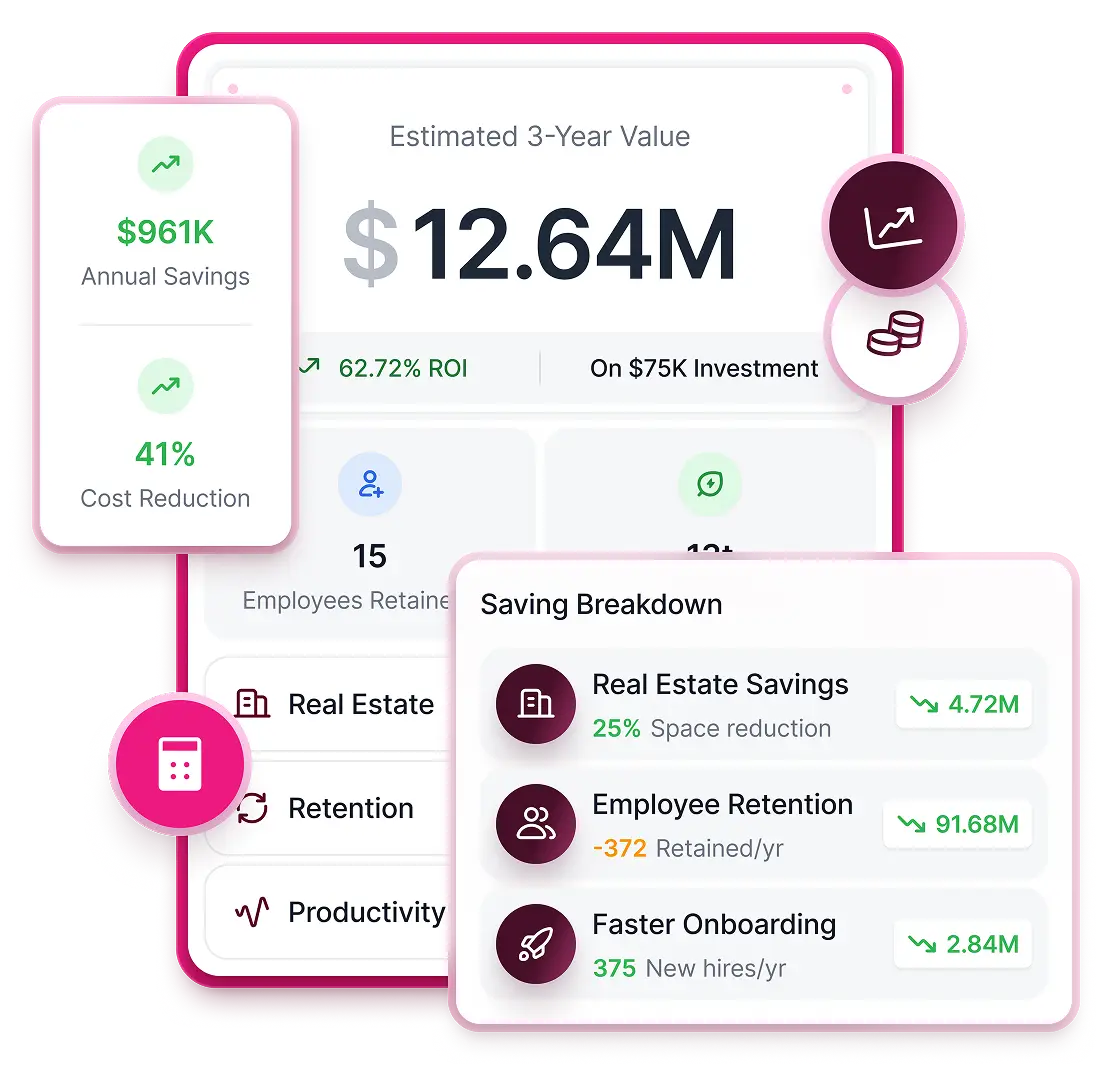
Calculate the ROI of Your Workplace Operations
Our brand-new ROI Calculator is here to help you visualize your success in seconds.

Why AI Has Not Fixed This Yet
Every answer to “do more with less” now starts with AI, and the direction is right. The execution is not. JLL’s 2025 Global Real Estate Technology Survey found that 92 percent of corporate occupiers are piloting AI, while only 5 percent report achieving all of their program goals. The barrier is rarely the model. It is the substrate the model has to work with.
AI is a reasoning engine, and a reasoning engine needs something to reason over. Point one at a workplace with no decision history and it returns confident, generic answers, the same answers it would give any company, because it knows nothing about yours. It does not know Finance demanded a contiguous floor in 2024. It does not know the last attempt at a tighter desk ratio quietly failed. It does not know that the three day policy moved attendance four points and the Friday change moved it none.
So the question most of the market is asking, which is “what AI should we deploy?”, is the wrong one. The better question is what your AI gets to remember.
What Workplace Memory Looks Like in Practice
A workplace that remembers comes down to four things, and each maps to a part of how Kadence already works.
- The building remembers. Every stack plan, every scenario you modeled in SpaceOps, every option you rejected and the reason behind it, and what happened to utilization afterward. This is the record of your spatial decisions, not just a picture of the current floor plate.
- Teams carry their own history. Where a team has sat, how it actually uses space against how you planned for it to, and what happened the last three times it moved. WorkOps treats the team as the unit of the workplace, which is where the real behavior lives. Most tools still only see seats.
- Policies carry their evidence. Every version of your hybrid strategy, the reasoning behind each change, and the measured effect on attendance and utilization, surfaced in Workplace Analytics. So when leadership asks whether three days in the office actually worked, the answer is data rather than recollection.
- Standards know their exceptions. The ratios and norms you set, and where real behavior diverges from them. SpaceOps plans against your actual occupancy rather than an org chart or an industry average, so the work starts from reality.
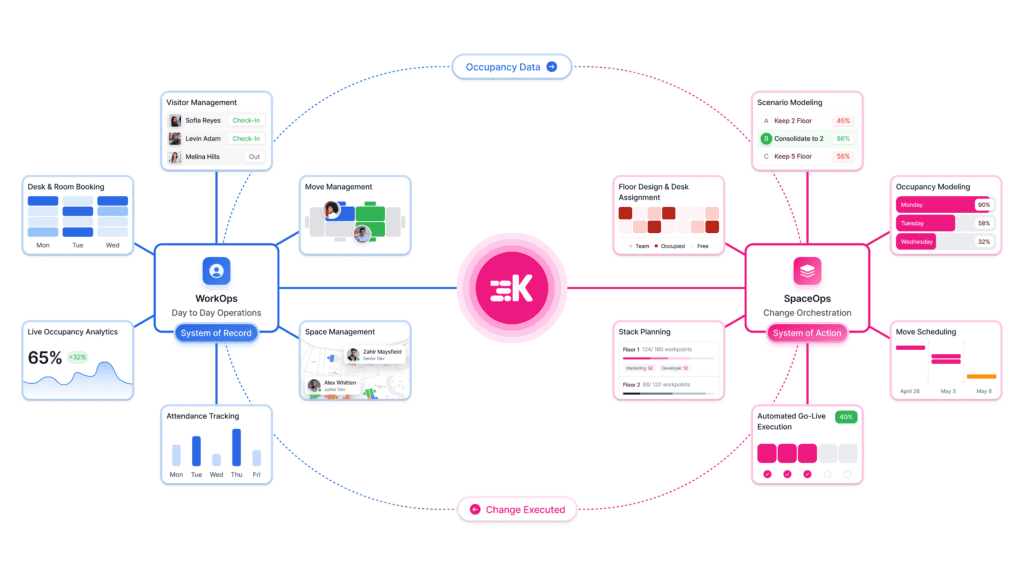
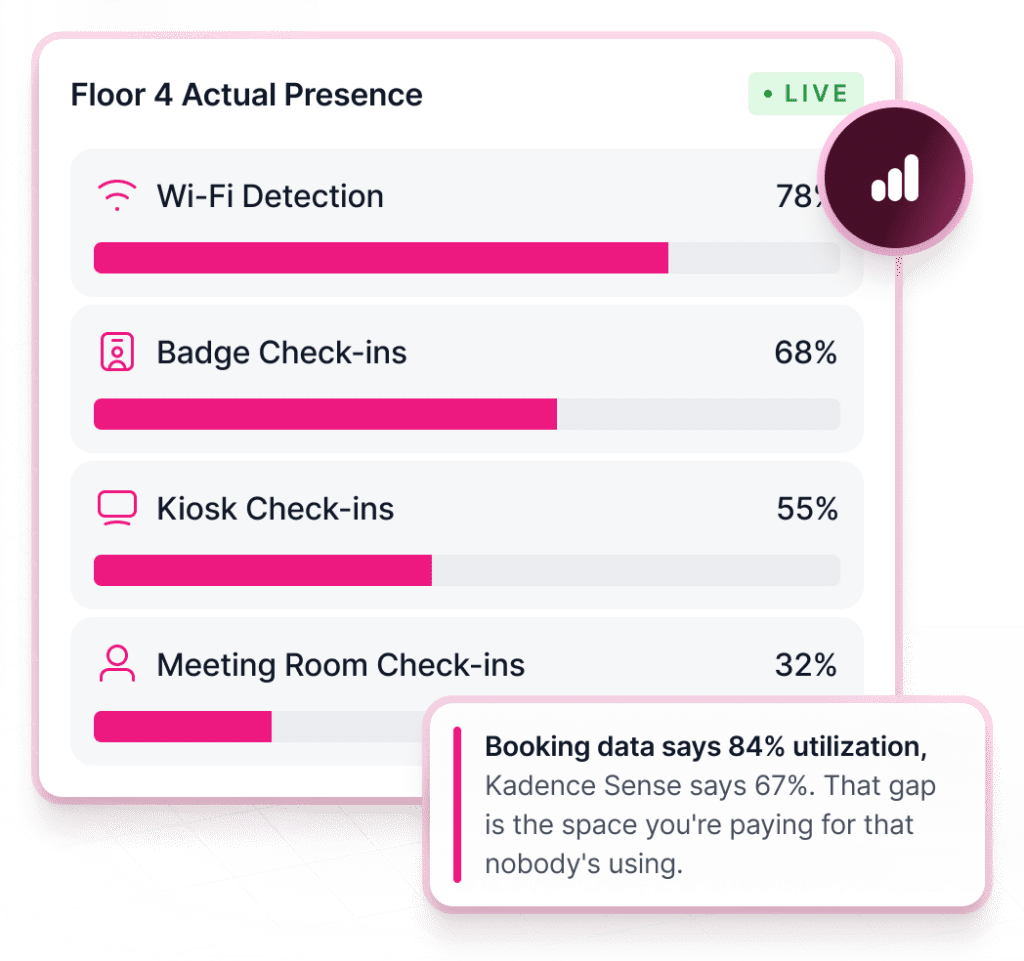
None of this should depend on anyone writing documentation. Knowledge capture that relies on diligence always loses to the urgent. The decisions are already happening inside your workplace systems. Scenarios get modeled, moves get executed, strategies change, and space gets used. Kadence Sense already captures presence across your buildings automatically, with no sensors and nothing for anyone to maintain. The memory should be a byproduct of that activity, captured at the moment of decision with at most one line explaining why. Anything heavier dies within a quarter.
Once that memory exists, AI stops being a demo and starts behaving like a colleague. It tells a new workplace lead why the floor looks the way it does on day one rather than month six. It flags that the layout you are about to propose was rejected eighteen months ago, and why. It learns which trade-offs your organization actually values because it has watched you make them. This is what portfolio intelligence becomes when it compounds, and it is the difference between scenario modeling that guesses and scenario modeling that remembers.
That is what “do more with less” looks like when it is real. A three person team operating with the accumulated judgment of every decision the function has ever made.
Buildings Already Learned This the Hard Way
The physical building industry has lived with this problem for decades. A commercial building’s documentation begins decaying the day it is handed over. The field changes, commissioning tweaks go unrecorded, and the things the longest serving engineer simply knows never make it into a system. A 2004 NIST study put the cost of inadequate information continuity across the US capital facilities industry at roughly sixteen billion dollars a year, with the largest share falling on the owners and operators who inherit the building.
The hard lesson from that world is that there is a window in which knowledge can be captured, and once the people disperse it closes for good. You can organize what you kept. You cannot recover what you never wrote down.
The Window Is Open Now
Workplace teams are inside that window today. The post-pandemic wave of spatial decisions, the consolidations, the hybrid strategies, and the great re-stacking, is the most consequential set of workplace choices most companies will make this decade. The people who made them are still in the building. Their reasoning is still reachable.
In three years it will not be. Every company will be standing in front of the same two doors. Behind one is a workplace that remembers. Behind the other is a team starting from scratch again, with fewer people, higher expectations, and an AI that knows nothing about them.
We built Kadence for the first door. The workplace should compound, not reset.
To see what a workplace that remembers looks like in practice, book a demo with our workplace operations experts.