CBRE says AI is already influencing space-planning decisions for 23% of occupiers. The workplace leaders I talk to are watching the rest of the company get lost, with tools that do not help them keep up.
CBRE’s 2026 Americas Office Occupier Sentiment Survey put a number on a feeling a lot of workplace leaders already had. In it, 23% of organizations report that artificial intelligence is already influencing their space-planning decisions.
It is being repeated as an adoption story. What CBRE measured was a force on the portfolio.
What CBRE Actually Asked
CBRE asked whether AI, as a pressure on the business, is already showing up in how leaders think about space. Whether occupiers have an AI that can produce a floor plan is a separate question entirely. Another 30% expect a meaningful impact within two years, which leaves close to half who do not expect AI to affect their space planning any time soon.
So the honest read is narrower than the headline. A minority of Americas occupiers already feel AI in the plan, a larger group is waiting, and the rest are not convinced it will matter.
It helps to know who is answering. That is 97 companies, senior occupiers with real portfolios behind them. A considered read from people close to the decision, which is exactly why it is worth reading properly rather than flattening into a statistic.
Reconfigurable Space Is a Stack-Plan Decision
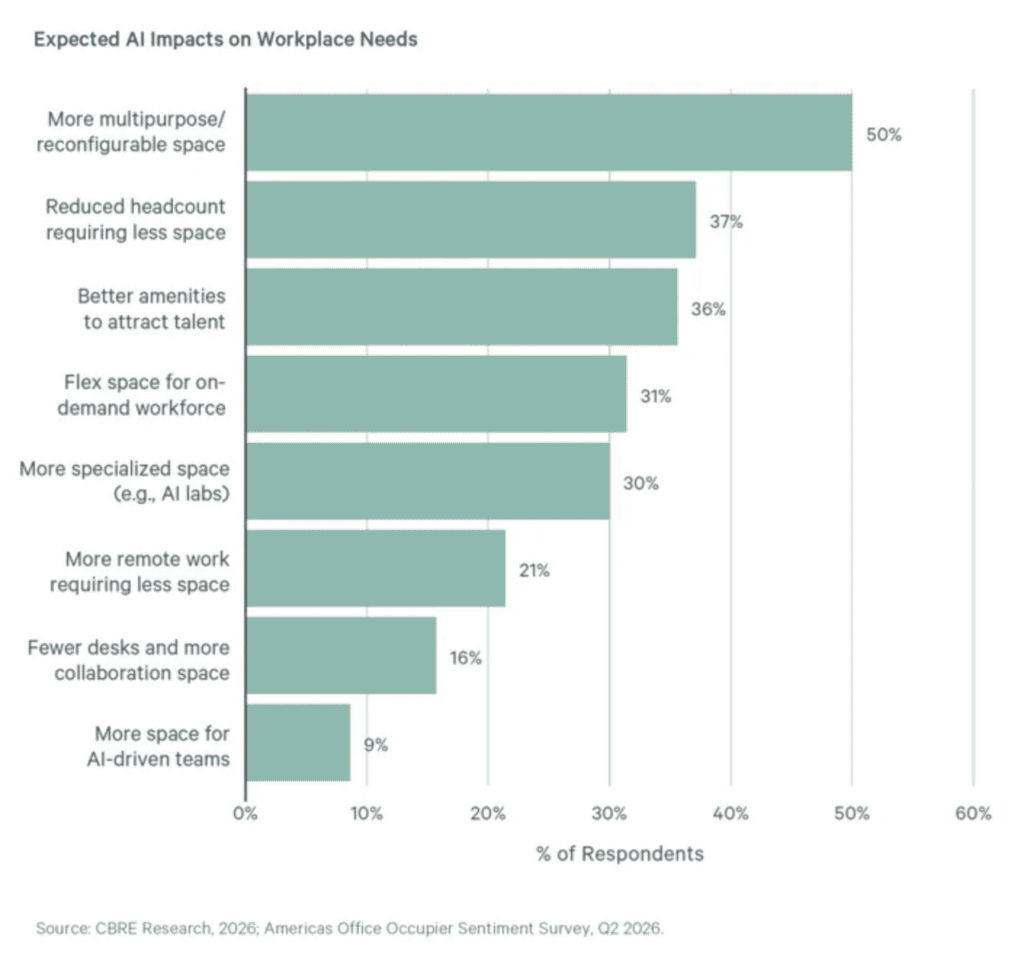
Half of those same occupiers expect AI to push them toward more multipurpose, reconfigurable space. That sounds like a furniture decision. It lands on the stack plan, because reconfigurable space only works if you can model what moves where, and under what rules.
Meanwhile 37% expect AI to lead to reduced headcount and less total space, and yet CBRE’s own read is that just 4% of that group are planning significant space cuts in the next three years. Premium, adaptable space is the more likely outcome. The survey is a signal without certainty, and nobody can hand it to a design team and call it a brief.
Finance Is Already Moving
Finance is not waiting for the workplace team to get comfortable. In a separate Censuswide survey of 1,000 U.S. and U.K. CEOs and CFOs commissioned by IWG, 73% said technological change, including AI, has made their organization less willing to commit to long-term leases or traditional real estate. Another 60% said AI has made it harder to predict how much office space they will need over the next two years. Two different questions, describing the same pressure.
The office is still the second-largest cost after people, and the people who sign the lease are asking for something they can underwrite. A vibe does not clear that bar.
What I Am Seeing
What I am seeing in conversations with workplace leaders is more specific than a survey cut. They look across their own companies and see that the rest of the organization is lost. Engineering has agents, marketing has a copilot, and finance has a forecast it does not fully trust. Nobody can tell the Head of Real Estate what any of that means for the floor, the stack, or the lease that is up in 14 months.
The tools are already there. Most workplace teams have booking software, an occupancy dashboard, and a copilot that will draft a paragraph about last month’s utilization. Using them does not help those leaders keep up.
Access to tools is not the same as transformation. That was Brian Elliott’s point when we talked at the end of last year, and it is more true now. JLL’s 2025 Global Real Estate Technology Survey found that 92% of occupiers are running corporate real estate AI pilots, a higher rate than investors, owners and landlords. Just 5% report having achieved all of their program goals. The barrier is rarely the model.
What those leaders need is a plan they can defend in front of the people who sign the lease. A chatbot bolted onto another dashboard will not produce one.
The Question Tracy Is Asking
Tracy Hawkins sits in a useful seat for this. She is VP of Real Estate and Workplace at OpenAI, and she joined Kadence as a strategic advisor last November.
Writing earlier this year, she argued that the question in front of workplace teams has already changed. It is no longer what the workplace strategy should be. It is how fast teams can learn, adapt, and operate differently. Then she named the thing standing in the way.
In the same post she listed where AI is already changing the work on a real estate team: how quickly you analyze portfolios and make decisions, how you plan space and model scenarios, how much capacity you can unlock without adding headcount. Every item on that list is a planning function, which is precisely the part of the job that has no tooling behind it.
She had made the stakes concrete a few days earlier.
That is the sentence to sit with, because it locates the work. Every lease is a decision, and every decision needs a plan behind it.
That is the part workplace leaders recognize. Traditional planning cycles are already too slow for the business sitting on the other side of the table, and the speed of change is outpacing the cycle. The question for a leader is whether the team is building a method that keeps up.
A Floor Plan Is Not a Paragraph
Most people hear “AI for workplace planning” and picture a language model. You ask a question, it gives you a plausible-sounding answer, and the answer reads well enough that nobody checks it.
A floor plan is not a paragraph. A seating plan has to be feasible, which means it has to survive contact with the actual building. You cannot put two people on one desk. You cannot put a team where there are not enough seats.
I have watched talented people try to solve that by hand. A reorg hits, someone has to work out who sits next to whom, and there is no late-night spreadsheet that does that well. One plan is also a hostage. You cannot compare it to anything, so every objection lands as an attack rather than a trade-off.
The questions a workplace leader actually needs answered are practical. Can we consolidate two floors? How do we keep engineering next to product? What happens if headcount grows next year? What fits, under our rules, and what has to move?
A dashboard can tell you what happened and a utilization report shows part of the picture. Neither helps you test different futures before you make an expensive decision. An AI that knows nothing about your history is an articulate intern on a permanent first day. It will talk fluently about your portfolio. It has never seen the building.
What SpaceOps Is For
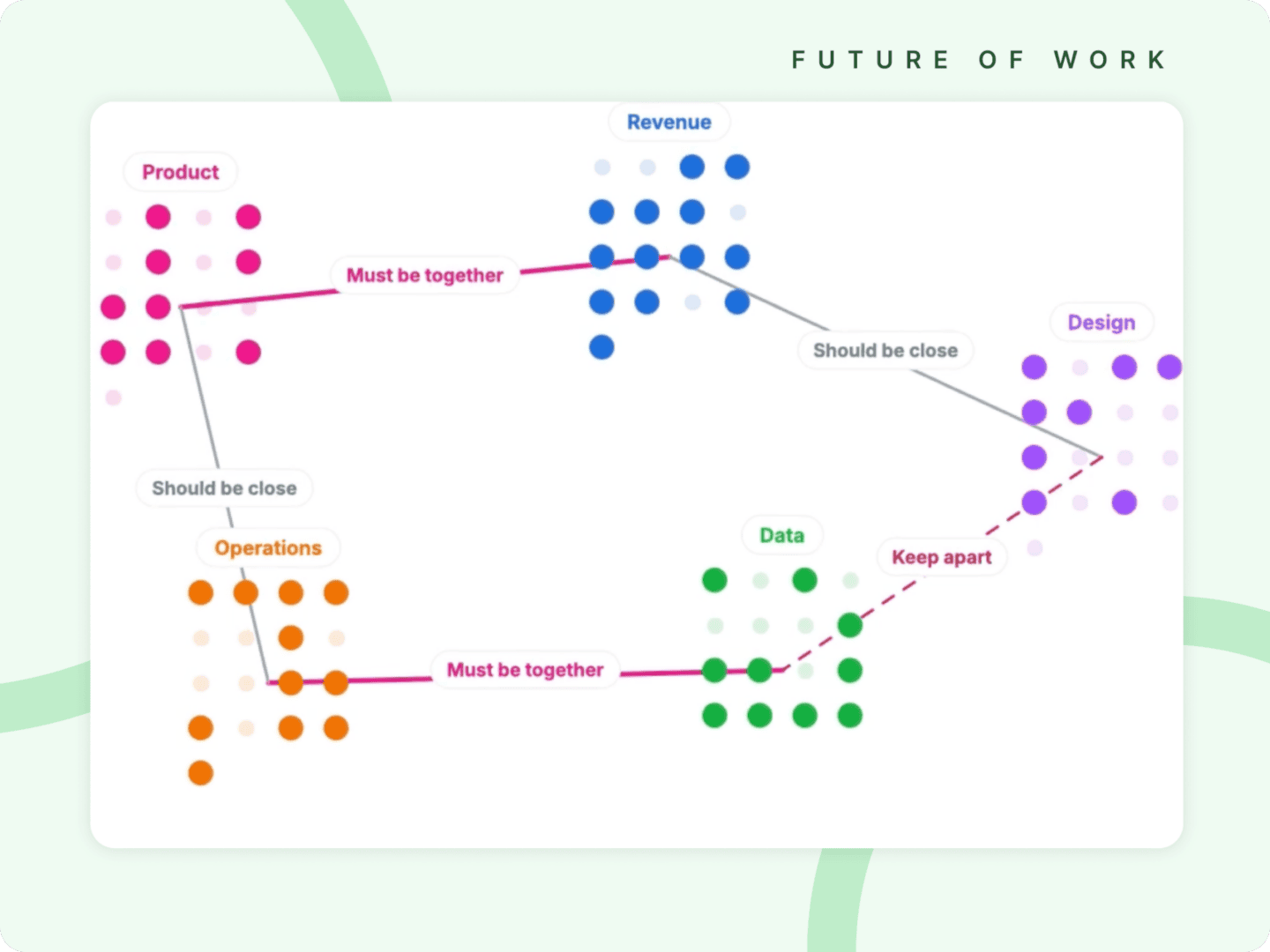
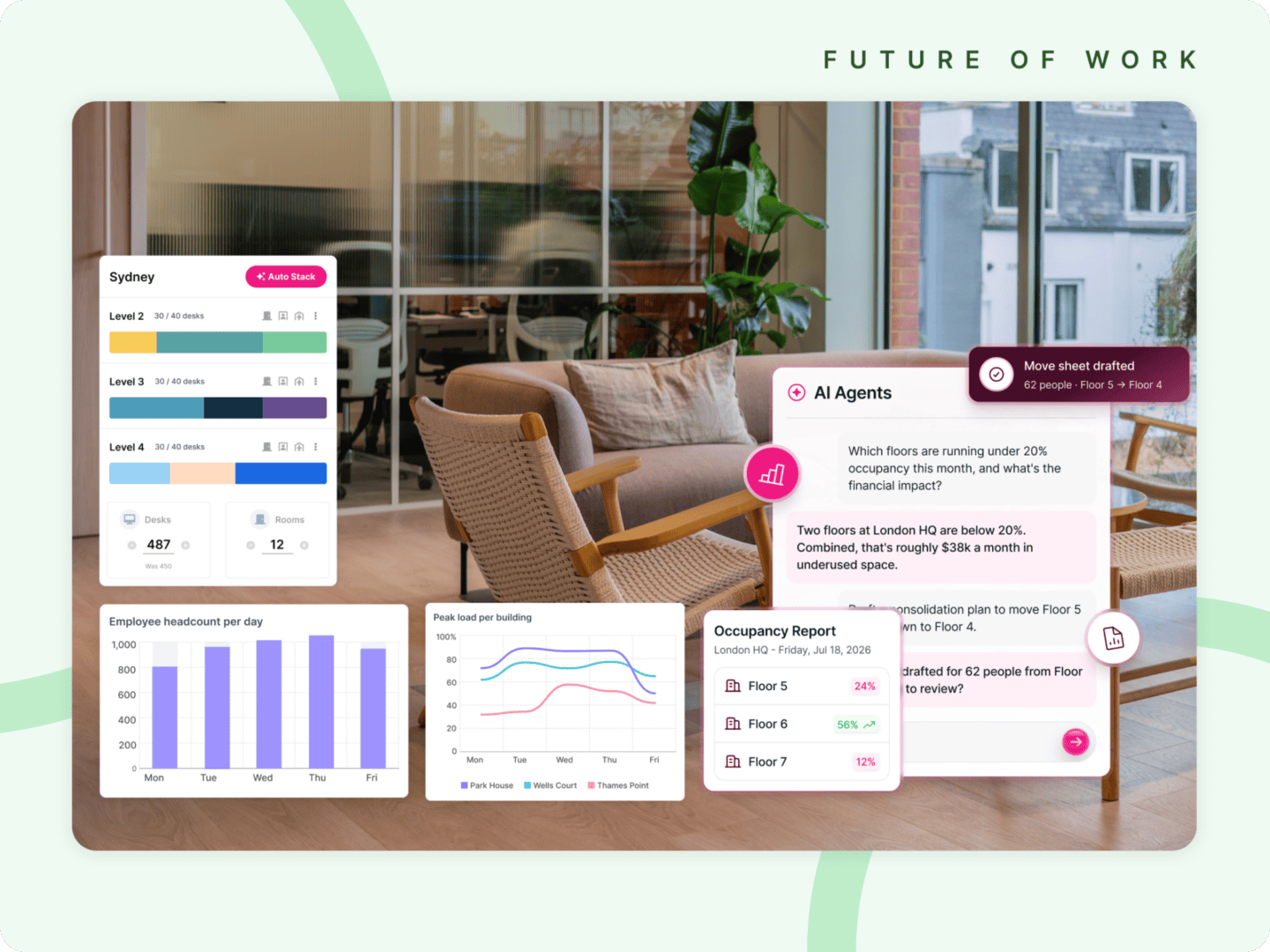
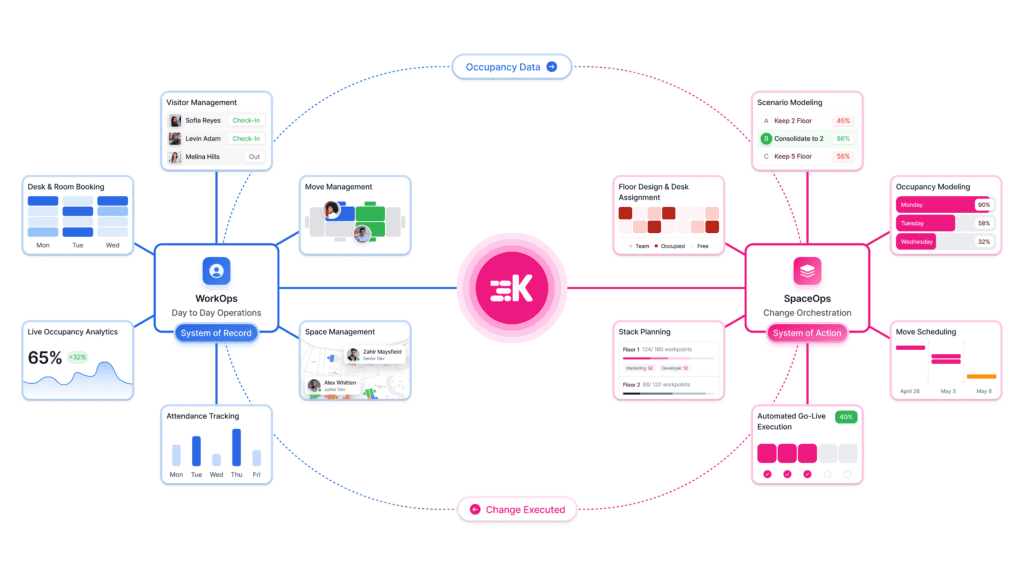
SpaceOps is the half of our workplace operating system that answers how the portfolio should evolve. It handles scenario modeling, stack planning, restack and consolidation. You give it your teams, your floors, your desks, and the rules you actually care about, and it produces portfolio scenarios you can compare and defend before you commit to a lease.
It runs on constraint-based optimization. Every scenario has to satisfy your rules before you ever see it, which is what lets you take the output into a boardroom and stand behind it. It generates a stack plan in minutes. You adjust, you re-optimize, and the plan that gets approved becomes the plan that goes live.
The intelligence underneath it is a live demand signal rather than a survey or a one-off study. WorkOps captures that signal as a byproduct of employees coordinating their week, so the scenarios are built on how the buildings are actually being used rather than on a planning assumption from two years ago.
The value of AI here is speed, clarity, and a decision you can explain.
Twenty-Three Percent Is the Start of a Question
CBRE’s 23% is useful if you refuse to let it become a slogan. It marks the point where AI entered the space-planning conversation. Producing the next plan is a different capability, and far fewer occupiers have it.
The leaders I talk to can see the rest of the company wandering. They have the tools, and using those tools does not close the gap. The job is still the one they were hired for: produce a plan the business can run, before the business has already moved.
If you are building that plan now and want to pressure-test it against your own portfolio, book a demo with our workplace operations team.