
The University of Exeter is not short on ambition. It is short on the one thing every growing institution runs out of first: space that works as hard as its people do.
Helen Wallace, Assistant Director of Estates, looks after that problem across the whole institution. “My role is to look across our portfolio of learning spaces, workspaces and our digital estate to ensure that we’re using our space effectively,” she explains. Before Kadence, the tools available to her team did not match the scale of the task. “We were often using an Excel spreadsheet to manage our space booking, and it became very difficult to manage. There were arguments and challenges,” she says, describing a process that was “administratively burdensome.”
The picture was the same at department level. Kirsty Mushing, Department Manager for Clinical and Biomedical Sciences, runs a department of over 400 staff spread across multiple sites and counties. “It was a bit of a free for all,” she recalls. Space was managed through “spreadsheets, emails really back and forth,” and attendance was anyone’s guess. “Most of our staff and colleagues would say, oh, I’m in every day, and we just know that that isn’t practical.”
For a university under pressure to grow, that gap between assumption and reality was expensive. As Helen puts it: “The university sector is a really challenging place to be at the moment, and we need to grow and change the courses we offer. But we need to do that without expanding our footprint, increasing our carbon consumption, and by staying incredibly efficient.”
What changed was the quality of the evidence behind every space decision the university makes.
“The most important thing that’s come out of using Kadence is the data insight,” Kirsty says. “That has given us the opportunity to see in real time now what space is being used more often.”
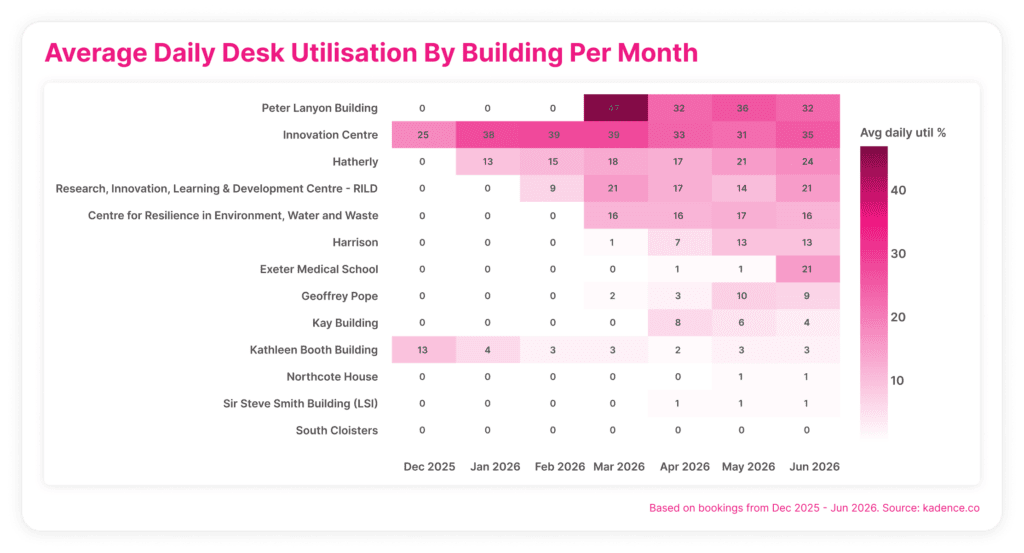
For Helen, that visibility feeds directly into portfolio strategy through Kadence Workplace Analytics. “Kadence has had an impact on the quality of data that is available to me, so I can start to look to see which of our most popular spaces where we’ve got pressure on our spaces and where we’re seeing an under utilization of space,” she says. The reports are not the end point. “We use them as a springboard to start discovering why the situation is the way it is.”
The data has also changed the nature of the conversation itself. “Kadence data allows us to have more honest conversations about whether the challenges people are facing are due to a lack of space, or whether it’s the distribution of space and the types of space available, or whether it’s just the way that we’re actually using space, and whether we could change our processes rather than create more space,” Helen says.
In Kirsty’s department, the results have been dramatic. “Collaborative team days have increased from 418 up to 1,900 per month,” she says. That is a 4.5x increase in teams choosing to come together, without a single square meter added.
The number matters because of the decisions it unlocked. “What we’ve been able to do with that data is see where we’ve got hotspots within our offices and where we are creating clashes with teams,” Kirsty explains. “We’ve been able to then move teams into spaces that are not used as much and expand into other areas around the university.”
The same evidence now shapes how the week itself is planned. Usage patterns show which days each team favors, which lets the department look at anchor zones and, in Kirsty’s words, “balance out the use of the space between different teams,” staggering one team’s Monday and Tuesday against another’s Wednesday and Thursday.
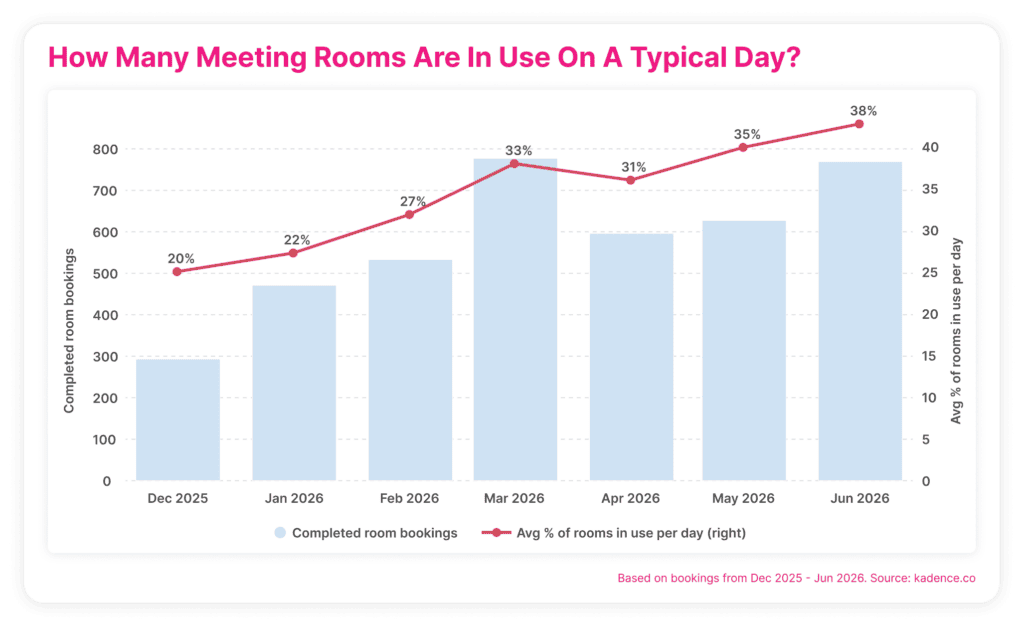
Meeting spaces tell the same story. “The average share of meeting room use nearly doubled from 20% to 38% per day,” Kirsty says. Part of that came from rethinking what a room is for: “The private offices that we have, when they are not in use, then they can now be used for meeting rooms. That’s been really great in adapting the way that we use our space to the needs of the teams.”
The clearest proof of the university’s approach sits at the top of the campus, at the Innovation Centre. When Exeter needed to stand up a new computer science and AI program for an incoming cohort of master’s students, the traditional answer would have been new build or new lease. Instead, the estates team used occupancy evidence to compress and restack existing professional services workspace.
“We were able to create a 120 person large, state of the art computer lab and academic offices, and an increased cafe facility by using our professional services workspace much more efficiently,” Helen says. Teams that once held space five days a week now share it in a coordinated rhythm, with one team on site on Monday and another on Tuesday. That is space optimization in its purest form: new academic capacity, funded not by capital expansion but by intelligence about the space the university already had.
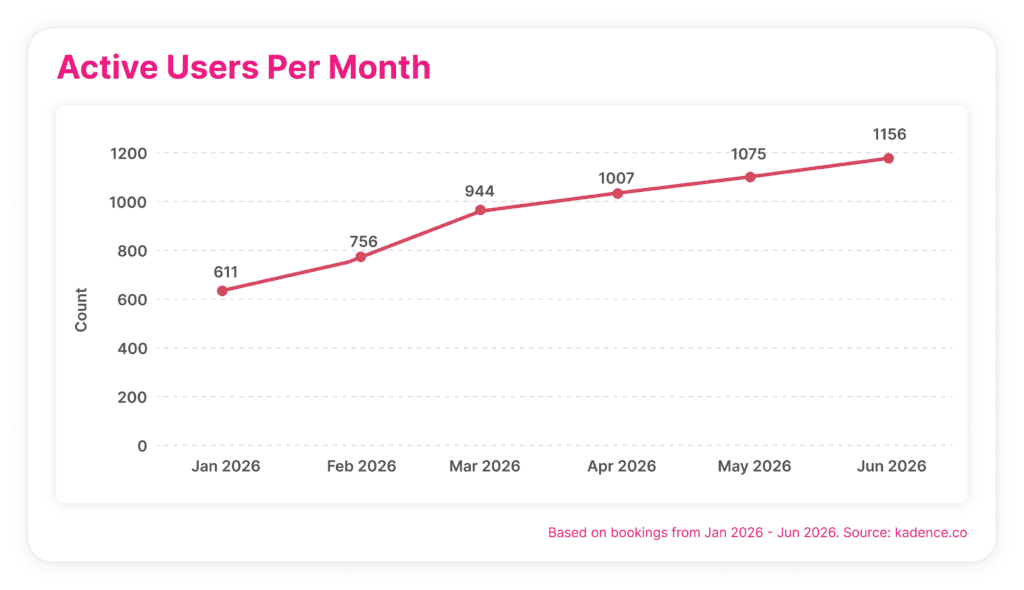
None of this works without people actually using the system, because the quality of the data depends on it. On that front, the numbers speak for themselves. “Our adoption of Kadence has tripled over the last year, and we’ve now got 14 buildings live on the system,” Helen says.
She credits the Microsoft Teams integration as a major driver. “The fact that this tool integrates entirely and sits entirely within that platform is being one of the reasons why the adoption has been so high,” she explains. “You barely even notice that you’re not just sitting inside Teams.” Rollout effort was minimal: “For the end users, the training has almost been nothing. It’s a product that you can pretty much click and go with.”
Inside departments, adoption was cultural as much as technical. “I set up some training sessions, real casual, just getting people together in a room, talking through the advantages of using Kadence,” Kirsty says. “We’ve got senior academics, we’ve got our dean of the medical school also using it to lead by example.” Staff were consulted on the booking principles before rollout, and the partnership worked in both directions. “We were able to give feedback, which I thought was really good, and the feedback was heard,” says Clemence Bernard, Lecturer in Neuroscience.
For end users, the change is simply felt as ease. “It has transformed how we use and book our desks and the meeting rooms,” says James Chelliah, Postdoctoral Fellow. Dan North, Student Recruitment and Events Manager, whose team of 25 spans sites in Exeter and Cornwall, puts it in practical terms: “It’s not even a five second job to make sure everybody’s sort of locked in and ready to go.”
Optimized space is not empty space. It is space that fills with the right people at the right time.
“A key way in which staff are using space differently is that they’re able to all come in together and look across when their diaries can coordinate,” Helen says. “It’s no good staff arriving at site, and Bob and Sarah are still at home.”
The effect shows up in the small moments that research careers are built on. “It helps to have that informal meetings that sometimes develop new ideas and help, or just simply to get a coffee with someone because you know they’re around and you know where to find them,” Clemence says. There is even a new office ritual. “If somebody is sat in the wrong place, they might have a bit of a joke and say, I think you might be in my space today, let’s check Kadence,” Dan laughs.
The university’s ambitions for the platform reach well beyond booking. Helen sees the next frontier in sustainability: “Ultimately, we’d like to think we could start limiting access to certain spaces in the winter where they’re really not being used and start to reduce our heating costs. That would be a huge win.”
Deeper integration is on the roadmap too. “We could see it integrating more into some of our other systems. That would be incredibly powerful if we could start to think about how it might work with something like our timetabling system,” she says.
Asked what the university would do without it, her answer is immediate: “Without it, it would be a bit like gridlock. It’s a key tool to enable efficient use of space.”
Kirsty’s advice to any organization staring at its own spreadsheet chaos is just as direct: “I would absolutely recommend it. If you are struggling with using your space or making your space efficient, it gives the managers that oversight as well to see where their teams are working.”
Your estate is already generating the evidence. The question is whether you can see it. Book a demo with our workplace operations experts and find out what your space data is ready to tell you.