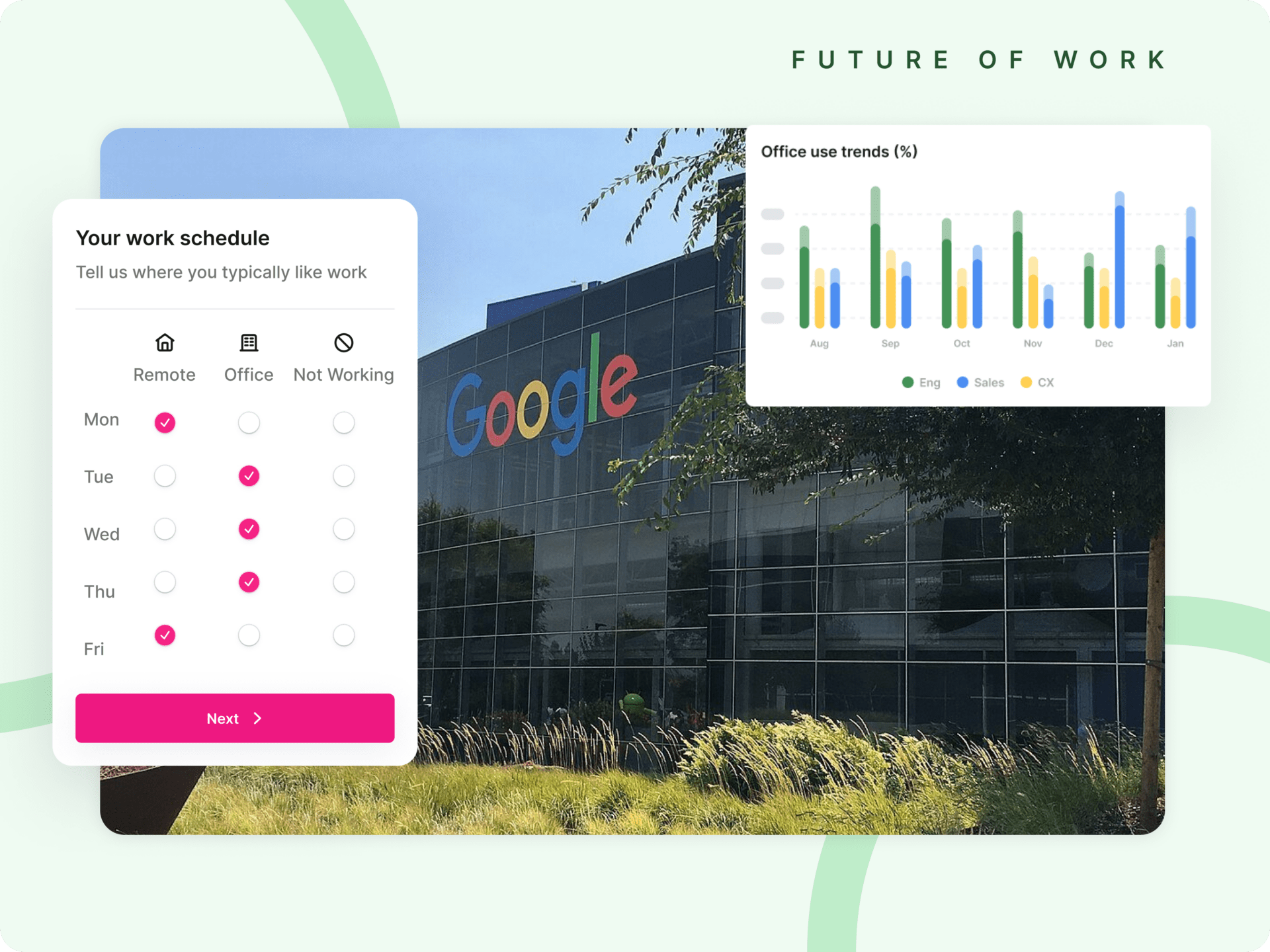
Google’s hybrid work model broke down in 2025 because it was run team by team, without company-wide principles or coordination. In April 2025, CNBC reported that several Google units were warning remote employees that their jobs could be eliminated unless they worked from an office at least three days a week.
The move was more than cost-cutting. It is a case study in what happens when hybrid work lacks leadership, coordination and clarity, and in why coordination, not control, is what makes hybrid work succeed.
What happened to Google’s hybrid work model?
In April 2025, multiple units within Google began warning remote employees, including some previously approved for remote roles, that their jobs could be cut unless they came into an office at least three days a week. Some who were unwilling or unable to comply were offered voluntary exit packages.
The details came from a CNBC report, and earlier in 2025 Google had already offered voluntary exit packages to some teams. Google explained the policy this way:
As we’ve said before, in-person collaboration is an important part of how we innovate and solve complex problems. To support this, some teams have asked remote employees that live near an office to return to in-person work three days a week.
— Courtenay Mencini, Google spokesperson
The shift came as tech companies faced rising infrastructure costs and an AI arms race that demanded aggressive reallocation of resources. Google’s headcount had already fallen from roughly 190,000 two years earlier to around 183,000 at the end of 2024, and the cuts suggested hybrid workers might keep bearing the brunt of leadership misalignment.

Why did Google’s hybrid strategy break down?
Google’s hybrid strategy broke down because policies were built on visibility rather than outcomes, and because each team set its own rules. Some employees had been approved to work remotely during the pandemic or because of their role. Without any change in their performance, they were told that being near an office now mattered more than their impact.
Proximity bias, or visibility bias, is the tendency to value people who are seen in the office over people whose results are the same but who work remotely.
CNBC reporting indicated that remote workers at Google felt increasingly vulnerable as teams tightened return-to-office expectations, and employees were warned their roles could be eliminated if they did not adopt a hybrid schedule. That reveals a deep-rooted problem in how performance is perceived and rewarded. It also shows teams were not working to a shared framework. Some units mandated relocations; others merely encouraged office presence. The lack of alignment was a cultural problem as much as a logistical one.
What does Google’s approach tell us about hybrid work?
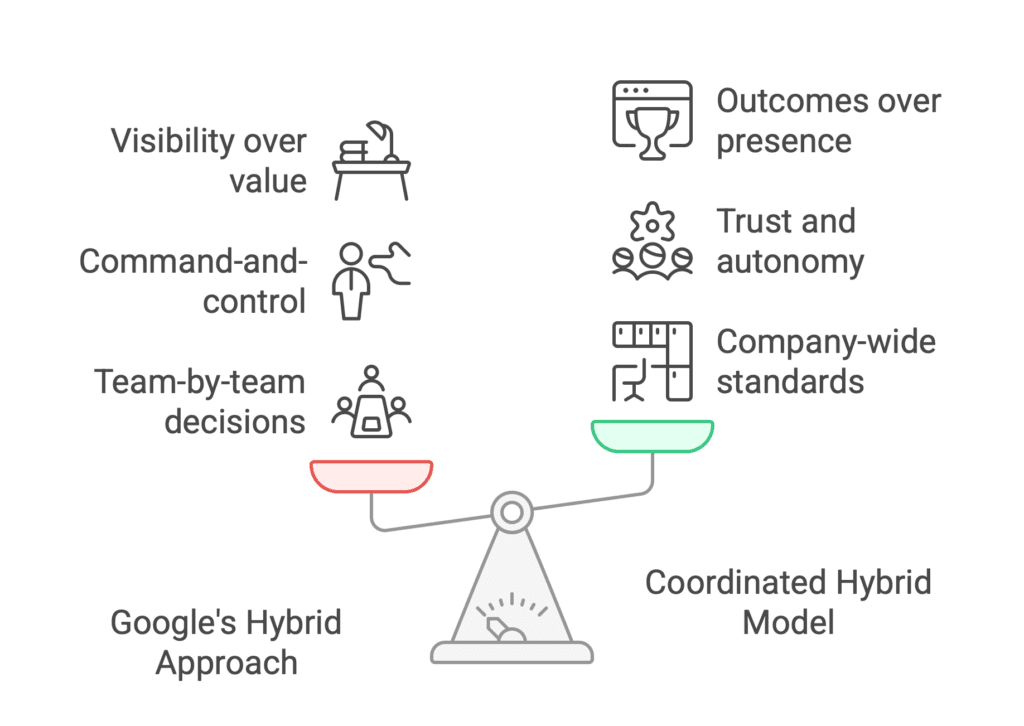
Google’s approach shows that leaving hybrid work to each team creates confusion and inequality, not flexibility. Rather than a company-wide stance grounded in purpose, rules varied by team, by distance from an office and by whether someone wanted to change roles. Employees could not predict how they would be treated.
Some argue that decentralization allows for flexibility. At Google, the outcome was uneven rules:
- People Operations mandated a return to hybrid for employees living within 50 miles of an office. Those farther away could keep remote setups, but only if they stayed in their current roles. Anyone changing teams had to adopt the hybrid model.
- Platforms and Devices, the division that includes Android and Nest, saw dozens of teams hit with cuts. Google said remote work was not the primary driver.
- AI teams heard from co-founder Sergey Brin, who in February 2025 reportedly told AI workers they should be in the office every weekday, with 60 hours a week being “the sweet spot of productivity.”
This mindset is a throwback to a traditional office culture driven by presenteeism, hierarchy and control, rather than trust, autonomy and outcomes.
What are the main hybrid work models?
Kadence sees four distinct approaches to hybrid work: Traditional, Controlled Hybrid, Flexible Hybrid and Coordinated Hybrid. They run from employer-centric, role-oriented models built on mandated office days to employee-centric, task-oriented models built on trust. In 2025, Google’s stance sat between Traditional and Controlled Hybrid.
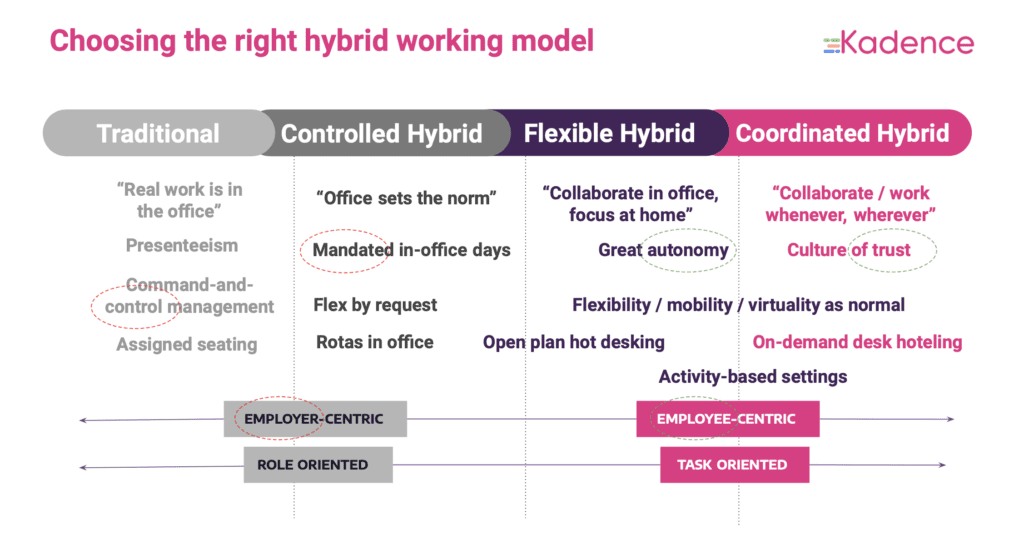
Traditional and Controlled Hybrid favor command-and-control management, mandated in-office days and top-down decisions. They put company oversight ahead of employee productivity. For a plain explanation of each type, see what a hybrid work model is.
What is coordinated hybrid work?
Coordinated hybrid is a hybrid work model that lets people work wherever they do their best work while aligning teams so collaboration happens with intention. In practice it combines shared in-office days for teams that benefit from live interaction, on-demand desk booking, virtual parity for all meetings, and activity-based space design.
Crucially, coordinated hybrid builds a culture of trust. It avoids the binary thinking that says real work happens only when people are visible. It recognizes that outcomes matter more than presence, and it gives individuals autonomy while keeping teams cohesive through coordination. On-demand desk booking and shared team days are what make that practical at scale.
This is the model companies like Google need, both to retain top talent and to get the most from it.
What does the data say about hybrid work?
The evidence favors well-structured hybrid work. A 2024 study published in Nature found that hybrid work reduces attrition by 33%. Research by Nicholas Bloom at Stanford has repeatedly shown that well-structured hybrid models boost productivity without hurting promotion rates. Gallup has found hybrid workers are more engaged and less likely to burn out.
- Retention: the 2024 study in Nature showed that hybrid work reduces attrition by 33%, a major win for companies trying to keep skilled workers in a tight labor market.
- Productivity: Nicholas Bloom’s research at Stanford has repeatedly shown that hybrid models, when structured well, boost productivity and do not hamper promotion rates.
- Engagement and wellbeing: Gallup found that hybrid workers are more engaged, less likely to burn out and more likely to feel in control of their work-life balance. Its research shows hybrid employees report the highest engagement compared with fully remote or fully on-site staff, and its State of the Global Workplace report emphasized that hybrid work contributes to employee wellbeing through greater autonomy.
These are not minor perks. They are the foundation for sustainable performance.
What should Google and other companies do instead?
Companies should treat hybrid work as a strategic asset rather than a logistical constraint. That starts with company-wide hybrid principles instead of leaving each team to make it up as it goes, and a shift from control to coordination: giving teams the tools and structures they need to thrive, wherever they are based.
In practice, this could include:
- defining collaboration days for each function, driven by task needs, not management preference;
- designing physical workspaces around connection and innovation, not occupancy metrics alone;
- ensuring remote employees have equal access to mentorship, feedback and growth opportunities;
- measuring impact, not attendance.
If Google wants to lead in AI, it must also lead in workplace design and hybrid work models. Attracting world-class talent depends not only on what you build, but on how you let people build it. The hybrid work strategy guide sets out how to build these principles step by step.
What is the real lesson from Google?
The real lesson is that hybrid work is not a compromise but an opportunity, and it needs intention, alignment and trust. Google’s 2025 decisions were a wake-up call for the industry. The companies that do best will stop asking, “Where should people work?” and start asking, “How can we enable them to do their best work — together?”
That is the promise of coordinated hybrid. With features like Kadence Insights Plus, part of its workplace analytics, leaders get customized dashboards that show how their teams work best and where there is room to improve. To see how Kadence supports a coordinated approach, book a demo with our hybrid work experts.
Frequently asked questions
What is Google’s hybrid work policy?
As reported in April 2025, some Google teams asked remote employees who live near an office to return to in-person work three days a week. Rules varied by team. People Operations, for example, required hybrid work for employees within 50 miles of an office.
Did Google cut remote workers?
In 2025, CNBC reported that several Google units warned remote employees their jobs could be eliminated unless they worked from an office at least three days a week, and some were offered voluntary exit packages.
What is the difference between controlled hybrid and coordinated hybrid?
Controlled hybrid is employer-centric: the office sets the norm, with mandated in-office days and flexibility by request. Coordinated hybrid is employee-centric: people work where they work best, and teams align their office days around tasks that benefit from being together.
Does hybrid work reduce employee turnover?
Yes, according to a 2024 study published in Nature, which found that hybrid work reduces attrition by 33%. Gallup has also found that hybrid employees report the highest engagement compared with fully remote or fully on-site employees.