
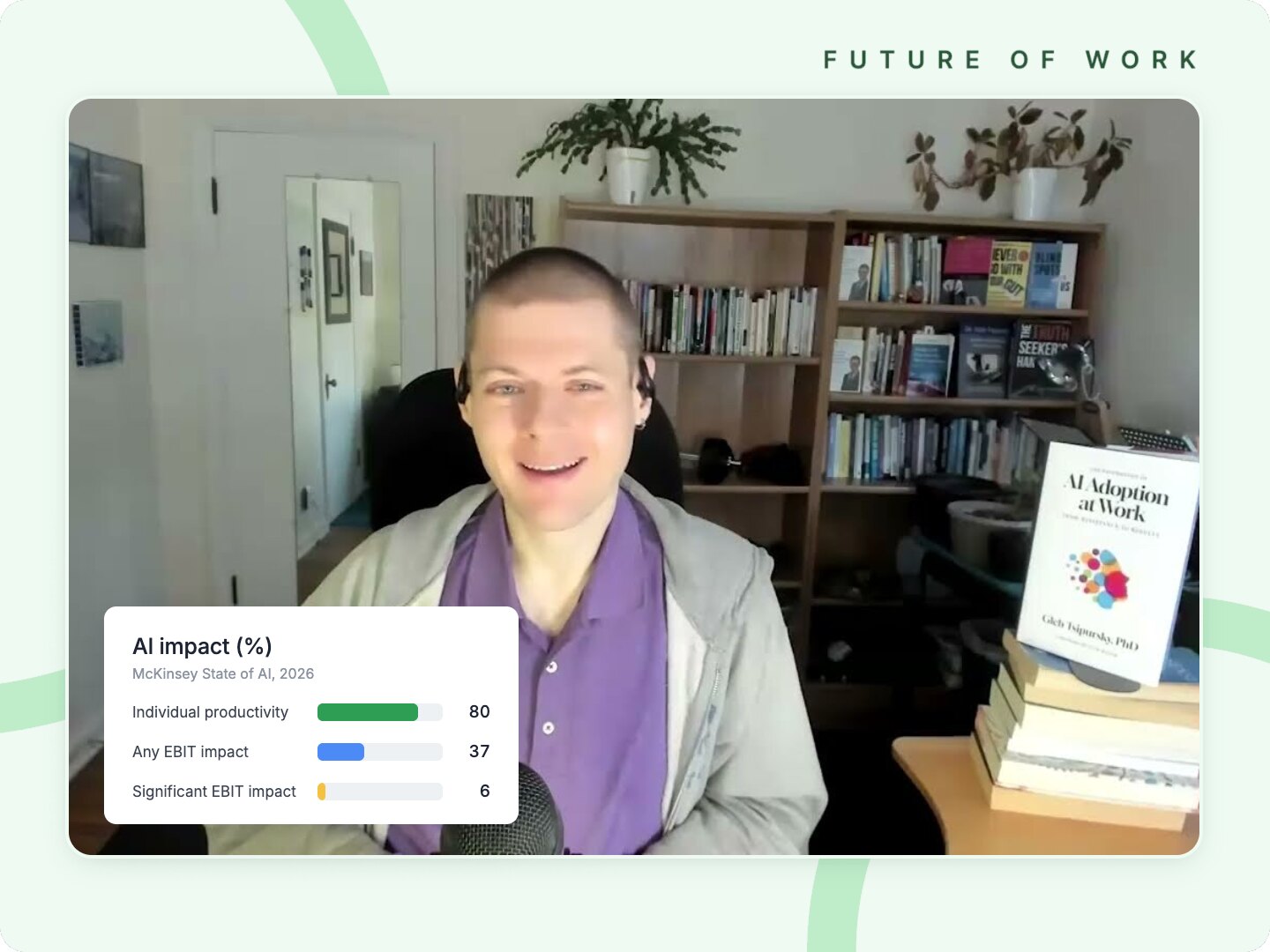
AI adoption is failing because companies are rolling it out the way they roll out any other enterprise software: buy it, train people, then require it. In McKinsey's 2026 State of AI survey, 80% of respondents said AI had improved their individual productivity, but only 37% reported any impact on EBIT and just 6% a significant one. That is the playbook that produced office mandates, and it breaks for the same reason. You can mandate attendance and compliance, but you cannot mandate curiosity. The same thinking sits underneath SpaceOps: office decisions hold when they come from what people actually do in the space, and AI rollouts hold when they come from what people actually do with the tool, rather than from a mandate in either case.
That was the argument Dr. Gleb Tsipursky made on a webinar I hosted with him earlier this week. Gleb is a behavioral scientist, CEO of Disaster Avoidance Experts and author of The Psychology of AI Adoption at Work: From Resistance to Results, published this year by Georgetown University Press. Most of the people who joined us lead facilities or workplace teams, and they have spent the last few years being asked first to make remote work, then to make the office work, usually with a mandate attached. This is what he told them, and what I took from it.
Why does the enterprise software playbook break with AI?
Gleb's explanation starts with what the playbook is for. When you roll out a CRM or a facilities management system, a top-down mandate with standard operating procedures is the right approach. Everyone enters data the same way, you measure compliance, and the value follows from consistency. Resistance exists, but it is the resistance of learning a new system and changing habits.
AI is a different kind of technology. It can do almost anything you can do with a computer, so no set of SOPs covers it, and the value depends on each person working out which parts of their own job to hand over. What most companies do instead is hand everyone a license, run some generic prompting training and leave people to figure it out. A few get individually faster. The organization does not change, which is what the McKinsey gap looks like from the inside.
"AI is very different as a technology. It's the first technology that challenges our identity as human beings. It's the first that actually can replace our intelligence."
Dr. Gleb Tsipursky, behavioral scientist and author of The Psychology of AI Adoption at Work
The alternative he describes is to treat the tool as an executive assistant that each person trains, building up the prompts and agents that take over the tedious parts of their own workflow. That only happens if people want to do it, and that is the part a mandate cannot reach.
What is actually stopping people from using AI?
Gleb's research, which draws on more than 100 consulting projects and interviews with leaders at companies including Microsoft, Uber and Experian, finds three emotional blockers behind most AI resistance.
The first group he calls AI alarmists. Their fear is job loss, and it is not an empty one. Stanford's Canaries in the Coal Mine research, updated in August 2026, finds employment for workers aged 22 to 25 in the most AI-exposed occupations is now 19% below where it would be had it kept pace with their less exposed peers, and the gap widened over the past year.
The second group, pragmatic resisters, tend to be more experienced and less worried about their jobs. What they feel is an identity threat. A spreadsheet moving into a room booking tool does not challenge anyone's expertise. A tool that schedules the rooms automatically, writes the proposal or predicts what a building will need does.
The third group, reluctant adopters, are already using AI and hiding it. Gleb told the story of a CEO whose VP of sales privately admitted that the annual client presentation everyone loved had taken 90 minutes with an AI tool instead of three days, then asked the CEO not to tell the other executives because they would think he was lazy and cheating. That attitude goes all the way to the top.
Laziness was the word that stuck with me. We assumed remote workers were lazy because we could not see them working. Now someone using an AI tool worries about looking lazy for getting a result too quickly.
None of this comes out in public. Resistance shows up as "I don't trust the output" or as concerns about data privacy and data centers. Almost nobody says "I'm worried about my job" out loud, which is why Gleb's data comes from anonymous surveys and focus groups. A Pew Research Center survey from June 2026 found 52% of US adults are more concerned than excited about the growing use of AI, with 9% more excited than concerned. I saw the same gap at the CoreNet Global Summit in Chicago recently: in a room of around 400 real estate and facilities leaders, a panel asked who in the crowd was a doomsayer, and nobody put a hand up.
What does an AI mandate actually produce?
Gleb has been a public critic of rigid mandates since the start of the return-to-office debate, and his AI research says forcing people onto tools produces workslop: output that looks finished and creates rework for whoever receives it. I asked him whether coffee badging is the office version of the same thing.
The example he gave was a defense contractor whose engineers used an AI tool to turn a program into a user manual. The manual used to run to three to five pages. The AI version ran to 50, and the people who have to read it are 19 year old recruits. Research from Stanford's Social Media Lab and BetterUp Labs, published in Harvard Business Review in 2025, found 40% of US desk workers had received workslop in the past month and spent nearly two hours dealing with each instance. The 2026 follow-up found that sending workslop was more common among people whose organizations encouraged AI use.
Shopify is the clearest named example. In 2025 its CEO Tobias Lütke told employees that using AI was a baseline expectation and that teams should prove AI could not do the work before asking for more resources. By September 2026 he was describing on The Knowledge Project podcast employees tossing "slop grenades" at each other: AI-generated emails and code that nobody examined before sending, which colleagues then had to review and fix. Shopify's ambition is reasonable, and the slop is what that ambition produces once a mandate meets the three groups above.
The mechanism is familiar to anyone who has enforced an office policy. Someone who resents the requirement pushes the button without a proper prompt, does not review the output and sends it on. When it comes back, the answer is "you told me to use AI." Gleb calls that malicious compliance, and it is what you get when the emotional blockers are left alone.
What do office mandates and AI mandates have in common?
My read is that the problem is a measurement habit rather than a technology gap. We spent five years measuring whether people showed up in the office rather than whether anything got better once they were there, and we are now doing the same with AI tools. Showing up in the office has become showing up in the license report.
When I polled the room on how their organizations measure whether AI is working, the answers split roughly evenly between license usage, business outcomes and not measuring at all. Gleb's view is that you get what you measure, and usage metrics get you usage.
"Just because people are using it doesn't mean that they're using it well."
Dr. Gleb Tsipursky, behavioral scientist and author of The Psychology of AI Adoption at Work
Time saved is the most common metric he sees, and it carries a message. If the only thing leadership tracks is how much less time work takes, employees read that as headcount coming out, which feeds the alarmists and sends the reluctant adopters further underground. The Wharton and GBK Collective 2026 AI Adoption Report, published in October, found that 35% of departments tracking at least one growth measure report strongly positive returns from AI, against 13% of those measuring efficiency alone, and hours saved is still the metric most departments use. Companies that frame AI around growth, meaning more output and better work from the same people, get better results and give those people a reason to engage. PwC's 2026 AI Jobs Barometer puts the average wage premium for workers with AI skills at 62%, which is the career case Gleb suggests leaders make to the people who are afraid.
Mindset and curiosity were the two words I kept coming back to on the call. They were the unsolved problem with where people work after Covid, and six or seven years on we have not solved the curiosity part at any scale. AI has landed on top of that, and where we work is a far less profound question than how we work with a technology that can do a large part of the job.
What can workplace leaders do this quarter?
Gleb's answer to "what do I do on Monday" was to find out which of the three groups you are dealing with before you build anything else. The rest follows from that.
- Run an anonymous survey on how people feel about AI. Internally led focus groups get the public answers about trust and data privacy. Anonymous surveys get the real ones, and they tell you whether you are managing fear, identity or shame.
- Add a growth measure next to hours saved. Track output, quality, cycle time or revenue alongside time saved, and say why, because the metric you publish tells employees what you intend to do with the gains.
- Make the growth commitment explicit. If leadership's orientation is to grow into the capacity AI creates rather than cut it, say so as policy, and pair it with the career case: the people who learn the tools well are the ones whose jobs and market value are most secure.
- Make AI use visible and high status. The reluctant adopters are already producing the best examples in the building and hiding them. Peer champions, show-and-tell sessions and leaders talking about their own workflows turn hidden use into shared practice.
- Treat output quality as a management skill. Gleb calls it meta competence: the ability to judge whether an AI output is good without having done the work yourself. That is the skill that catches workslop before it reaches a colleague, and it is trainable.
I used to play poker professionally, and we would sit beside each other playing online, partly for company and partly to learn by watching. So I asked Gleb whether the office is the natural place for step four, and whether that is a reason to come in. His answer cut both ways. AI makes remote work easier, because you can ask the tool for what you used to ask a colleague. At the same time, the jobs that rely most on human-to-human collaboration are the most secure, because AI is not good at that yet, so people who build relationships in the office may have more protection than people who do not.
Where is the argument weaker?
Three things cut against it, and I would rather say them here than have a reader say them for me.
The measurement finding is a correlation. Departments that already track growth outcomes are likely to be further along in general, so measuring growth is a marker of maturity as much as a cause of it. The Wharton authors also flag that some of their sub-groups are small.
A mandate does get people started. With 52% of US adults more concerned than excited about AI, some push is needed, and both Shopify and Duolingo grew AI use quickly by requiring it. Gleb's point is about what you measure once the push has happened. Leaders still set expectations.
The long-term picture for workplace teams is not reassuring, and Gleb did not pretend otherwise. When an attendee asked how AI will affect facilities management, his view was that the function will not follow the pattern where cheaper work creates more demand for it, because companies are not adding buildings. In the medium term, the facilities managers who learn the tools will be better off and their employers will take share from those who do not. In the longer term he expects fewer facilities managers to be needed, because each one will be able to do more. I appreciated the sobriety of that answer, and it is a reason to start now.
What should you take to your leadership team?
I closed by asking Gleb what someone should say to an executive team if they believe a mandate is wrong, whether it is an office mandate or an AI mandate.
"The key thing that the leadership team needs to understand is that this is not a typical technology adoption. You can mandate being in the office. You can mandate using CRM. You can't mandate curiosity, innovation and discovery."
Dr. Gleb Tsipursky, behavioral scientist and author of The Psychology of AI Adoption at Work
The companies with the biggest gap between individual productivity and business impact are, in his view, the ones mandating it. The ones closing the gap have found a win for the employee as well as the company, and that starts with an orientation toward growth and the evidence to back it.
The same case applies to the office, and it is the one SpaceOps is built for. An attendance number tells you who came in. Utilization data tells you what they did with the space, which floors and neighborhoods work, and where the portfolio is carrying rooms and desks nobody uses. That is the evidence a workplace leader needs to replace a mandate with a decision: stack planning and scenario planning start from what people actually do, and workplace analytics is where that record begins.
If you are being asked to enforce a policy you privately doubt and do not yet have the data to argue with it, the place to start is an occupancy check on the buildings in question. It will tell you, in the terms your leadership team uses, whether the mandate is measuring the right thing.
If you would rather see what that looks like on your own portfolio, book a demo with our workplace operations experts and we will walk through it with you.
FAQ
Why do AI mandates fail?
Mandates work for software that needs consistent use, such as a CRM, because compliance is the value. AI only pays off when each person works out which parts of their own job to hand over, and that depends on curiosity, which cannot be required.
What are the three emotional blockers to AI adoption?
Dr. Gleb Tsipursky's research identifies AI alarmists, who fear job loss; pragmatic resisters, who feel the tool threatens their professional identity; and reluctant adopters, who use AI but hide it to avoid being seen as lazy. Each needs a different response, so the first step is finding out which one dominates your team.
What is workslop?
Workslop is AI-generated work that looks polished but lacks the substance to be useful, so the person who receives it has to redo it. Stanford and BetterUp Labs research found 40% of US desk workers received workslop in a month, at nearly two hours of rework per instance.
How should companies measure AI adoption?
License usage shows who has logged in, and time saved signals that headcount may be next, so neither tells you whether work improved. Wharton and GBK Collective found that departments tracking at least one growth measure were almost three times as likely to report strongly positive AI returns as those tracking efficiency alone.
What does AI adoption have to do with return-to-office mandates?
Both measure presence, whether a badge-in or a login, rather than outcomes, and both produce compliance without improvement. The fix in each case is the same: measure what changes, through utilization data for the office and growth measures for AI.