Deutsche Bank’s hybrid working model shifted toward office time at both ends of the week. In June 2025, Panmure Liberum joined Deutsche Bank in asking employees not to work from home on both Mondays and Fridays. UBS asked for either or both of those days to be part of the office routine.
The City of London pattern was shaped less by sweeping mandates than by shifts in the weekly rhythm: a recalibration of hybrid work, not a retreat.
What changed in Deutsche Bank’s hybrid working model?
Deutsche Bank asked employees not to work from home on both Mondays and Fridays, and in June 2025 Panmure Liberum joined it. UBS asked for either or both days to be office days. The aim was to fill the quiet ends of the week, since post-pandemic attendance had settled on Tuesday through Thursday. Hybrid working stayed in place.
Others went further. Peel Hunt and Man Group set four-day and five-day requirements, respectively.
“We’re trying to avoid completely empty office days,” one banker said.
Why are banks targeting Mondays and Fridays?
Banks want to smooth the weekly curve of office attendance. Tuesdays, Wednesdays and Thursdays had become the peak days for collaboration, while Mondays and Fridays stayed largely quiet. That uneven rhythm affects everything from resource planning to morale, even when the goal is not a full office.
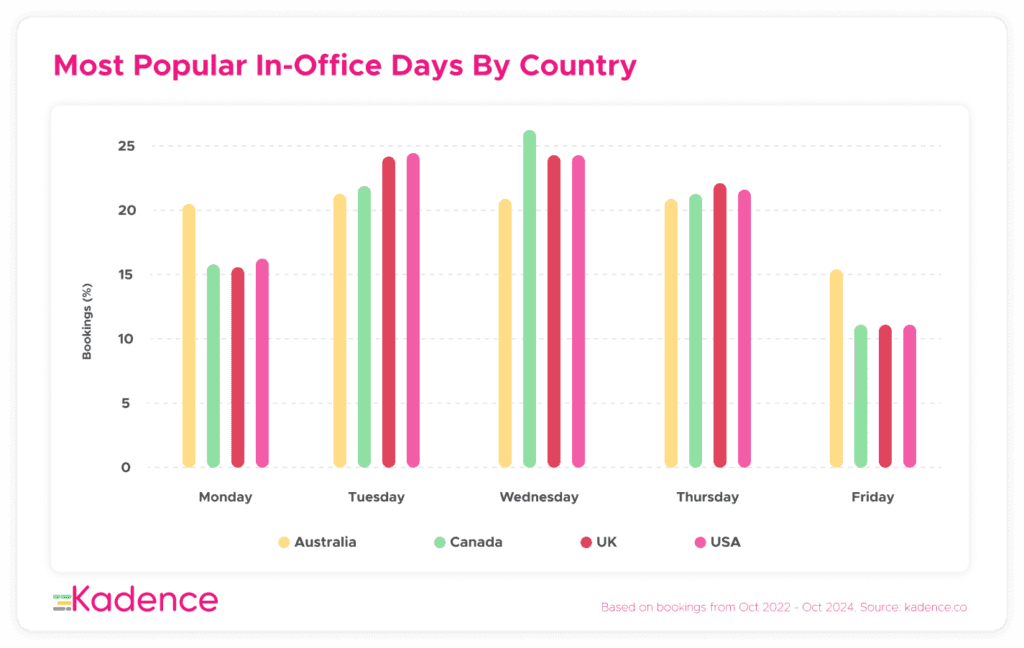
Kadence’s own booking data, published in its Hybrid Pulse Check, shows the same mid-week peak across regions. For a real estate team, quiet Mondays and Fridays mean space that sits largely empty for part of every week. Occupancy data by weekday shows how large that gap is in a given office.
Is this a return to five days in the office?
No. For most firms it was a return to routine, not to the past. UK employees still work from home an average of 1.8 days a week, well above the global average, and 90% of companies in London still offer hybrid working.
Cevat Giray Aksoy, lead economist at the EBRD, described remote work as having moved from an emergency response to a defining feature of the UK labor market. Rather than ending hybrid work, companies like Deutsche Bank appeared to be shaping it more deliberately.
What is the real tension in hybrid work?
The real tension is between predictability and autonomy, not the number of days. Employers want smoother attendance patterns, and employees want flexibility. Both are valid, and both point to better coordination tools rather than stricter policies. Office rhythm means the weekly pattern of who comes in, and when.
Some firms found creative ways forward. Barclays moved 100 employees to a Shoreditch coworking space originally designed for fintechs. Others, such as HSBC and BlackRock, were grappling with space shortages caused by earlier downsizing.
Office design, team planning and culture-building are now closely linked. Tools that help teams coordinate their office days address the rhythm problem without a blanket rule.
What makes the office worth coming in for?
Beneath the headlines, the real question is not how many days. Banks such as Deutsche Bank and UBS could be asking what makes it worth coming in. Attendance is not the goal. Engagement is. That shifts the focus from counting days to designing intentional moments of connection, rhythm and presence.
Firms such as Deloitte and KPMG are using flexible policies to attract and retain talent. Others are quietly tightening rules. But even among the most traditional institutions, the conversation has shifted.
As Aksoy put it: “The question isn’t whether they can force people back. It’s whether they can afford the talent exodus that inevitably follows.”
That may be the most important recalibration of all. Kadence’s guide to return to office covers how to plan office days around that question.
Frequently asked questions
What is Deutsche Bank’s hybrid working policy?
Deutsche Bank asked employees not to work from home on both Mondays and Fridays, while keeping a hybrid model. In June 2025, Panmure Liberum joined it in making the same request.
What did UBS ask of its employees in 2025?
As reported in June 2025, UBS asked for Monday, Friday or both to be part of employees’ office routine.
How many days do UK employees work from home?
UK employees work from home an average of 1.8 days a week, well above the global average, according to research cited in June 2025.